


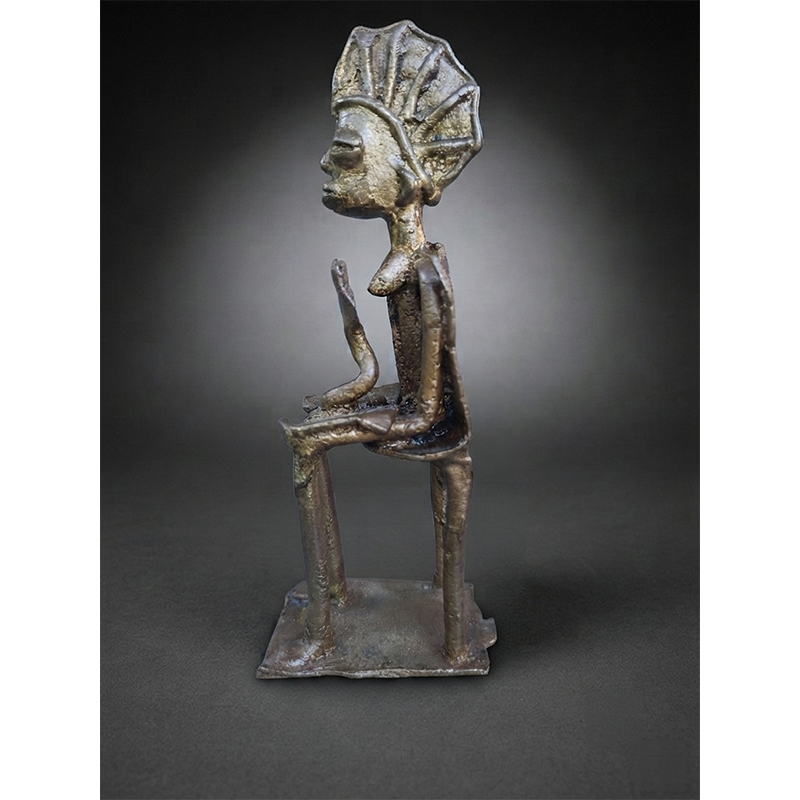


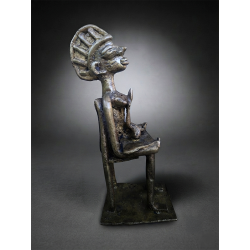
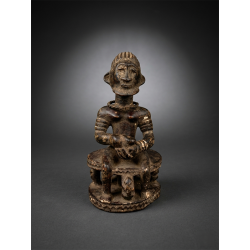
« A quiet court presence — a female figure seated on her stool, the royal python coiled across her lap. »
This exceptional lost-wax cast bronze statuette represents a rare, highly collectable ritual effigy from the Gan people of Burkina Faso. The figure depicts a royal ancestor or a semi-divine monarch seated upon a ceremonial throne, holding a coiled serpent—the ultimate symbol of protection, dynastic continuity, and spiritual power within the Gan cosmological framework. The fan-shaped, incised crown or headdress signifies elite leadership and spiritual authority.
In Gan culture, metalsmiths were sacred artisans who cast these figures under strict spiritual protocols. These objects were not merely decorative; they functioned as active vectors for protective cults (Asie) and were placed on royal altars or sanctuaries to appease ancestral spirits and shield the kingdom from misfortune. The serpent represents the mythical python spirit, a foundational guardian deity. This piece offers an intimate window into a centuries-old West African sacred lineage, making it a cornerstone acquisition for discerning connoisseurs of African metalwork.
The figure belongs to the corpus of small cast-brass court figures attributed to the Gan people (also written Kaan or Gain), a small population concentrated in the Loropéni and Gaoua region of south-western Burkina Faso, on the border with Côte d'Ivoire and Ghana. The Gan share this cultural landscape with the Lobi, Birifor, and Dagara peoples, and their brass casting is produced by hereditary blacksmith-caster families whose work has long served the small Gan chieftaincies.
Attribution rests on a convergence of diagnostic markers: the tall crested coiffure of the royal Gan canon, the seated-on-stool composition with visible open space beneath the seat, the presence of the serpent as an attribute of chiefly authority, and the granular lost-wax surface.
The serpent that rises from the figure's lap is the signal iconographic element. In the Gan and neighbouring Voltaic traditions, the python is a royal attribute, associated with the ancestral protection of the chiefly line, the continuity of the lineage, and the presence of tutelary spirits in and around the royal compound. It is neither a decorative motif nor a fantasy creature: it names the sitter as a person of authority whose being is guarded by, and whose power is expressed through, the python.
Read together, the crested headdress, the seated posture on the stool, and the presence of the python identify the figure most probably as a court or ancestral figure — a mother of the chief, a senior female of the royal compound, or a commemorative ancestor figure belonging to a family shrine assemblage. The specific identification cannot be fixed without provenance evidence tracing the object back to its origin compound; the typology is what is defensible.
Small cast-brass Gan figures of this scale belong, in the Gan cultural setting, to a domestic and lineage register rather than to a public masking or large-shrine one. They are kept within the family compound, on ancestral altars, or in the personal shrine of a senior person of the household. In use, they may receive occasional libations — beer, palm wine, oil — and their presence commemorates and channels the tutelary agency of the sitter they represent.
The figure is thus best described as belonging to a ritual and commemorative register: an object of veneration inside the family shrine, not a stage prop of public masquerade. In the absence of confirmed provenance to a specific compound, the ritual function is described here typologically — that is, as belonging to the class of objects that served in this way — rather than as evidenced for this specific piece.
The figure is complete and structurally sound. It stands upright on its own base without support. The four legs and the base plate are intact and there is no evidence of restoration, welding, or infill. The lost-wax surface is well preserved, with the granular casting texture visible throughout and no signs of aggressive cleaning or chemical repatination.
The patina is a warm, variegated golden brass, darker in the recesses of the coiffure, the axilla, and the underside of the stool, where oxidation has accumulated naturally over time. Small surface losses and casting porosity, consistent with cire-perdue technique, are visible on the base and along the joins. Weight: 767 g, a density consistent with solid or near-solid traditional Gan casting rather than thin-walled workshop production.
This is a figure of considerable presence for its scale. The verticality of the crested headdress, the frank stylisation of the seated body, and the compositional device of the serpent rising from the lap combine to produce a sculpture that is at once ethnographically legible and aesthetically confident. It reads well from every side: front, profile, and reverse each offer a distinct compositional idea. As a display piece, it holds its own in a cabinet alongside larger works; as a document of West African brass tradition, it belongs squarely in the Gan corpus.
For the collector, the piece offers:
 Security policy
Transactions protected by 256-bit SSL through 3D-Secure gateways—we never store your card details.
 Delivery policy
All items are professionally packed and shipped via premium, fully tracked carrier services.
 Return policy
If you are not entirely satisfied, you can return your acquisition within 15 days for a full refund.
Data sheet
« A quiet court presence — a female figure seated on her stool, the royal python coiled across her lap. »
This exceptional lost-wax cast bronze statuette represents a rare, highly collectable ritual effigy from the Gan people of Burkina Faso. The figure depicts a royal ancestor or a semi-divine monarch seated upon a ceremonial throne, holding a coiled serpent—the ultimate symbol of protection, dynastic continuity, and spiritual power within the Gan cosmological framework. The fan-shaped, incised crown or headdress signifies elite leadership and spiritual authority.
In Gan culture, metalsmiths were sacred artisans who cast these figures under strict spiritual protocols. These objects were not merely decorative; they functioned as active vectors for protective cults (Asie) and were placed on royal altars or sanctuaries to appease ancestral spirits and shield the kingdom from misfortune. The serpent represents the mythical python spirit, a foundational guardian deity. This piece offers an intimate window into a centuries-old West African sacred lineage, making it a cornerstone acquisition for discerning connoisseurs of African metalwork.
The figure belongs to the corpus of small cast-brass court figures attributed to the Gan people (also written Kaan or Gain), a small population concentrated in the Loropéni and Gaoua region of south-western Burkina Faso, on the border with Côte d'Ivoire and Ghana. The Gan share this cultural landscape with the Lobi, Birifor, and Dagara peoples, and their brass casting is produced by hereditary blacksmith-caster families whose work has long served the small Gan chieftaincies.
Attribution rests on a convergence of diagnostic markers: the tall crested coiffure of the royal Gan canon, the seated-on-stool composition with visible open space beneath the seat, the presence of the serpent as an attribute of chiefly authority, and the granular lost-wax surface.
The serpent that rises from the figure's lap is the signal iconographic element. In the Gan and neighbouring Voltaic traditions, the python is a royal attribute, associated with the ancestral protection of the chiefly line, the continuity of the lineage, and the presence of tutelary spirits in and around the royal compound. It is neither a decorative motif nor a fantasy creature: it names the sitter as a person of authority whose being is guarded by, and whose power is expressed through, the python.
Read together, the crested headdress, the seated posture on the stool, and the presence of the python identify the figure most probably as a court or ancestral figure — a mother of the chief, a senior female of the royal compound, or a commemorative ancestor figure belonging to a family shrine assemblage. The specific identification cannot be fixed without provenance evidence tracing the object back to its origin compound; the typology is what is defensible.
Small cast-brass Gan figures of this scale belong, in the Gan cultural setting, to a domestic and lineage register rather than to a public masking or large-shrine one. They are kept within the family compound, on ancestral altars, or in the personal shrine of a senior person of the household. In use, they may receive occasional libations — beer, palm wine, oil — and their presence commemorates and channels the tutelary agency of the sitter they represent.
The figure is thus best described as belonging to a ritual and commemorative register: an object of veneration inside the family shrine, not a stage prop of public masquerade. In the absence of confirmed provenance to a specific compound, the ritual function is described here typologically — that is, as belonging to the class of objects that served in this way — rather than as evidenced for this specific piece.
The figure is complete and structurally sound. It stands upright on its own base without support. The four legs and the base plate are intact and there is no evidence of restoration, welding, or infill. The lost-wax surface is well preserved, with the granular casting texture visible throughout and no signs of aggressive cleaning or chemical repatination.
The patina is a warm, variegated golden brass, darker in the recesses of the coiffure, the axilla, and the underside of the stool, where oxidation has accumulated naturally over time. Small surface losses and casting porosity, consistent with cire-perdue technique, are visible on the base and along the joins. Weight: 767 g, a density consistent with solid or near-solid traditional Gan casting rather than thin-walled workshop production.
This is a figure of considerable presence for its scale. The verticality of the crested headdress, the frank stylisation of the seated body, and the compositional device of the serpent rising from the lap combine to produce a sculpture that is at once ethnographically legible and aesthetically confident. It reads well from every side: front, profile, and reverse each offer a distinct compositional idea. As a display piece, it holds its own in a cabinet alongside larger works; as a document of West African brass tradition, it belongs squarely in the Gan corpus.
For the collector, the piece offers: