




« IN THE SACRED COSMOLOGIES OF THE PEOPLE INHABITING THE COASTAL FRINGES OF THE SEPIC, MASKS ARE LITERAL VESSELS FOR THE WALE—POWERFUL ANCESTRAL WATER SPIRITS. »
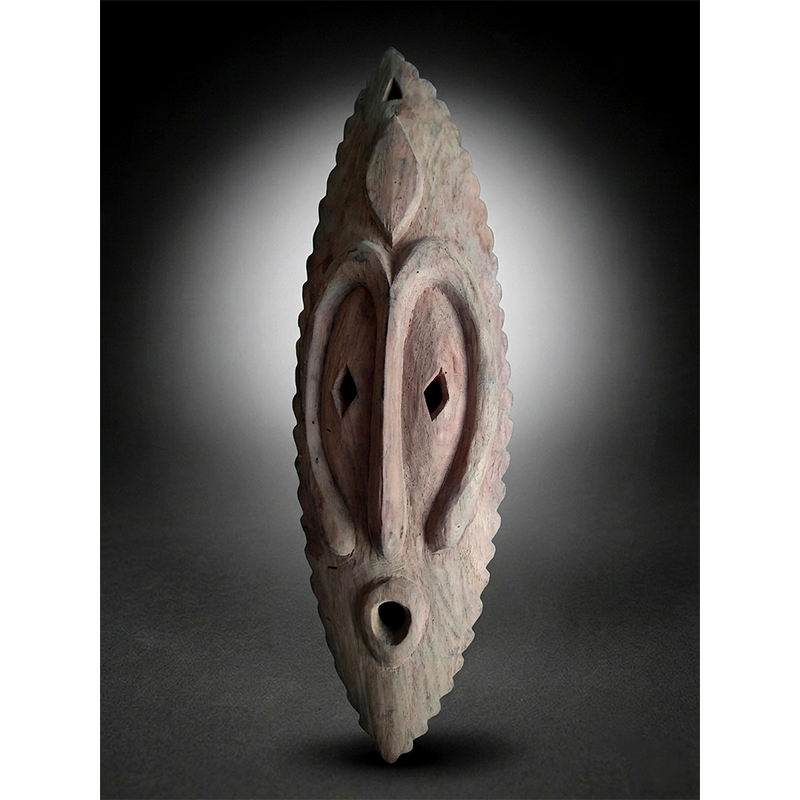
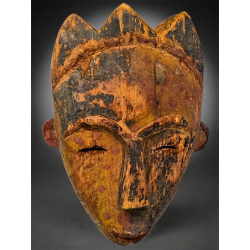
A large, flat, lance-shaped face-plate mask carved from a single block of softwood, distinguished by its dramatically serrated perimeter — a continuous zigzag crown of pointed teeth running the full circuit of the ovoid form from apex to terminal point. At 54 cm in height, this is a full-scale ceremonial example, not a miniature or ornamental variant. The facial plane is organised within a recessed elliptical field. From this shallow concave ground rises a centrally placed nasal ridge, narrow and crisply carved, flanked by two symmetrically placed eye perforations cut in a characteristic diamond (rhombus) form — a diagnostic feature consistently associated with the Kominimung and related Ramu / Guam River masking traditions by the Metropolitan Museum of Art and Eric Kjellgren's Oceania: Art of the Pacific Islands (2007).
The brow plane above the eyes is articulated by a double-arc ridge forming an omega-like superstructure. The mouth aperture is rendered as a single round perforation at the lower pole, echoing the circular form of the upper crown hole — the single suspension/attachment point at the apex. Viewed in profile (Images 3–4), the mask's depth is notably shallow — approximately 6 cm — confirming it functioned as a flat face-plate attached to a larger cane or basketry superstructure worn on the dancer's body. The reverse (Image 2) shows the raw, open-grained wood interior with a collector label ('L52'), longitudinal tool marks, and a naturally oxidised surface — consistent with age and storage rather than active use-patina.
The convergence of three formal features — (1) the serrated perimeter, (2) the diamond pierced eyes, and (3) the nested elliptical facial recess — places this mask within the masking corpus of the middle Ramu and Guam River peoples of northeast New Guinea, specifically the Kominimung and closely related groups including the Romkun, Breri, and Igana. The Metropolitan Museum of Art (inv. 1978.7) holds a directly comparable example attributed to the Romkun, Breri or Igana peoples of the Ramu and Guam Rivers, described as a dance mask secured to a larger basketry headdress by peripheral perforations — precisely the configuration evidenced here. Kjellgren notes that these peoples share stylistic features — most notably the large diamond-shaped eyes — with the dance masks of the neighbouring Kominimung, whose language and culture are related. Among the Kominimung, both masks and figures depict ancestral spirits called bwongogo, whose powers ensure the success of agriculture, hunting, fishing, and formerly warfare. The serrated tooth border is a regionally distinctive vocabulary element differentiating this group from both the Murik / lower Sepik tradition (long-nosed, concave-back helmet masks) and the Iatmul middle Sepik tradition (shell-encrusted, three-dimensional face masks).
Dance masks among the Kominimung and related Ramu River peoples were worn by initiated men during ritual performances. Women and children were explicitly excluded from witnessing both the creation and storage of the masks. The entire community, however, could observe the masked performances. The bwongogo spirits depicted were held responsible for the fertility of gardens, the success of fishing and hunting expeditions, and formerly the outcomes of warfare — placing these objects at the intersection of subsistence, cosmology, and social authority. The peripheral lashing holes confirm that this mask was attached to a basketry or cane superstructure forming part of a full-body dance costume. This mounting system is consistent across the lower Sepik / Ramu coastal tradition: the mask plate serving as the face of a larger assembled spirit being, with the dancer concealed beneath an elaborate fibre and organic costume. The flat back and shallow depth — unsuitable for direct face-wearing — confirm this non-face-worn typology.
As observed across the views provided, the mask is in an exceptional, stable ethnographic condition.
The Ramu River empties into the Bismarck Sea at the eastern end of Madang Province, having wound through some of the most culturally dense and artistically productive terrain in Melanesia. The peoples of the middle Ramu and Guam Rivers — the Kominimung, Romkun, Breri, and Igana — developed a masking vocabulary of particular formal severity: flat, ovoid face-plates enclosed within a corona of serrated teeth, the facial features reduced to their minimum: twin diamond eyes, a central nasal ridge, a circular mouth. The result is an object of almost heraldic economy — a spirit-face stripped to its essential grammar. At 54 cm, this example is a full working mask — not a domestic ornament or a trade copy.
The peripheral lashing holes around the serrated crown are its biography: they record the cane armature to which the plate was bound, the fibre body that hung below it, the dancer whose shoulders bore the weight, and the bwongogo spirit that descended into him during the performance. The community stood outside the fence. The initiated men stood within. This face looked out. For the Oceanic specialist, this mask resolves a specific acquisition challenge: objects from the middle Ramu / Guam River corridor are substantially rarer in European private collections than Iatmul or Murik material, partly because the river is harder to access and partly because academic documentation of these masking traditions remains comparatively sparse. The Metropolitan Museum holds one parallel example (inv. 1978.7); published comparables in major auction catalogues are few. The formal vocabulary — particularly the serrated crown combined with diamond eyes — is immediately identifiable to the specialist and immediately striking to the non-specialist eye.
 Security policy
Transactions protected by 256-bit SSL through 3D-Secure gateways—we never store your card details.
 Delivery policy
All items are professionally packed and shipped via premium, fully tracked carrier services.
 Return policy
If you are not entirely satisfied, you can return your acquisition within 15 days for a full refund.
Data sheet
« IN THE SACRED COSMOLOGIES OF THE PEOPLE INHABITING THE COASTAL FRINGES OF THE SEPIC, MASKS ARE LITERAL VESSELS FOR THE WALE—POWERFUL ANCESTRAL WATER SPIRITS. »
A large, flat, lance-shaped face-plate mask carved from a single block of softwood, distinguished by its dramatically serrated perimeter — a continuous zigzag crown of pointed teeth running the full circuit of the ovoid form from apex to terminal point. At 54 cm in height, this is a full-scale ceremonial example, not a miniature or ornamental variant. The facial plane is organised within a recessed elliptical field. From this shallow concave ground rises a centrally placed nasal ridge, narrow and crisply carved, flanked by two symmetrically placed eye perforations cut in a characteristic diamond (rhombus) form — a diagnostic feature consistently associated with the Kominimung and related Ramu / Guam River masking traditions by the Metropolitan Museum of Art and Eric Kjellgren's Oceania: Art of the Pacific Islands (2007).
The brow plane above the eyes is articulated by a double-arc ridge forming an omega-like superstructure. The mouth aperture is rendered as a single round perforation at the lower pole, echoing the circular form of the upper crown hole — the single suspension/attachment point at the apex. Viewed in profile (Images 3–4), the mask's depth is notably shallow — approximately 6 cm — confirming it functioned as a flat face-plate attached to a larger cane or basketry superstructure worn on the dancer's body. The reverse (Image 2) shows the raw, open-grained wood interior with a collector label ('L52'), longitudinal tool marks, and a naturally oxidised surface — consistent with age and storage rather than active use-patina.
The convergence of three formal features — (1) the serrated perimeter, (2) the diamond pierced eyes, and (3) the nested elliptical facial recess — places this mask within the masking corpus of the middle Ramu and Guam River peoples of northeast New Guinea, specifically the Kominimung and closely related groups including the Romkun, Breri, and Igana. The Metropolitan Museum of Art (inv. 1978.7) holds a directly comparable example attributed to the Romkun, Breri or Igana peoples of the Ramu and Guam Rivers, described as a dance mask secured to a larger basketry headdress by peripheral perforations — precisely the configuration evidenced here. Kjellgren notes that these peoples share stylistic features — most notably the large diamond-shaped eyes — with the dance masks of the neighbouring Kominimung, whose language and culture are related. Among the Kominimung, both masks and figures depict ancestral spirits called bwongogo, whose powers ensure the success of agriculture, hunting, fishing, and formerly warfare. The serrated tooth border is a regionally distinctive vocabulary element differentiating this group from both the Murik / lower Sepik tradition (long-nosed, concave-back helmet masks) and the Iatmul middle Sepik tradition (shell-encrusted, three-dimensional face masks).
Dance masks among the Kominimung and related Ramu River peoples were worn by initiated men during ritual performances. Women and children were explicitly excluded from witnessing both the creation and storage of the masks. The entire community, however, could observe the masked performances. The bwongogo spirits depicted were held responsible for the fertility of gardens, the success of fishing and hunting expeditions, and formerly the outcomes of warfare — placing these objects at the intersection of subsistence, cosmology, and social authority. The peripheral lashing holes confirm that this mask was attached to a basketry or cane superstructure forming part of a full-body dance costume. This mounting system is consistent across the lower Sepik / Ramu coastal tradition: the mask plate serving as the face of a larger assembled spirit being, with the dancer concealed beneath an elaborate fibre and organic costume. The flat back and shallow depth — unsuitable for direct face-wearing — confirm this non-face-worn typology.
As observed across the views provided, the mask is in an exceptional, stable ethnographic condition.
The Ramu River empties into the Bismarck Sea at the eastern end of Madang Province, having wound through some of the most culturally dense and artistically productive terrain in Melanesia. The peoples of the middle Ramu and Guam Rivers — the Kominimung, Romkun, Breri, and Igana — developed a masking vocabulary of particular formal severity: flat, ovoid face-plates enclosed within a corona of serrated teeth, the facial features reduced to their minimum: twin diamond eyes, a central nasal ridge, a circular mouth. The result is an object of almost heraldic economy — a spirit-face stripped to its essential grammar. At 54 cm, this example is a full working mask — not a domestic ornament or a trade copy.
The peripheral lashing holes around the serrated crown are its biography: they record the cane armature to which the plate was bound, the fibre body that hung below it, the dancer whose shoulders bore the weight, and the bwongogo spirit that descended into him during the performance. The community stood outside the fence. The initiated men stood within. This face looked out. For the Oceanic specialist, this mask resolves a specific acquisition challenge: objects from the middle Ramu / Guam River corridor are substantially rarer in European private collections than Iatmul or Murik material, partly because the river is harder to access and partly because academic documentation of these masking traditions remains comparatively sparse. The Metropolitan Museum holds one parallel example (inv. 1978.7); published comparables in major auction catalogues are few. The formal vocabulary — particularly the serrated crown combined with diamond eyes — is immediately identifiable to the specialist and immediately striking to the non-specialist eye.