


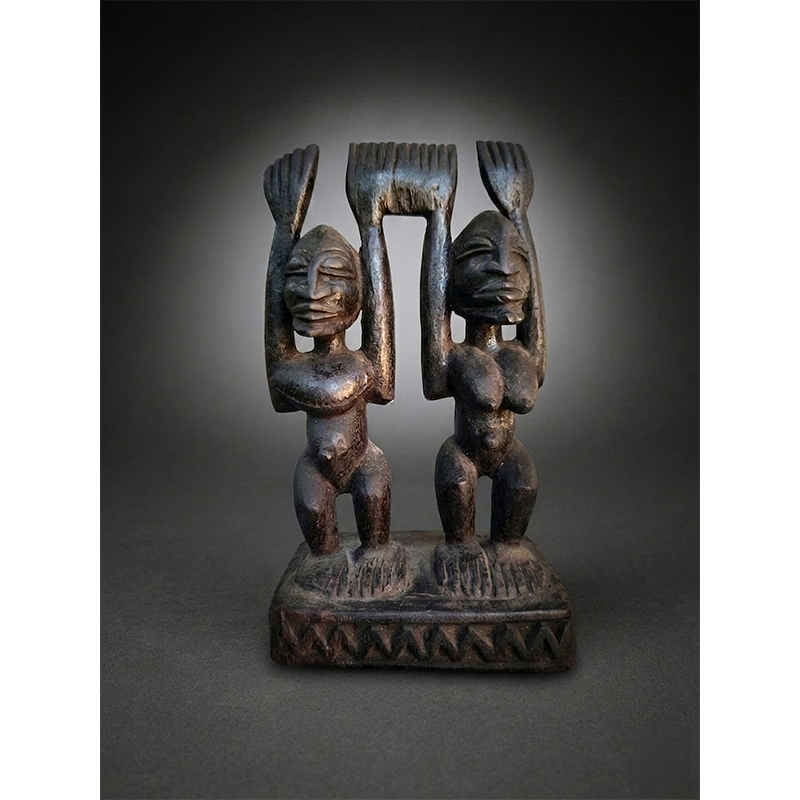


"The Dogon couple is among the most immediately recognisable expressions of West African sculpture — and among the most enduring in collector demand."
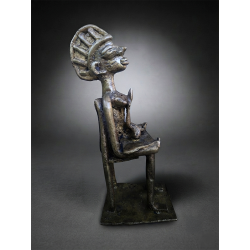
Two figures stand shoulder to shoulder upon a single carved plinth, their arms raised in a gesture that has become, for those familiar with the sculpture of the Bandiagara cliffs, almost a signature: the prayer for rain, the supplication addressed to Amma, the supporting of the celestial vault by the primordial ancestors.
Carved from a single block of dense hardwood — most likely a regional acacia or tropical iroko — the couple displays the heart-shaped facial geometry, the columnar torsos, and the broad expressive mouths characteristic of Dogon figural sculpture. The depth of the patina, the encrusted residues visible across the chest, base and underside, and the network of fine vertical age-checks running through the wood all indicate that this work was not made for display: it was made for use.
An old inked inventory marking is still legible on the underside of the base, an indication of at least one prior European collection — a discreet but meaningful trace of provenance that, while not in itself naming the collector, places the work outside recent decorative production and within the older circuit of collected Dogon material.
Among the Dogon, the paired male/female figure occupies a foundational place in the imagery of the lineage altar. In the cosmology recorded by Marcel Griaule and Germaine Dieterlen in the mid-twentieth century, creation begins with the supreme deity Amma and unfolds through the Nommo — the primordial ancestral pair from whom the eight founding ancestors of humanity descend. Sculpted couples are not literal portraits of named individuals: they are visual condensations of this origin, the model of complementarity from which lineage continuity flows.
The arms held vertically aloft — found across a wide range of Dogon figural types, from monumental Tellem-tradition statues to smaller domestic pieces — has been variously interpreted by ethnographers. It is most often read as the prayer for rain addressed to the sky deity, a vital concern in the Sahelian zone where Dogon agriculture remains rain-fed. A second register of reading places the gesture in the support of the celestial vault: the ancestors hold up the world. A third reading, less metaphysical, is straightforwardly liturgical — the gesture of the Hogon, the Dogon priest, at moments of address.
The crusted, irregularly distributed patina across the chest, the hollows between the raised arms, the base and underside is consistent with prolonged ritual handling. Such surfaces typically accumulate through repeated libations — millet beer, oil, the blood of small sacrificial animals — together with the smoke of household and altar fires. Within Dogon practice, such couples were maintained on the family altar (vageu) of the lineage compound, addressed at agricultural transitions, funerary rites, and during the propitiation of misfortune.
The Dogon people number approximately four hundred thousand and occupy the Bandiagara escarpment in central Mali — a sandstone cliff some two hundred kilometres long rising abruptly from the Séno plain. Settled in the region from at least the fifteenth century, they displaced or absorbed the earlier Tellem population whose burial caves in the cliff face remain a primary archaeological context for the oldest wooden sculpture in the region.
Dogon religious life rests on three intertwined institutions: the cult of the lineage ancestors, maintained at the household and clan altars; the Binu cult, centred on totemic clan founders and presided over by Binu priests; and the Awa society of masks, responsible for the great dama funerary cycle. Sculpted figures — singular, paired, equestrian, kneeling — circulate among these institutions according to local tradition. The paired standing couple, the type to which the present work belongs, is overwhelmingly associated with the lineage altar and the domain of ancestor veneration.
Within the broader West African sculptural canon, Dogon figural work occupies a place comparable to the Romanesque within European art: an idiom of high formal discipline, geometric clarity, and explicit symbolic charge. The body is read as architecture — torsos as columns, shoulders as lintels, the raised arms as roof supports — and the face is reduced to its essential markers: blade nose, narrow eyes, marked brow, the broad horizontal mouth. The integral plinth, often patterned as here with a saw-tooth or zigzag motif, anchors the figures both physically and iconographically: the earth from which they rise and to which they remain attached.
The work reads stylistically as Dogon and falls within the broad category of paired-figure altar sculpture. Several features support this attribution: the heart-shaped facial geometry with continuous brow ridge meeting a blade-form nose, the columnar torso, the gesture of the vertically raised arms, the integral rectangular plinth with carved zigzag border, and the deep encrusted patina consistent with altar use in the Sahelian climate.
Within the Dogon corpus the work does not present the highly individuated physiognomy of a known master's hand, nor does it correspond to the great Tellem-tradition pieces from the cliff caves. It belongs more probably to the ongoing village production of altar furniture maintained throughout the late nineteenth and twentieth centuries — work of genuine ritual function but outside the named-master tier.
Wood does not lend itself to confident visual dating. In the absence of laboratory dating and without a written collection history with date markers, the Shyu house policy is to date such works to the first half of the twentieth century (c. 1900–1950), with explicit acknowledgement that an earlier dating — late nineteenth century — is possible and would require expert authentication to substantiate.
We name only what the work itself supports. The attribution to the Dogon people of the Bandiagara escarpment is stated with confidence. The dating is given conservatively. No claim is made to a named workshop or master. Should a specialist of the Dogon corpus — for example, members of the network around Charles-Wesley Hourdé, Schoffel & Valluet, Didier Claes or Bernard de Grunne — confirm an earlier dating or a more specific workshop attribution, the gallery valuation would be revised upward accordingly.
CANONICAL ICONOGRAPHIC TYPE : The paired primordial couple stands at the heart of the Dogon sculptural canon. Acquiring such a piece is acquiring not an ornament but a recognised cultural document of the Bandiagara tradition.
GENUINE RITUAL SURFACE : The encrusted, multi-layered patina is the visible record of altar use — not a workshop finish. This is the surface that specialists look for first and that recent decorative production cannot replicate.
COHERENT SCALE AND INTACT GESTURE : At 22.5 cm, the piece is the right size for a private interior display while preserving the iconic raised-arm gesture in its full integrity. Both arms, both heads, the joining upper element and the carved plinth are intact.
DISCRETE PROVENANCE TRACE : The old inked inventory mark on the underside places the work in the older European collection circuit. While not a named provenance, it is the kind of trace that consistently differentiates collected pieces from recent production.
HONEST PRICING : The valuation presented reflects what the work itself supports — no inflated attribution, no fabricated provenance.
 Security policy
Transactions protected by 256-bit SSL through 3D-Secure gateways—we never store your card details.
 Delivery policy
All items are professionally packed and shipped via premium, fully tracked carrier services.
 Return policy
If you are not entirely satisfied, you can return your acquisition within 15 days for a full refund.
Data sheet
"The Dogon couple is among the most immediately recognisable expressions of West African sculpture — and among the most enduring in collector demand."
Two figures stand shoulder to shoulder upon a single carved plinth, their arms raised in a gesture that has become, for those familiar with the sculpture of the Bandiagara cliffs, almost a signature: the prayer for rain, the supplication addressed to Amma, the supporting of the celestial vault by the primordial ancestors.
Carved from a single block of dense hardwood — most likely a regional acacia or tropical iroko — the couple displays the heart-shaped facial geometry, the columnar torsos, and the broad expressive mouths characteristic of Dogon figural sculpture. The depth of the patina, the encrusted residues visible across the chest, base and underside, and the network of fine vertical age-checks running through the wood all indicate that this work was not made for display: it was made for use.
An old inked inventory marking is still legible on the underside of the base, an indication of at least one prior European collection — a discreet but meaningful trace of provenance that, while not in itself naming the collector, places the work outside recent decorative production and within the older circuit of collected Dogon material.
Among the Dogon, the paired male/female figure occupies a foundational place in the imagery of the lineage altar. In the cosmology recorded by Marcel Griaule and Germaine Dieterlen in the mid-twentieth century, creation begins with the supreme deity Amma and unfolds through the Nommo — the primordial ancestral pair from whom the eight founding ancestors of humanity descend. Sculpted couples are not literal portraits of named individuals: they are visual condensations of this origin, the model of complementarity from which lineage continuity flows.
The arms held vertically aloft — found across a wide range of Dogon figural types, from monumental Tellem-tradition statues to smaller domestic pieces — has been variously interpreted by ethnographers. It is most often read as the prayer for rain addressed to the sky deity, a vital concern in the Sahelian zone where Dogon agriculture remains rain-fed. A second register of reading places the gesture in the support of the celestial vault: the ancestors hold up the world. A third reading, less metaphysical, is straightforwardly liturgical — the gesture of the Hogon, the Dogon priest, at moments of address.
The crusted, irregularly distributed patina across the chest, the hollows between the raised arms, the base and underside is consistent with prolonged ritual handling. Such surfaces typically accumulate through repeated libations — millet beer, oil, the blood of small sacrificial animals — together with the smoke of household and altar fires. Within Dogon practice, such couples were maintained on the family altar (vageu) of the lineage compound, addressed at agricultural transitions, funerary rites, and during the propitiation of misfortune.
The Dogon people number approximately four hundred thousand and occupy the Bandiagara escarpment in central Mali — a sandstone cliff some two hundred kilometres long rising abruptly from the Séno plain. Settled in the region from at least the fifteenth century, they displaced or absorbed the earlier Tellem population whose burial caves in the cliff face remain a primary archaeological context for the oldest wooden sculpture in the region.
Dogon religious life rests on three intertwined institutions: the cult of the lineage ancestors, maintained at the household and clan altars; the Binu cult, centred on totemic clan founders and presided over by Binu priests; and the Awa society of masks, responsible for the great dama funerary cycle. Sculpted figures — singular, paired, equestrian, kneeling — circulate among these institutions according to local tradition. The paired standing couple, the type to which the present work belongs, is overwhelmingly associated with the lineage altar and the domain of ancestor veneration.
Within the broader West African sculptural canon, Dogon figural work occupies a place comparable to the Romanesque within European art: an idiom of high formal discipline, geometric clarity, and explicit symbolic charge. The body is read as architecture — torsos as columns, shoulders as lintels, the raised arms as roof supports — and the face is reduced to its essential markers: blade nose, narrow eyes, marked brow, the broad horizontal mouth. The integral plinth, often patterned as here with a saw-tooth or zigzag motif, anchors the figures both physically and iconographically: the earth from which they rise and to which they remain attached.
The work reads stylistically as Dogon and falls within the broad category of paired-figure altar sculpture. Several features support this attribution: the heart-shaped facial geometry with continuous brow ridge meeting a blade-form nose, the columnar torso, the gesture of the vertically raised arms, the integral rectangular plinth with carved zigzag border, and the deep encrusted patina consistent with altar use in the Sahelian climate.
Within the Dogon corpus the work does not present the highly individuated physiognomy of a known master's hand, nor does it correspond to the great Tellem-tradition pieces from the cliff caves. It belongs more probably to the ongoing village production of altar furniture maintained throughout the late nineteenth and twentieth centuries — work of genuine ritual function but outside the named-master tier.
Wood does not lend itself to confident visual dating. In the absence of laboratory dating and without a written collection history with date markers, the Shyu house policy is to date such works to the first half of the twentieth century (c. 1900–1950), with explicit acknowledgement that an earlier dating — late nineteenth century — is possible and would require expert authentication to substantiate.
We name only what the work itself supports. The attribution to the Dogon people of the Bandiagara escarpment is stated with confidence. The dating is given conservatively. No claim is made to a named workshop or master. Should a specialist of the Dogon corpus — for example, members of the network around Charles-Wesley Hourdé, Schoffel & Valluet, Didier Claes or Bernard de Grunne — confirm an earlier dating or a more specific workshop attribution, the gallery valuation would be revised upward accordingly.
CANONICAL ICONOGRAPHIC TYPE : The paired primordial couple stands at the heart of the Dogon sculptural canon. Acquiring such a piece is acquiring not an ornament but a recognised cultural document of the Bandiagara tradition.
GENUINE RITUAL SURFACE : The encrusted, multi-layered patina is the visible record of altar use — not a workshop finish. This is the surface that specialists look for first and that recent decorative production cannot replicate.
COHERENT SCALE AND INTACT GESTURE : At 22.5 cm, the piece is the right size for a private interior display while preserving the iconic raised-arm gesture in its full integrity. Both arms, both heads, the joining upper element and the carved plinth are intact.
DISCRETE PROVENANCE TRACE : The old inked inventory mark on the underside places the work in the older European collection circuit. While not a named provenance, it is the kind of trace that consistently differentiates collected pieces from recent production.
HONEST PRICING : The valuation presented reflects what the work itself supports — no inflated attribution, no fabricated provenance.