




THE DOGON OF THE BANDIAGARA CLIFFS
The Dogon people occupy one of the most striking cultural landscapes in all of Africa: the dramatic sandstone escarpment of the Bandiagara cliffs, rising from the Sahel plain in central Mali. Having settled this terrain between the 14th and 16th centuries, the Dogon built villages directly into and beneath the cliff face, creating an architectural and spiritual landscape that has fascinated European observers since the earliest French colonial expeditions. The work of the ethnographer Marcel Griaule (1898–1956) and his successors – particularly the famous conversations with the Dogon elder Ogotemmêli published as Dieu d'eau (1948) – made the Dogon cosmology one of the most extensively documented and influential of any African religious system.
THE ICONOGRAPHY OF THE RAISED ARMS
Among all the figural compositions of African sculpture, the Dogon figure aux bras levés – the figure with raised arms – is one of the most immediately recognisable and most charged with meaning. The traditional interpretation, transmitted through Dogon religious specialists to the ethnographers of the 20th century, identifies this gesture as a prayer for rain – the human figure reaching upward toward the sky god Amma, beseeching the heavens to release the water that the millet fields require. In a region where agricultural success or failure depends entirely on the timing and abundance of the brief rainy season (June to September), the figure aux bras levés is not abstract piety but concrete supplication for survival.
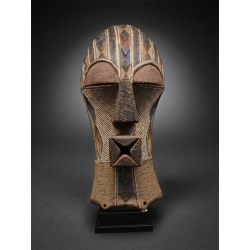
The pose has additional layers of meaning in Dogon cosmology. The vertical axis from earth to sky is central to Dogon spatial conception – the sacred kanaga mask that dances at funerals also raises arms in this same gesture, connecting the deceased to the upper world. The eight ancestors (Nommo) who descended from Amma in the beginning of time are sometimes depicted with raised arms in their own act of cosmic creation. The figure aux bras levés thus participates in a deep theological vocabulary that extends well beyond the immediate prayer for rain.
THE DOGON SCULPTURAL TRADITION
Dogon figural sculpture has been continuously produced from at least the 14th century (though most surviving examples are from the 19th and 20th centuries) and includes multiple categories: tellem-style figures with raised arms (after the earlier population whose iconography the Dogon absorbed), nommo ancestral figures, equestrian figures, maternity figures, and various ritual implements. The carving idiom – stocky proportions, geometric simplification, deep encrusted patina from libation residues – has been admired by European modernists since the early 20th century, with the Dogon raised-arms figure achieving particular international fame following major auction results in the late 20th century.
THE PRESENT FIGURE
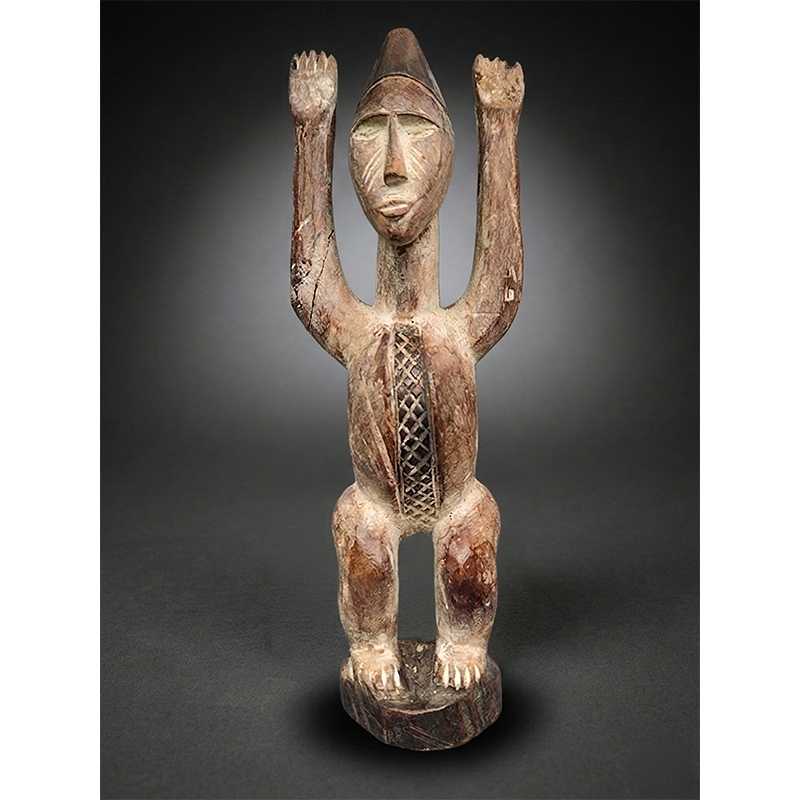
The present figure preserves the canonical Dogon raised-arms vocabulary in clear and recognisable form. The vertical gesture is rendered with full architectural commitment – the arms extend straight up from the shoulders, the hands open with fingers spread skyward, the figure entire becomes an axis of supplication. The conical cap, the closed serene eyes, the geometric scarification panel descending from chest to abdomen, the stocky robust body proportions, and the integral circular base all conform to the documented Dogon sculptural canon as established in the published comparative literature.
The applied white kaolin coating – known in Dogon contexts as pemba or tô, used on figures associated with rain rituals, ancestor veneration, and the practices of the Hogon (priestly elder) – is partially worn and integrated with the wood substrate, exposing the warmer brown-black wood beneath at the cap, the high points, and the base edges. This pattern of partial kaolin survival, with real wear visible at the most-handled zones, is consistent with a piece that has had genuine use rather than recent decorative production.
The figure is offered in good ethnographic condition – fully intact at the body and base, structurally sound, with the inevitable wear that characterises a working Dogon figure of this period.
Erosion at the hands: the splayed fingers show partial wear and minor losses at the tips, consistent with extended handling and exposure. This is the area most vulnerable to damage on any raised-arms figure and the present erosion is normal for the type and age.
• Stable wood with no significant cracks affecting structural integrity;
• Real ageing visible throughout – wood character at exposed areas, soft polish at high contact points, accumulated wear at base edges;
• Integrated kaolin – partial wear and integration with wood substrate, not the fresh-applied uniform character of recent decorative coating;
• No active insect damage observed;
• Stands stably on its integral circular base;
• The right arm shows evidence of an old repair, likely carried out in the field. Both arms display wear to the fingertips consistent with age.
Several major reasons stand out:
1. Iconic Form : The Dogon raised-arms figure is among the most internationally celebrated and immediately recognisable of all African sculptural forms. Held in nearly every major museum collection from the Musée du quai Branly to the Metropolitan Museum, and continuously celebrated since the early 20th-century studies of Marcel Griaule, this iconography carries instant cultural weight and aesthetic appeal.
2. Compelling Narrative : The prayer-for-rain interpretation – the human figure reaching toward Amma beneath the merciless Sahel sky – is one of the most evocative cultural narratives in all of African art. It speaks immediately to viewers regardless of their background, communicating the vulnerability of agricultural societies and the universality of the gesture of supplication.
3. Genuine Wear Evidence : The partially worn kaolin treatment, the erosion at the hands, and the wear at the base edges argue convincingly for a piece that has had a real life rather than recent decorative production. This places the figure in the credible mid-tier of the Dogon market – not a documented antique, but also not a recent tourist carving.
At this price point, the figure offers the entry-level collector access to one of African art's most canonical forms without the financial commitment required for documented antique examples. It is a substantial first piece that anchors a beginning collection with a recognisable and compelling iconography. Acquired on the French regional antiques market in Limoges, consistent with the type of pre-2000 European holding from which Dogon figures of this period frequently emerge. It is offered at a transparent price reflecting what we can confirm: correct Dogon iconography, second-half-20th-century date, real wear evidence, attractive aesthetic. The buyer pays for what is verifiably here.
 Security policy
Transactions protected by 256-bit SSL through 3D-Secure gateways—we never store your card details.
 Delivery policy
All items are professionally packed and shipped via premium, fully tracked carrier services.
 Return policy
If you are not entirely satisfied, you can return your acquisition within 15 days for a full refund.
Data sheet
THE DOGON OF THE BANDIAGARA CLIFFS
The Dogon people occupy one of the most striking cultural landscapes in all of Africa: the dramatic sandstone escarpment of the Bandiagara cliffs, rising from the Sahel plain in central Mali. Having settled this terrain between the 14th and 16th centuries, the Dogon built villages directly into and beneath the cliff face, creating an architectural and spiritual landscape that has fascinated European observers since the earliest French colonial expeditions. The work of the ethnographer Marcel Griaule (1898–1956) and his successors – particularly the famous conversations with the Dogon elder Ogotemmêli published as Dieu d'eau (1948) – made the Dogon cosmology one of the most extensively documented and influential of any African religious system.
THE ICONOGRAPHY OF THE RAISED ARMS
Among all the figural compositions of African sculpture, the Dogon figure aux bras levés – the figure with raised arms – is one of the most immediately recognisable and most charged with meaning. The traditional interpretation, transmitted through Dogon religious specialists to the ethnographers of the 20th century, identifies this gesture as a prayer for rain – the human figure reaching upward toward the sky god Amma, beseeching the heavens to release the water that the millet fields require. In a region where agricultural success or failure depends entirely on the timing and abundance of the brief rainy season (June to September), the figure aux bras levés is not abstract piety but concrete supplication for survival.
The pose has additional layers of meaning in Dogon cosmology. The vertical axis from earth to sky is central to Dogon spatial conception – the sacred kanaga mask that dances at funerals also raises arms in this same gesture, connecting the deceased to the upper world. The eight ancestors (Nommo) who descended from Amma in the beginning of time are sometimes depicted with raised arms in their own act of cosmic creation. The figure aux bras levés thus participates in a deep theological vocabulary that extends well beyond the immediate prayer for rain.
THE DOGON SCULPTURAL TRADITION
Dogon figural sculpture has been continuously produced from at least the 14th century (though most surviving examples are from the 19th and 20th centuries) and includes multiple categories: tellem-style figures with raised arms (after the earlier population whose iconography the Dogon absorbed), nommo ancestral figures, equestrian figures, maternity figures, and various ritual implements. The carving idiom – stocky proportions, geometric simplification, deep encrusted patina from libation residues – has been admired by European modernists since the early 20th century, with the Dogon raised-arms figure achieving particular international fame following major auction results in the late 20th century.
THE PRESENT FIGURE
The present figure preserves the canonical Dogon raised-arms vocabulary in clear and recognisable form. The vertical gesture is rendered with full architectural commitment – the arms extend straight up from the shoulders, the hands open with fingers spread skyward, the figure entire becomes an axis of supplication. The conical cap, the closed serene eyes, the geometric scarification panel descending from chest to abdomen, the stocky robust body proportions, and the integral circular base all conform to the documented Dogon sculptural canon as established in the published comparative literature.
The applied white kaolin coating – known in Dogon contexts as pemba or tô, used on figures associated with rain rituals, ancestor veneration, and the practices of the Hogon (priestly elder) – is partially worn and integrated with the wood substrate, exposing the warmer brown-black wood beneath at the cap, the high points, and the base edges. This pattern of partial kaolin survival, with real wear visible at the most-handled zones, is consistent with a piece that has had genuine use rather than recent decorative production.
The figure is offered in good ethnographic condition – fully intact at the body and base, structurally sound, with the inevitable wear that characterises a working Dogon figure of this period.
Erosion at the hands: the splayed fingers show partial wear and minor losses at the tips, consistent with extended handling and exposure. This is the area most vulnerable to damage on any raised-arms figure and the present erosion is normal for the type and age.
• Stable wood with no significant cracks affecting structural integrity;
• Real ageing visible throughout – wood character at exposed areas, soft polish at high contact points, accumulated wear at base edges;
• Integrated kaolin – partial wear and integration with wood substrate, not the fresh-applied uniform character of recent decorative coating;
• No active insect damage observed;
• Stands stably on its integral circular base;
• The right arm shows evidence of an old repair, likely carried out in the field. Both arms display wear to the fingertips consistent with age.
Several major reasons stand out:
1. Iconic Form : The Dogon raised-arms figure is among the most internationally celebrated and immediately recognisable of all African sculptural forms. Held in nearly every major museum collection from the Musée du quai Branly to the Metropolitan Museum, and continuously celebrated since the early 20th-century studies of Marcel Griaule, this iconography carries instant cultural weight and aesthetic appeal.
2. Compelling Narrative : The prayer-for-rain interpretation – the human figure reaching toward Amma beneath the merciless Sahel sky – is one of the most evocative cultural narratives in all of African art. It speaks immediately to viewers regardless of their background, communicating the vulnerability of agricultural societies and the universality of the gesture of supplication.
3. Genuine Wear Evidence : The partially worn kaolin treatment, the erosion at the hands, and the wear at the base edges argue convincingly for a piece that has had a real life rather than recent decorative production. This places the figure in the credible mid-tier of the Dogon market – not a documented antique, but also not a recent tourist carving.
At this price point, the figure offers the entry-level collector access to one of African art's most canonical forms without the financial commitment required for documented antique examples. It is a substantial first piece that anchors a beginning collection with a recognisable and compelling iconography. Acquired on the French regional antiques market in Limoges, consistent with the type of pre-2000 European holding from which Dogon figures of this period frequently emerge. It is offered at a transparent price reflecting what we can confirm: correct Dogon iconography, second-half-20th-century date, real wear evidence, attractive aesthetic. The buyer pays for what is verifiably here.