


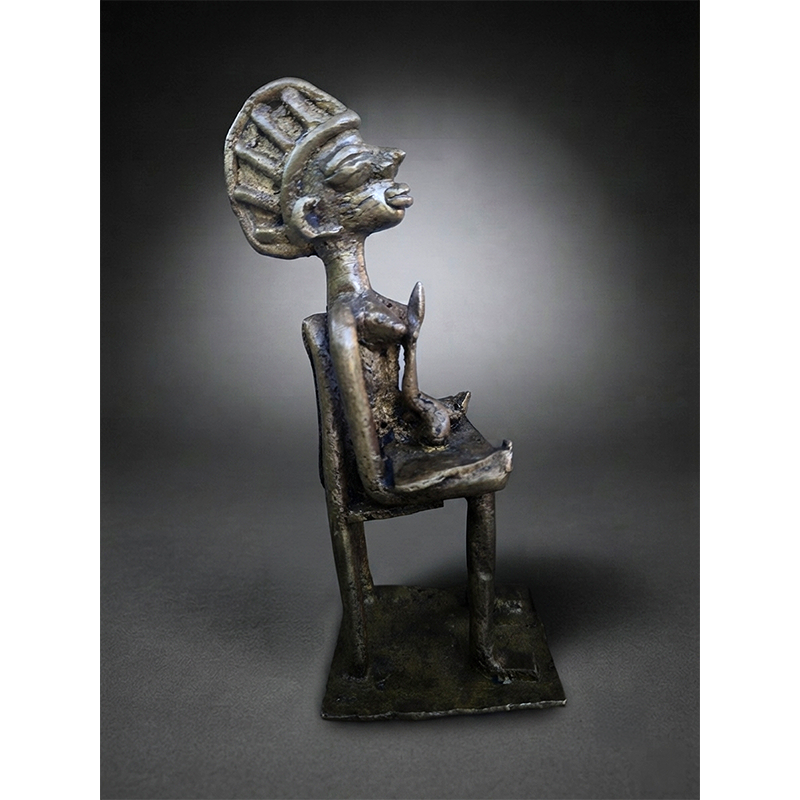


« A seated presence in quiet dialogue with ITS mythical python spirit, a foundational guardian deity. »
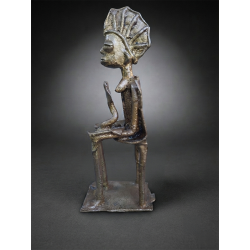
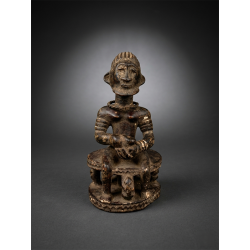
This exceptional lost-wax cast bronze sculpture, represents an extraordinarily rare sacred effigy of a Queen Mother (Soma) or royal female ancestor from the Gan people of Burkina Faso. Distinct from male figures, this statue features prominent, gracefully sculpted anatomical markers identifying her as a matriarch of immense political and spiritual lineage. She is depicted seated majestically upon an intricate royal throne featuring a dramatic, open A-frame or triangular structural backrest.
Across her lap tray rests a coiled, undulating python—the foundational protective totem of the Gan dynastic cults (Asie). The python represents immortality, guardianship, and the link between the terrestrial kingdom and the ancestral underworld. Her high, status-defining segmented coiffure, signifies absolute spiritual authority and elite rank. Cast by sacred blacksmiths using ancient casting techniques, this object served an active ceremonial function, placed directly on institutional or ancestral court altars to receive libations, channel protective spirits, and safeguard the continuity of the royal bloodline.
The figure belongs, like its companion "The Royal Sacred Serpent", to the corpus of small cast-brass court and ancestral figures attributed to the Gan people (also written Kaan or Gain), of the Loropéni and Gaoua region of south-western Burkina Faso. The Gan are a small population sharing the upper Volta cultural landscape with the Lobi, Birifor and Dagara. Their brass casting is the work of hereditary blacksmith-caster families whose practice has long served the small Gan chieftaincies of the region.
The fan-shaped headdress on this figure represents a variant of the Gan royal coiffure canon, distinct in its opening lateral form from the taller, crested version worn by the companion figure. In court iconography, the two headdress types often signal different court roles or different registers within the royal compound — but establishing this specifically for a given figure requires provenance evidence that we do not possess.
Where "The Royal Sacred Serpent" shows the python rising vertically from the lap, this figure carries the same tutelary attribute in a coiled register — tightly wound and resting, but no less charged. In Gan and neighbouring Voltaic traditions, the python is a royal attribute, associated with the ancestral protection of the chiefly line, the continuity of the lineage, and the tutelary presence of the household spirits. Whether raised or coiled, the serpent designates the sitter as a person of authority under ancestral guard.
The pairing of the two figures — a raised and a coiled python — reads compellingly as a compositional dialogue between two moments or two aspects of the same tutelary power. Whether the two were originally produced as a pair, or whether they came together through later collection, cannot be established without provenance; but their stylistic and iconographic coherence is unmistakable.
Small cast-brass Gan figures of this scale belong to a domestic and lineage register rather than a public masking or large-shrine one. They are kept within the family compound, on ancestral altars, or in the personal shrine of a senior person of the household. In use, they may receive occasional libations — beer, palm wine, oil — and their presence commemorates and channels the tutelary agency of the sitter they represent.
This figure is therefore best described as belonging to a ritual and commemorative register: an object of veneration inside the family shrine, not a stage prop of public masquerade. In the absence of confirmed provenance to a specific compound, the ritual function is described here typologically — that is, as belonging to the class of objects that served in this way — rather than as evidenced for this particular piece.
The figure is complete and structurally sound. It stands upright on its own base without support. The four legs of the stool and the base plate are intact; the figure–stool–base junctions are original casting, not later repair. No welding, infill, or restoration is visible. A small, minor casting perforation is present on the upper crest of the headdress, entirely inherent to the traditional lost-wax process (cire perdue).
The lost-wax surface is well preserved, with the granular casting texture characteristic of termite-clay mould work visible throughout. The patina is a warm golden brass, darker in the recesses of the coiffure and along the underside of the stool. Small surface losses and casting porosity, consistent with cire-perdue technique, are visible along the edges of the base. Weight: 749 g, a density consistent with solid or near-solid traditional casting rather than thin-walled workshop production.
This figure is best acquired as the companion piece to SHYU 26-020, with which it forms a compositionally and iconographically coherent pair. Read together, the two figures offer a dialogue between the raised and coiled registers of the same tutelary python attribute — a dialogue that gives each piece additional gravity beyond what it holds alone. Displayed as a pair, the two figures deliver considerably more presence than the sum of their parts, and represent a scarce opportunity to acquire two coherent Gan royal-register figures together rather than sourcing matched pieces piecemeal over years.
As a standalone piece, this figure offers:
 Security policy
Transactions protected by 256-bit SSL through 3D-Secure gateways—we never store your card details.
 Delivery policy
All items are professionally packed and shipped via premium, fully tracked carrier services.
 Return policy
If you are not entirely satisfied, you can return your acquisition within 15 days for a full refund.
Data sheet
« A seated presence in quiet dialogue with ITS mythical python spirit, a foundational guardian deity. »
This exceptional lost-wax cast bronze sculpture, represents an extraordinarily rare sacred effigy of a Queen Mother (Soma) or royal female ancestor from the Gan people of Burkina Faso. Distinct from male figures, this statue features prominent, gracefully sculpted anatomical markers identifying her as a matriarch of immense political and spiritual lineage. She is depicted seated majestically upon an intricate royal throne featuring a dramatic, open A-frame or triangular structural backrest.
Across her lap tray rests a coiled, undulating python—the foundational protective totem of the Gan dynastic cults (Asie). The python represents immortality, guardianship, and the link between the terrestrial kingdom and the ancestral underworld. Her high, status-defining segmented coiffure, signifies absolute spiritual authority and elite rank. Cast by sacred blacksmiths using ancient casting techniques, this object served an active ceremonial function, placed directly on institutional or ancestral court altars to receive libations, channel protective spirits, and safeguard the continuity of the royal bloodline.
The figure belongs, like its companion "The Royal Sacred Serpent", to the corpus of small cast-brass court and ancestral figures attributed to the Gan people (also written Kaan or Gain), of the Loropéni and Gaoua region of south-western Burkina Faso. The Gan are a small population sharing the upper Volta cultural landscape with the Lobi, Birifor and Dagara. Their brass casting is the work of hereditary blacksmith-caster families whose practice has long served the small Gan chieftaincies of the region.
The fan-shaped headdress on this figure represents a variant of the Gan royal coiffure canon, distinct in its opening lateral form from the taller, crested version worn by the companion figure. In court iconography, the two headdress types often signal different court roles or different registers within the royal compound — but establishing this specifically for a given figure requires provenance evidence that we do not possess.
Where "The Royal Sacred Serpent" shows the python rising vertically from the lap, this figure carries the same tutelary attribute in a coiled register — tightly wound and resting, but no less charged. In Gan and neighbouring Voltaic traditions, the python is a royal attribute, associated with the ancestral protection of the chiefly line, the continuity of the lineage, and the tutelary presence of the household spirits. Whether raised or coiled, the serpent designates the sitter as a person of authority under ancestral guard.
The pairing of the two figures — a raised and a coiled python — reads compellingly as a compositional dialogue between two moments or two aspects of the same tutelary power. Whether the two were originally produced as a pair, or whether they came together through later collection, cannot be established without provenance; but their stylistic and iconographic coherence is unmistakable.
Small cast-brass Gan figures of this scale belong to a domestic and lineage register rather than a public masking or large-shrine one. They are kept within the family compound, on ancestral altars, or in the personal shrine of a senior person of the household. In use, they may receive occasional libations — beer, palm wine, oil — and their presence commemorates and channels the tutelary agency of the sitter they represent.
This figure is therefore best described as belonging to a ritual and commemorative register: an object of veneration inside the family shrine, not a stage prop of public masquerade. In the absence of confirmed provenance to a specific compound, the ritual function is described here typologically — that is, as belonging to the class of objects that served in this way — rather than as evidenced for this particular piece.
The figure is complete and structurally sound. It stands upright on its own base without support. The four legs of the stool and the base plate are intact; the figure–stool–base junctions are original casting, not later repair. No welding, infill, or restoration is visible. A small, minor casting perforation is present on the upper crest of the headdress, entirely inherent to the traditional lost-wax process (cire perdue).
The lost-wax surface is well preserved, with the granular casting texture characteristic of termite-clay mould work visible throughout. The patina is a warm golden brass, darker in the recesses of the coiffure and along the underside of the stool. Small surface losses and casting porosity, consistent with cire-perdue technique, are visible along the edges of the base. Weight: 749 g, a density consistent with solid or near-solid traditional casting rather than thin-walled workshop production.
This figure is best acquired as the companion piece to SHYU 26-020, with which it forms a compositionally and iconographically coherent pair. Read together, the two figures offer a dialogue between the raised and coiled registers of the same tutelary python attribute — a dialogue that gives each piece additional gravity beyond what it holds alone. Displayed as a pair, the two figures deliver considerably more presence than the sum of their parts, and represent a scarce opportunity to acquire two coherent Gan royal-register figures together rather than sourcing matched pieces piecemeal over years.
As a standalone piece, this figure offers: