




THE TEACHER OF THE SHAN HILLS
In the sacred, mist-shrouded highlands of the historical Shan States, an 18th-century master craftsman channeled lifetime devotion into casting this exceptional bronze.
The Eternal Teacher — A Meditation in Bronze from Mainland Southeast Asia
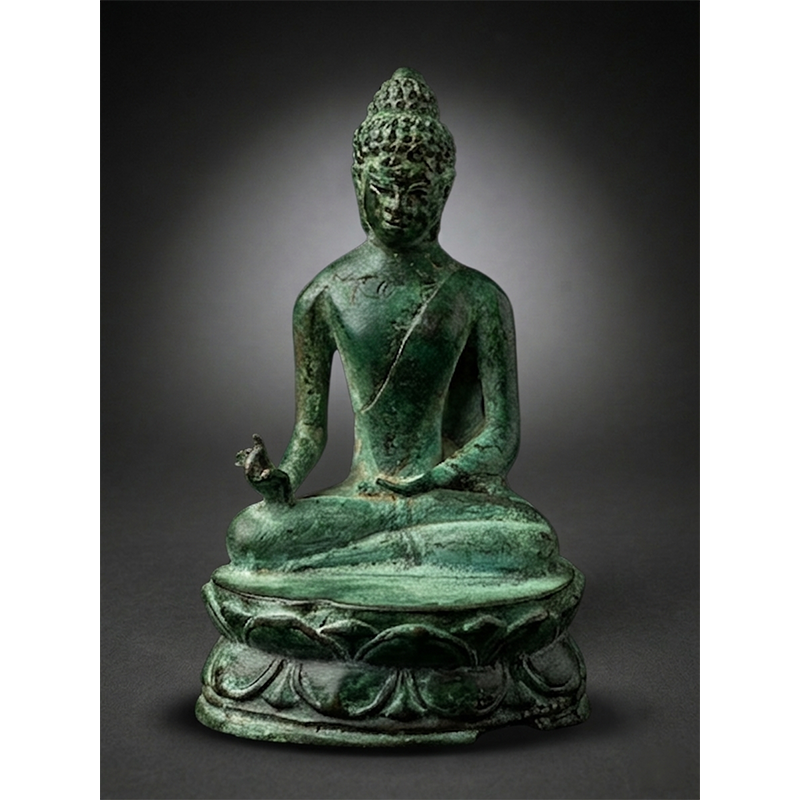
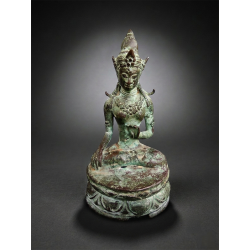
This quietly compelling bronze Buddha belongs to the great tradition of Theravada devotional casting that flourished across Burma (present-day Myanmar) and the Lan Na kingdom of Northern Thailand from roughly the 13th century onward. It is a portable meditation object: cast to be placed in a domestic shrine, a monk's cell, or the inner sanctum of a small temple, held in the hands during prayer, and venerated over generations. The passage of time has transformed its surface into a landscape of deep malachite green, warm cuprite russet, and iron-oxide orange — a patina whose chromatic complexity is the direct record of centuries of burial in mineral-rich tropical soil.
Iconography — The Mark of Shakyamuni
The figure sits in vajrasana (the full lotus posture) upon a double register of lotus petals, the padmasana throne whose botanical precision signals both ritual purity and cosmological significance: the lotus rises from the muddy water of existence to flower in unconditioned light. The right hand is raised at chest height in vitarka mudra — the gesture of teaching and philosophical exposition — with the thumb and index finger joined to form the circle of the Dharma Wheel. The left hand rests in the lap, open, in receptive meditation.
The head exhibits the canonical lakshana of a fully Awakened Being. The cranium is surmounted by the ushnisha — the protuberance of supreme wisdom — here rendered as a distinctly conical, sharply pointed form. This is a diagnostic feature of the mainland tradition: Central Javanese ushnishas of the Shailendra period are invariably rounder or flame-topped; the tapering cone seen here is characteristic of Burmese (Pagan–Ava–Mandalay lineage) and of Northern Thai Chiang Saen / Lan Na bronzes.
The tightly coiled snail-shell curls (kapardin) that cover the head follow the legend of the snails who sheltered the meditating Buddha from the sun. The elongated earlobes recall the heavy golden earrings of his princely former life, shed at the moment of the Great Renunciation. The face is serene and inwardly absorbed — downcast eyes, gently arched brows, a straight refined nose, and softly closed lips — the expression of one whose attention has turned permanently inward. The monastic robe (uttarasanga) is draped in the classical Indian manner, over the left shoulder and arm, leaving the right shoulder bare — the iconography of the historical Shakyamuni in his teaching aspect, recalling the First Sermon in the Deer Park at Sarnath where he set the Wheel of the Law in motion.
Material, Technique & the Vanished Gold
The figure was produced by cire perdue (lost-wax casting): a wax model was sculpted around a clay-and-charcoal core, encased in a refractory outer mould, then fired to vaporise the wax. Molten high-tin bronze was poured into the resulting void; after cooling, the mould was broken away, producing a unique, irreproducible cast.
The hollow underside — clearly documented in the base photograph — reveals the original casting cavity. Traces of mercury gilding are visible on the interior surface: gold was amalgamated with mercury, applied to the bronze, and driven home by heat that evaporated the mercury and left pure gold fused to the substrate. As it left its maker's hands, this figure would have shone like the sun. Today, fragments of that gold survive alongside the magnificent verdigris — two superimposed histories in the same object.
Ritual Function & Sacred Use
Small bronze Buddhas of this type were not decorative objects. They were votive images produced for active devotional use: placed on domestic altars, carried during pilgrimage, installed in temple niches, or offered as meritorious donations to monastic communities. The vitarka mudra — the teaching gesture — makes this figure specifically an image of the transmitting Buddha, the one who communicates the Dharma across time. That a devotee looking at this object was, in a sense, receiving a teaching is not merely poetic: in Theravada practice, the ritual gaze upon a Buddha image is itself a meritorious act. The figure was made to be lived with, looked at, and contemplated.
The figure is offered in excellent archaeological condition, structurally sound, and bearing the magnificent surface that only genuine antiquity produces.
Patina: An exceptionally rich multi-layered patina ranges from deep malachite green and blue-green azurite through warm cuprite-russet and iron-oxide orange. The patina is stable, dry, and free of active corrosion (no bronze disease). The colour variation across the surface is entirely natural, produced by differential burial chemistry over a long period.
Casting porosities: The lower portion of the lotus base displays small casting porosities and burial-related perforations. These are not damage: they are original lost-wax casting flaws (gas pockets in the cooling alloy) enlarged by decades or centuries of contact with mineral-rich tropical soil. Specialists treat these openings as authenticating evidence. A bronze of claimed antiquity with no such features would be the anomaly requiring explanation.
Surface wear: Minor abrasions to the high points — ushnisha tip, knees, raised fingers — and a soft erosion of the finest surface detail are consistent with age and use. No restorations, no replaced elements, no overpainting, no later interventions.
Aesthetic quality: The harmonious proportions, the absorbed facial expression, and the incomparable verdigris patina combine into an object of genuine aesthetic authority. It functions equally as a devotional sculpture, a museum-calibre antiquity, and a jewel-like presence in any considered interior.
Iconographic completeness: The figure preserves all essential canonical signs of a Buddha image: the full lotus seat, the double throne, the perfect vitarka mudra, the complete monastic robe, ushnisha, snail-shell curls, and elongated earlobes. Many surviving small bronzes of this type are fragmentary; complete examples command a premium.
Market position: Mainland Southeast Asian Buddhist bronzes — particularly Burmese and Lan Na material with confirmed patina and complete iconography — occupy a growing and underserved segment of the Asian art market, attracting both specialist and Asian diaspora buyers.
 Security policy
Transactions protected by 256-bit SSL through 3D-Secure gateways—we never store your card details.
 Delivery policy
All items are professionally packed and shipped via premium, fully tracked carrier services.
 Return policy
If you are not entirely satisfied, you can return your acquisition within 15 days for a full refund.
Data sheet
THE TEACHER OF THE SHAN HILLS
In the sacred, mist-shrouded highlands of the historical Shan States, an 18th-century master craftsman channeled lifetime devotion into casting this exceptional bronze.
The Eternal Teacher — A Meditation in Bronze from Mainland Southeast Asia
This quietly compelling bronze Buddha belongs to the great tradition of Theravada devotional casting that flourished across Burma (present-day Myanmar) and the Lan Na kingdom of Northern Thailand from roughly the 13th century onward. It is a portable meditation object: cast to be placed in a domestic shrine, a monk's cell, or the inner sanctum of a small temple, held in the hands during prayer, and venerated over generations. The passage of time has transformed its surface into a landscape of deep malachite green, warm cuprite russet, and iron-oxide orange — a patina whose chromatic complexity is the direct record of centuries of burial in mineral-rich tropical soil.
Iconography — The Mark of Shakyamuni
The figure sits in vajrasana (the full lotus posture) upon a double register of lotus petals, the padmasana throne whose botanical precision signals both ritual purity and cosmological significance: the lotus rises from the muddy water of existence to flower in unconditioned light. The right hand is raised at chest height in vitarka mudra — the gesture of teaching and philosophical exposition — with the thumb and index finger joined to form the circle of the Dharma Wheel. The left hand rests in the lap, open, in receptive meditation.
The head exhibits the canonical lakshana of a fully Awakened Being. The cranium is surmounted by the ushnisha — the protuberance of supreme wisdom — here rendered as a distinctly conical, sharply pointed form. This is a diagnostic feature of the mainland tradition: Central Javanese ushnishas of the Shailendra period are invariably rounder or flame-topped; the tapering cone seen here is characteristic of Burmese (Pagan–Ava–Mandalay lineage) and of Northern Thai Chiang Saen / Lan Na bronzes.
The tightly coiled snail-shell curls (kapardin) that cover the head follow the legend of the snails who sheltered the meditating Buddha from the sun. The elongated earlobes recall the heavy golden earrings of his princely former life, shed at the moment of the Great Renunciation. The face is serene and inwardly absorbed — downcast eyes, gently arched brows, a straight refined nose, and softly closed lips — the expression of one whose attention has turned permanently inward. The monastic robe (uttarasanga) is draped in the classical Indian manner, over the left shoulder and arm, leaving the right shoulder bare — the iconography of the historical Shakyamuni in his teaching aspect, recalling the First Sermon in the Deer Park at Sarnath where he set the Wheel of the Law in motion.
Material, Technique & the Vanished Gold
The figure was produced by cire perdue (lost-wax casting): a wax model was sculpted around a clay-and-charcoal core, encased in a refractory outer mould, then fired to vaporise the wax. Molten high-tin bronze was poured into the resulting void; after cooling, the mould was broken away, producing a unique, irreproducible cast.
The hollow underside — clearly documented in the base photograph — reveals the original casting cavity. Traces of mercury gilding are visible on the interior surface: gold was amalgamated with mercury, applied to the bronze, and driven home by heat that evaporated the mercury and left pure gold fused to the substrate. As it left its maker's hands, this figure would have shone like the sun. Today, fragments of that gold survive alongside the magnificent verdigris — two superimposed histories in the same object.
Ritual Function & Sacred Use
Small bronze Buddhas of this type were not decorative objects. They were votive images produced for active devotional use: placed on domestic altars, carried during pilgrimage, installed in temple niches, or offered as meritorious donations to monastic communities. The vitarka mudra — the teaching gesture — makes this figure specifically an image of the transmitting Buddha, the one who communicates the Dharma across time. That a devotee looking at this object was, in a sense, receiving a teaching is not merely poetic: in Theravada practice, the ritual gaze upon a Buddha image is itself a meritorious act. The figure was made to be lived with, looked at, and contemplated.
The figure is offered in excellent archaeological condition, structurally sound, and bearing the magnificent surface that only genuine antiquity produces.
Patina: An exceptionally rich multi-layered patina ranges from deep malachite green and blue-green azurite through warm cuprite-russet and iron-oxide orange. The patina is stable, dry, and free of active corrosion (no bronze disease). The colour variation across the surface is entirely natural, produced by differential burial chemistry over a long period.
Casting porosities: The lower portion of the lotus base displays small casting porosities and burial-related perforations. These are not damage: they are original lost-wax casting flaws (gas pockets in the cooling alloy) enlarged by decades or centuries of contact with mineral-rich tropical soil. Specialists treat these openings as authenticating evidence. A bronze of claimed antiquity with no such features would be the anomaly requiring explanation.
Surface wear: Minor abrasions to the high points — ushnisha tip, knees, raised fingers — and a soft erosion of the finest surface detail are consistent with age and use. No restorations, no replaced elements, no overpainting, no later interventions.
Aesthetic quality: The harmonious proportions, the absorbed facial expression, and the incomparable verdigris patina combine into an object of genuine aesthetic authority. It functions equally as a devotional sculpture, a museum-calibre antiquity, and a jewel-like presence in any considered interior.
Iconographic completeness: The figure preserves all essential canonical signs of a Buddha image: the full lotus seat, the double throne, the perfect vitarka mudra, the complete monastic robe, ushnisha, snail-shell curls, and elongated earlobes. Many surviving small bronzes of this type are fragmentary; complete examples command a premium.
Market position: Mainland Southeast Asian Buddhist bronzes — particularly Burmese and Lan Na material with confirmed patina and complete iconography — occupy a growing and underserved segment of the Asian art market, attracting both specialist and Asian diaspora buyers.