




« STANDING BEFORE YOU IS A RARE AND FULLY INTACT EXAMPLE OF A TIKAR TERRACOTTA HOUSE DIVINITY FIGURE — THE LARGEST AND MOST COMPOSITIONALLY COMPLEX CATEGORY OF PROTECTIVE SPIRIT SCULPTURE PRODUCED BY THE TIKAR PEOPLE. »
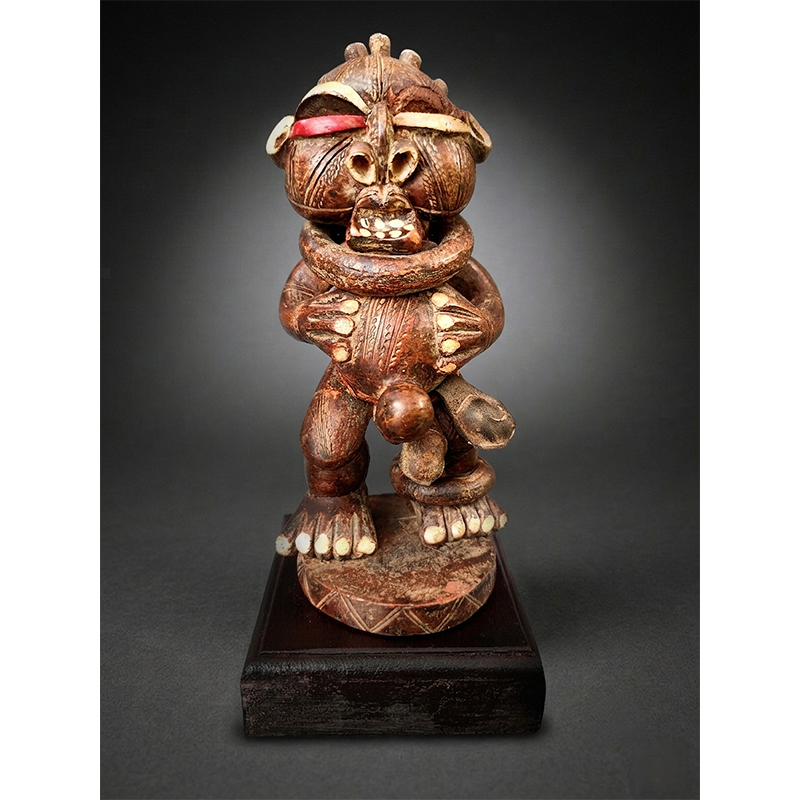
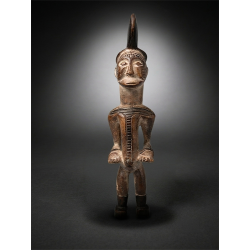
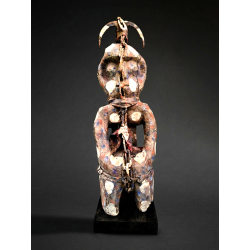
Standing before you is a rare and fully intact example of a Tikar terracotta house god figure — the largest and most compositionally complex category of protective spirit sculpture produced by the Tikar peoples of the Cameroon Grasslands. Measuring 22 cm in height, this piece occupies the upper register of surviving examples, which more commonly range between 8 and 15 cm. The figure is built in the classic Tikar idiom: a compact, powerfully frontal male form, massive head crowned by a corona of hollow tubular protrusions — a headdress format unique to this corpus, the cylinders possibly serving as receptacles for medicinal or ritual substances. The face is rendered with deliberate intensity: bulbous orbital ridges, deep-set eyes, an open mouth baring incised teeth, and a pronounced brow-band inlaid with red camwood pigment and set with a bone or shell appliqué — attributes that reinforce the spirit's power over natural forces. Ring-shaped ear ornaments complete the head's regalia.
The most singular feature of this piece is the modelled serpent that wraps the entire body in a continuous spiral coil, from the circular base up through the torso to the neck. In Grasslands iconography, the python is a royal and chiefly animal, associated with protection and the authority of the royal compound. Its presence here — fully modelled and integrated into the clay at the time of construction, not an addition — elevates this figure well above the common house god type into the category of charged prestige object.
The body surface is covered in precise incised scarification patterns on the torso, fingers, and toes, infilled with white kaolin paste — a widespread Central African convention marking ritual status and spiritual potency. Residual red pigment (camwood / ngula) survives in the facial recesses and brow zone. The overall surface has developed an authentic use-patina of dark burnished iron: the clay's natural iron content combining with decades of handling, smoke exposure, and sacrificial application.
The rear of the figure is of particular ethnographic importance: a bundle of raffia fibre, knotted at the small of the back, remains in situ — direct physical evidence that this object was actively charged and maintained as a ritual vessel. In Tikar practice, house gods are regularly addressed through libation, food offerings, and the binding of empowering materials. This raffia bundle, darkened and compacted by use, constitutes one of the strongest authentication markers the type can offer.
The Tikar are a Central African people of the Cameroon Grasslands, numbering approximately 500,000, concentrated in the Tikar Plain and Ndop area of the North-West Region. Closely related culturally and historically to the Bamum (Bamoun) and Bamileke, they share a hierarchical court society in which art objects — whether cast bronze, carved wood, or hand-built terracotta — function as markers of political rank and spiritual authority.
Among documented Tikar artistic outputs, terracotta house god figures represent the most widely distributed category of personal spiritual equipment, produced for household rather than royal use. House gods (no single standardised Tikar-language term is established in the ethnographic literature) are understood to embody the spirits of the Pygmy peoples (Baka / Bagyeli) who preceded the Tikar in the forest, and who are regarded as having privileged access to the spiritual world. The Tikar believe these figures, when properly maintained through sacrifice and offering, provide protection for the household, promote fertility and agricultural success, and can be petitioned in healing rituals. The owner's relationship with the figure is active and ongoing — its power dependent on regular attention.
The coiled serpent motif that dominates this figure is not a common element in the standard house god corpus and suggests a higher-tier commission — possibly for a compound head, senior man, or specialist healer rather than a standard domestic household. The python (ngyem) in Grasslands belief is specifically associated with royal protection, chiefly compounds, and the authority to ward off malevolent spirits. Its full integration into the figure at the modelling stage indicates intentional iconographic choice, not later modification.
Magnificent, untouched field condition. The terracotta exhibits a dry, heavily layered surface texture with an authentic crusty patina resulting from ceremonial storage and handling. The fragile white and red porcelain/glass fragments used for the eyes and teeth are entirely original and tightly locked into their native clay matrix, displaying genuine age contraction lines around the edges.
 Security policy
Transactions protected by 256-bit SSL through 3D-Secure gateways—we never store your card details.
 Delivery policy
All items are professionally packed and shipped via premium, fully tracked carrier services.
 Return policy
If you are not entirely satisfied, you can return your acquisition within 15 days for a full refund.
Data sheet
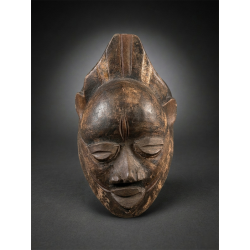
« STANDING BEFORE YOU IS A RARE AND FULLY INTACT EXAMPLE OF A TIKAR TERRACOTTA HOUSE DIVINITY FIGURE — THE LARGEST AND MOST COMPOSITIONALLY COMPLEX CATEGORY OF PROTECTIVE SPIRIT SCULPTURE PRODUCED BY THE TIKAR PEOPLE. »
Standing before you is a rare and fully intact example of a Tikar terracotta house god figure — the largest and most compositionally complex category of protective spirit sculpture produced by the Tikar peoples of the Cameroon Grasslands. Measuring 22 cm in height, this piece occupies the upper register of surviving examples, which more commonly range between 8 and 15 cm. The figure is built in the classic Tikar idiom: a compact, powerfully frontal male form, massive head crowned by a corona of hollow tubular protrusions — a headdress format unique to this corpus, the cylinders possibly serving as receptacles for medicinal or ritual substances. The face is rendered with deliberate intensity: bulbous orbital ridges, deep-set eyes, an open mouth baring incised teeth, and a pronounced brow-band inlaid with red camwood pigment and set with a bone or shell appliqué — attributes that reinforce the spirit's power over natural forces. Ring-shaped ear ornaments complete the head's regalia.
The most singular feature of this piece is the modelled serpent that wraps the entire body in a continuous spiral coil, from the circular base up through the torso to the neck. In Grasslands iconography, the python is a royal and chiefly animal, associated with protection and the authority of the royal compound. Its presence here — fully modelled and integrated into the clay at the time of construction, not an addition — elevates this figure well above the common house god type into the category of charged prestige object.
The body surface is covered in precise incised scarification patterns on the torso, fingers, and toes, infilled with white kaolin paste — a widespread Central African convention marking ritual status and spiritual potency. Residual red pigment (camwood / ngula) survives in the facial recesses and brow zone. The overall surface has developed an authentic use-patina of dark burnished iron: the clay's natural iron content combining with decades of handling, smoke exposure, and sacrificial application.
The rear of the figure is of particular ethnographic importance: a bundle of raffia fibre, knotted at the small of the back, remains in situ — direct physical evidence that this object was actively charged and maintained as a ritual vessel. In Tikar practice, house gods are regularly addressed through libation, food offerings, and the binding of empowering materials. This raffia bundle, darkened and compacted by use, constitutes one of the strongest authentication markers the type can offer.
The Tikar are a Central African people of the Cameroon Grasslands, numbering approximately 500,000, concentrated in the Tikar Plain and Ndop area of the North-West Region. Closely related culturally and historically to the Bamum (Bamoun) and Bamileke, they share a hierarchical court society in which art objects — whether cast bronze, carved wood, or hand-built terracotta — function as markers of political rank and spiritual authority.
Among documented Tikar artistic outputs, terracotta house god figures represent the most widely distributed category of personal spiritual equipment, produced for household rather than royal use. House gods (no single standardised Tikar-language term is established in the ethnographic literature) are understood to embody the spirits of the Pygmy peoples (Baka / Bagyeli) who preceded the Tikar in the forest, and who are regarded as having privileged access to the spiritual world. The Tikar believe these figures, when properly maintained through sacrifice and offering, provide protection for the household, promote fertility and agricultural success, and can be petitioned in healing rituals. The owner's relationship with the figure is active and ongoing — its power dependent on regular attention.
The coiled serpent motif that dominates this figure is not a common element in the standard house god corpus and suggests a higher-tier commission — possibly for a compound head, senior man, or specialist healer rather than a standard domestic household. The python (ngyem) in Grasslands belief is specifically associated with royal protection, chiefly compounds, and the authority to ward off malevolent spirits. Its full integration into the figure at the modelling stage indicates intentional iconographic choice, not later modification.
Magnificent, untouched field condition. The terracotta exhibits a dry, heavily layered surface texture with an authentic crusty patina resulting from ceremonial storage and handling. The fragile white and red porcelain/glass fragments used for the eyes and teeth are entirely original and tightly locked into their native clay matrix, displaying genuine age contraction lines around the edges.