


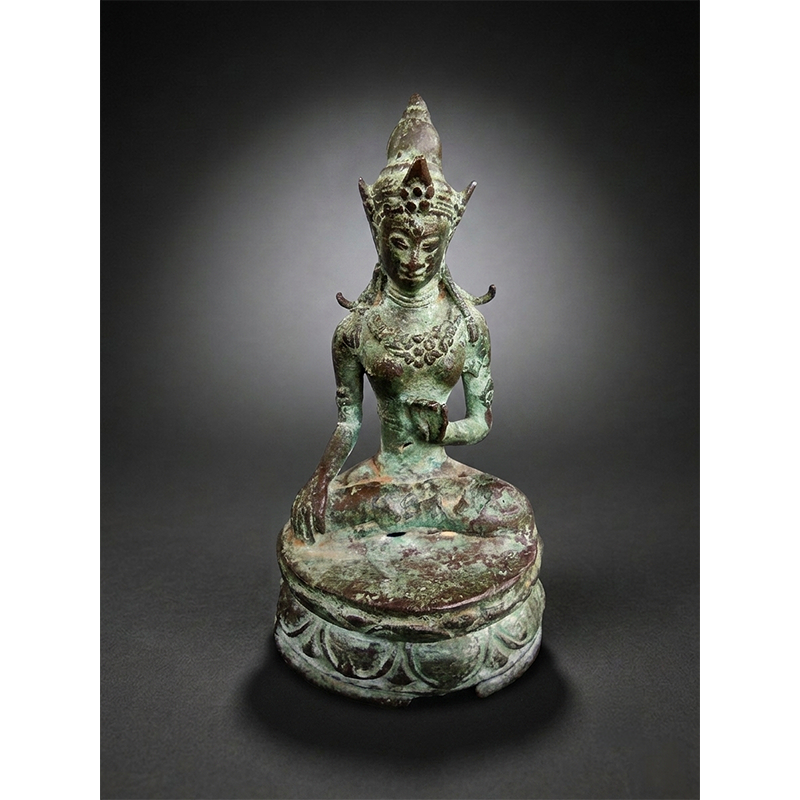


« CAST IN THE DYING LUMINESCENCE OF THE ANGKOR EMPIRE, THIS SMALL BRONZE DEVATA IS A DEVOTIONAL OBJECT OF EXTRAORDINARY REFINEMENT. »
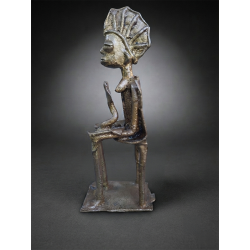
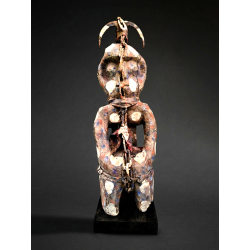
The figure is presented in a strictly frontal, hieratic pose, seated on a circular padmāsana (lotus throne). The body is female-presenting, with simply but firmly modelled breasts, a narrow waist, and a torso left bare above the waistband. The lower body is treated as an undifferentiated mass merging into the lotus throne, with no articulated garment-folds or pleated sampot — a stylistic point that will become important when we weigh the attribution. The head is dominated by a tall conical jaṭā-mukuṭa — a crown formed of matted ascetic hair — surmounted by a flame-shaped finial. A triangular frontal plaque (kirīṭa) is fixed to the front of the crown, ornamented with a central rosette flanked by smaller bosses, with radiating incised lines representing the matted hair fanning outward from the centre. The back of the headdress carries horizontal banding, also intended to read as matted hair coiled and tied. Flame-like kuṇṇḍala (ear ornaments) flare outward at ear-level, giving the silhouette its winged profile when seen from the front. The face is rounded, with arched eyebrows, downcast almond-shaped eyes, a broad nose, and small full lips set in a meditative expression. The earlobes are elongated and pendulous — a standard mark of divine status in Hindu-Buddhist iconography. Around the neck and across the chest, the figure wears a beaded hāra (ceremonial necklace / breastplate) composed of multiple registers of beads or floral elements. The right arm extends down towards the lap; the left arm is raised, bent at the elbow, with the hand brought up near the chest. The exact gesture is softened by surface erosion: it may originally have represented vitarka-mudrā (the gesture of teaching) or have held a small attribute now lost. The lotus base is a single-register padmāsana — one ring of stylised, flattened petals around the lower rim — set on a flared lower foot. The wall between the petals and the figure’s lap is heavily abraded and pierced in several places by losses.
The Khmer reading rests on iconographic and compositional evidence of the highest order:
The most likely iconographic identification is Tārā, the female bodhisattva of compassion in Mahāyāna Buddhism. The reasons are compositional rather than attributive: the gesture pattern itself is the iconographic signature.
THE TĀRĀ GESTURE PATTERN: The left arm raised, bent at the elbow, with the hand brought up near the chest, paired with the right arm extended downward toward the lap or knee, is the textbook compositional signature of seated Tārā in Buddhist Southeast Asian bronze. In the fully preserved version of this composition, the left hand holds the stem of an utpala (blue lotus) at chest level, and the right hand is in varada-mudrā (gift-giving), palm outward and downward, in a gesture of compassionate giving. Both attributes are lost on this figure — the utpala stem broken or never modelled as a separate element, the right-hand mudrā softened by surface erosion — but the compositional armature remains unambiguous.
SECONDARY READINGS: The same gesture pattern is occasionally used by other female deities, and three secondary identifications remain available:
The honest gallery position is ‘Tārā (most likely); Prajñāpāramitā or Devī as secondary readings.’
The object is cast in a cuprous alloy — almost certainly a tin-bronze, possibly leaded, in line with the standard alloys of mainland and insular Southeast Asia in the relevant period. The casting is hollow, executed by the lost-wax method (cire perdue) over a clay core. The underside shows the original open base, the remnants of the inner core, and the irregular wall-thickness typical of a hand-modelled wax original. Surface treatment is restricted to incised line-work (the radiating hair lines on the front of the mukuṭa, the rosette of the kirīṭa, the registers of the hāra) and to plastic modelling of the volumes. There is no chasing, no inlay, no cold-working visible. This restraint is consistent with the provincial / folk register of the workmanship. The patina is original, archaeological, and untouched. The dominant tonality is a soft pistachio-green cuprite-and-malachite layer, with strong veins of red metallic copper (cuprite) bleeding through at every high point and at the edges of the base. In several places the green layer has flaked, exposing the underlying copper.
Overall the object is stable, with no active corrosion. The figure has not been cleaned, polished, or chemically treated in the recent past; the surface is as recovered.
A small bronze devotional figure of this kind would have functioned within one or more of four interlocking ritual registers. These registers are not exclusive of each other; a single object could move between them across its lifetime.
 Security policy
Transactions protected by 256-bit SSL through 3D-Secure gateways—we never store your card details.
 Delivery policy
All items are professionally packed and shipped via premium, fully tracked carrier services.
 Return policy
If you are not entirely satisfied, you can return your acquisition within 15 days for a full refund.
Data sheet
« CAST IN THE DYING LUMINESCENCE OF THE ANGKOR EMPIRE, THIS SMALL BRONZE DEVATA IS A DEVOTIONAL OBJECT OF EXTRAORDINARY REFINEMENT. »
The figure is presented in a strictly frontal, hieratic pose, seated on a circular padmāsana (lotus throne). The body is female-presenting, with simply but firmly modelled breasts, a narrow waist, and a torso left bare above the waistband. The lower body is treated as an undifferentiated mass merging into the lotus throne, with no articulated garment-folds or pleated sampot — a stylistic point that will become important when we weigh the attribution. The head is dominated by a tall conical jaṭā-mukuṭa — a crown formed of matted ascetic hair — surmounted by a flame-shaped finial. A triangular frontal plaque (kirīṭa) is fixed to the front of the crown, ornamented with a central rosette flanked by smaller bosses, with radiating incised lines representing the matted hair fanning outward from the centre. The back of the headdress carries horizontal banding, also intended to read as matted hair coiled and tied. Flame-like kuṇṇḍala (ear ornaments) flare outward at ear-level, giving the silhouette its winged profile when seen from the front. The face is rounded, with arched eyebrows, downcast almond-shaped eyes, a broad nose, and small full lips set in a meditative expression. The earlobes are elongated and pendulous — a standard mark of divine status in Hindu-Buddhist iconography. Around the neck and across the chest, the figure wears a beaded hāra (ceremonial necklace / breastplate) composed of multiple registers of beads or floral elements. The right arm extends down towards the lap; the left arm is raised, bent at the elbow, with the hand brought up near the chest. The exact gesture is softened by surface erosion: it may originally have represented vitarka-mudrā (the gesture of teaching) or have held a small attribute now lost. The lotus base is a single-register padmāsana — one ring of stylised, flattened petals around the lower rim — set on a flared lower foot. The wall between the petals and the figure’s lap is heavily abraded and pierced in several places by losses.
The Khmer reading rests on iconographic and compositional evidence of the highest order:
The most likely iconographic identification is Tārā, the female bodhisattva of compassion in Mahāyāna Buddhism. The reasons are compositional rather than attributive: the gesture pattern itself is the iconographic signature.
THE TĀRĀ GESTURE PATTERN: The left arm raised, bent at the elbow, with the hand brought up near the chest, paired with the right arm extended downward toward the lap or knee, is the textbook compositional signature of seated Tārā in Buddhist Southeast Asian bronze. In the fully preserved version of this composition, the left hand holds the stem of an utpala (blue lotus) at chest level, and the right hand is in varada-mudrā (gift-giving), palm outward and downward, in a gesture of compassionate giving. Both attributes are lost on this figure — the utpala stem broken or never modelled as a separate element, the right-hand mudrā softened by surface erosion — but the compositional armature remains unambiguous.
SECONDARY READINGS: The same gesture pattern is occasionally used by other female deities, and three secondary identifications remain available:
The honest gallery position is ‘Tārā (most likely); Prajñāpāramitā or Devī as secondary readings.’
The object is cast in a cuprous alloy — almost certainly a tin-bronze, possibly leaded, in line with the standard alloys of mainland and insular Southeast Asia in the relevant period. The casting is hollow, executed by the lost-wax method (cire perdue) over a clay core. The underside shows the original open base, the remnants of the inner core, and the irregular wall-thickness typical of a hand-modelled wax original. Surface treatment is restricted to incised line-work (the radiating hair lines on the front of the mukuṭa, the rosette of the kirīṭa, the registers of the hāra) and to plastic modelling of the volumes. There is no chasing, no inlay, no cold-working visible. This restraint is consistent with the provincial / folk register of the workmanship. The patina is original, archaeological, and untouched. The dominant tonality is a soft pistachio-green cuprite-and-malachite layer, with strong veins of red metallic copper (cuprite) bleeding through at every high point and at the edges of the base. In several places the green layer has flaked, exposing the underlying copper.
Overall the object is stable, with no active corrosion. The figure has not been cleaned, polished, or chemically treated in the recent past; the surface is as recovered.
A small bronze devotional figure of this kind would have functioned within one or more of four interlocking ritual registers. These registers are not exclusive of each other; a single object could move between them across its lifetime.