


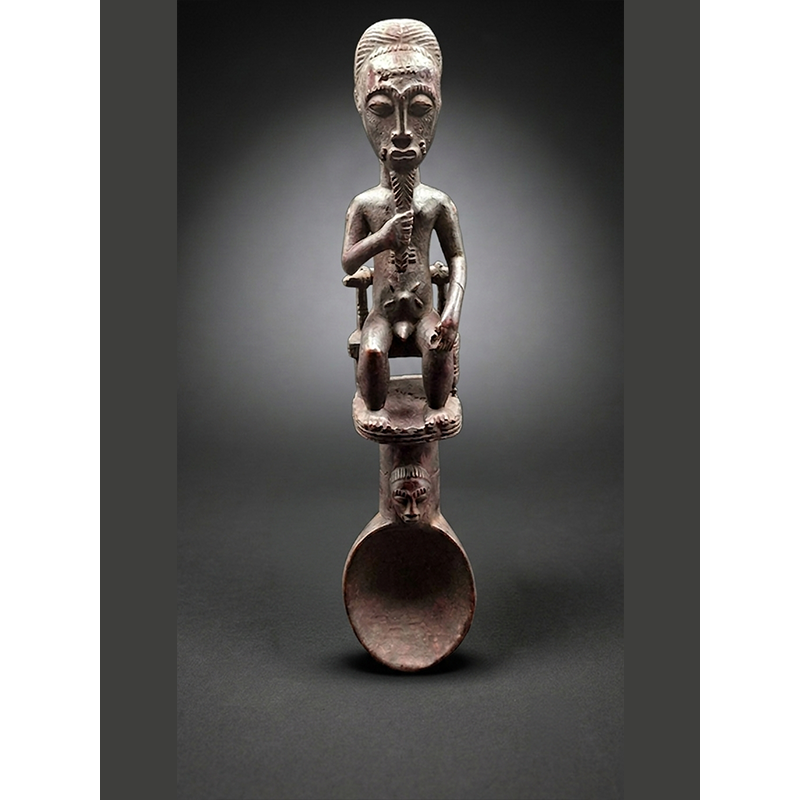


« THE MOST HOSPITABLE WOMAN OF A VILLAGE IS THE CUSTODIAN OF THIS SACRED SPOON: A MASTERPIECE OF DAN ARTISTRY. »
In Dan society, the most hospitable woman of a village is honored with the title of Wunkirle (the "most generous woman"). She is the custodian of this sacred spoon, which serves as her badge of office. During great festivals, the Wunkirle dances with this spoon, using it to symbolically distribute rice and wealth to the community, proving that her spirit is as vast as the vessel itself.
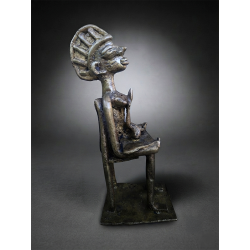
This specific piece is exceptionally rare due to the seated figure atop the handle. The woman is depicted on a European-style "prestige chair," a visual signifier of high status and successful cross-cultural trade during the colonial era. She holds her braided beard—a symbol of wisdom and elderhood—signifying that she is not merely a provider, but a judge and a matriarch.
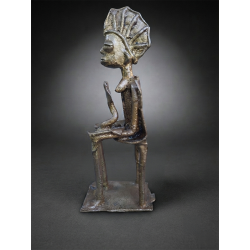
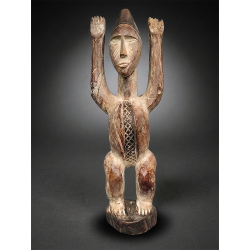
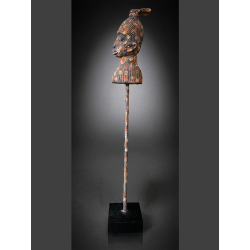
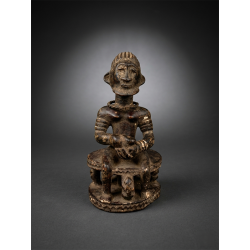
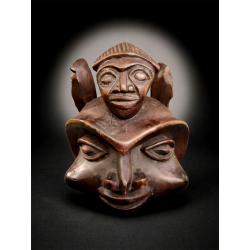
The object is a single-block carving conceived as a vertical composition in three interlocking registers, each legible independently but constituting a unified sculptural argument when read together. The formal intelligence of the piece — the balance of mass, negative space, and figurative detail across 49 centimetres — places it firmly in the upper register of Dan feast-ladle production. The bowl (lower register) is large, deep, and oval, its interior worn to a high sheen by extended use. The outer rim carries incised geometric banding — a characteristic Dan ornamental register reading as textile or woven pattern, connecting the object to the domestic and agricultural economy it was made to celebrate. The transition from bowl to handle is anchored by a compact, frontal secondary head: closed eyes, indicated coiffure, composed expression. This secondary face is the threshold between the functional zone (the bowl) and the symbolic zone above — a guardian presence at the pivot point of the object. The handle (middle register) narrows above the secondary head into a columnar shaft, then widens into a raised platform supporting the stool and upper figure. The platform rim is incised with hatching that mirrors the bowl's geometric language, creating a visual echo between the two horizontal registers and giving the object its internal formal coherence. The figure (upper register) is a seated female on a multi-legged prestige stool. The hairstyle — fine parallel incised ridges sweeping from a central part into a pronounced rear chignon — is the standard Dan female coiffure, diagnostic for this attribution. The face is an elongated oval: high forehead, subtly modelled brow ridges, almond eyes, fine nose with indicated nostrils, lips slightly parted in composed presence. One hand engages near the face; the other rests. The figure reads as an active social agent, not a passive emblem. The stool is rendered with precision — seat platform, multiple legs, cross-members — at a scale that makes it iconographically legible as a prestige object. This is not decorative shorthand: it signals that the woman represented is a wunkirle, a Dan feast hostess of recognised social standing within her community.
The Dan Attribution -- Four Diagnostic Markers
1. Hairstyle. The most decisive single marker. The figure's hair is rendered in fine parallel incised ridges sweeping from a central part and gathered into a pronounced rear chignon. This is the canonical Dan female coiffure, found consistently across the Dan figural corpus -- masks, figurines, and feast spoons. It is not the Guro coiffure convention, which tends toward higher-relief and more architecturally independent hair elements.
2. Facial typology. The elongated oval face, high forehead, subtly modelled brow, almond eyes, and fine nose with indicated nostrils are consistent Dan facial conventions. The composed, slightly inward expression -- not the more frontal, assertive quality of Guro faces -- confirms the Dan reading.
3. Secondary face convention. The secondary face at the bowl-neck junction, compact and composed, with indicated coiffure and closed eyes, is more canonical in Dan feast spoon production than in Guro equivalents, where it appears with less regularity and in a slightly different morphological register.
4. Stool form. The multi-legged prestige stool with cross-members, rendered at precise iconographic scale, is a marker of Dan social vocabulary around the wunkirle institution. The stool type rendered here corresponds more closely to the Dan prestige stool than to Guro equivalents.
Dating -- c. 1920-1950
The dating of c. 1920-1950 (first half of the twentieth century) is supported by three convergent observations. First, the depth and character of the palm-oil patina: the near-black darkening of the bowl interior and the handle, with reddish-brown tones surviving at the less-handled surfaces, is consistent with decades of regular ritual use. Second, the overall surface biography -- handled smooth in use zones, retaining tool marks in sheltered areas -- argues against both a very recent production and an implausibly early date. Third, the Dan wunkirmian tradition was most actively produced and institutionally functional from the late nineteenth century through to the mid-twentieth, with the finest documented examples in museum collections attributable to this window. A nineteenth-century date is possible but requires physical analysis (wood sampling or thermoluminescence) to defend on the market. The 1920-1950 window is the defensible dating under current evidence.
The wunkirmian (literally 'the spoon that dances') is one of the most institutionally significant objects in Dan material culture, and one of the most celebrated in the African art canon. Understanding what it is requires understanding what it does -- and what it represents within the social fabric of the Dan community.
The institution of the Wunkirle. In Dan society, the wunkirle ('feast owner' or 'feast hostess') is a woman who has earned a social title through repeated acts of extraordinary generosity -- hosting large communal feasts, feeding the community during periods of hardship, supporting masquerade ceremonies, and maintaining the reciprocal networks of hospitality that constitute the moral economy of Dan village life. The title is not inherited; it is earned. A woman who achieves it occupies one of the highest social positions available to a Dan woman.
The ladle as emblem and instrument. The wunkirmian is both the instrument of the feast and its emblem. It is the object with which rice is scooped and served -- a practical implement -- and simultaneously the portable symbol of the hostess's title, her status, and the social capital accumulated through her generosity. The figural carving on the handle is not decoration; it is the visual statement of the woman who owns it. The seated figure on the prestige stool IS the wunkirle -- she is literally depicted on the instrument of her authority.
Ritual and ceremonial function. The wunkirmian was used at major Dan celebrations: harvest feasts, masquerade ceremonies, the reception of important visitors, the resolution of disputes. At these events, the wunkirle served food publicly with the ladle, a performative act that displayed her status and renewed her social contract with the community. The ladle was also displayed -- hung in the house, brought out at ceremonies, passed between hostesses when a title changed hands. Some examples received libations and acquired a sacred patina over their working lives.
Was this object used? Almost certainly yes. The deep, reddish-brown to near-black palm-oil patina in the bowl interior -- worn smooth by the repeated action of scooping rice -- is not achievable by artificial means at this depth and consistency. The lighter reddish tones surviving at the less-handled areas of the handle confirm that the dark zones are use-related, not applied. The surface biography is that of an object that lived an active ritual life across decades.
Overall assessment
Structurally sound and stable. No active deterioration detected. The surface is original and untouched — no restoration, no cleaning, no applied wax or varnish visible. The object presents the honest accumulated surface of an actively used ritual implement across several decades.
Bowl (lower register)
The interior of the bowl is the primary use zone and shows the deepest patina — a near-black, high-sheen palm-oil surface worn smooth by the repeated action of scooping. This interior darkening is fully original and consistent with decades of functional use. The rim of the bowl retains its incised geometric banding, legible on all visible faces. Minor surface erosion at the rim high points is consistent with handling and age. No cracks, splits, or structural losses in the bowl.
Secondary face (bowl-handle junction)
The compact secondary face at the junction of bowl and handle is structurally intact. Surface detail — coiffure indication, brow, eyes — is preserved and legible, though slightly smoothed by handling at the high points (brow ridge, nose). No losses to the face or to the surrounding junction zone.
Handle shaft (middle register)
The columnar shaft shows a deep, even reddish-brown to near-black patina consistent with long-term hand contact. The incised hatching on the platform rim is intact and legible. No cracks or splits in the shaft.
Platform and stool
The raised platform and the stool structure are intact. The stool legs and cross-members are all present and unbroken. Minor surface detail softening at the stool elements is consistent with age and the natural compression of patina over time — not damage.
Upper figure
The seated female figure is structurally complete. All primary elements are present: head, torso, arms, legs, feet. The hairstyle incisions are preserved and legible across the cranium and into the rear chignon. The face of the upper figure retains fine surface detail — brow ridges, almond eyes, indicated nostrils, parted lips — with slight softening at the highest points (brow, nose tip, cheekbones) consistent with age and handling. The arm posture is intact; both arms are present and unbroken.
Cracks and splits
Minor age-related shrinkage cracks are visible in several locations, consistent with the natural drying and contraction of tropical hardwood over decades. These are all stable, longitudinal cracks following the wood grain — not structural fractures. Specifically: a fine crack is visible along the rear of the handle shaft (visible in the back view), and minor surface crazing is present at the junction between the platform and the figure base. None of these compromise the structural integrity of the object or require intervention.
Wood and surface
The wood is dense, hard, and shows no evidence of active insect damage (no fresh boring holes, no frass, no friable zones). Historical surface texture — the tool marks preserved in sheltered areas, the compressed grain at high-contact zones — is consistent with an object of the proposed age. No areas of structural softness or delamination detected.
Summary of losses
No significant losses to the figural or ornamental programme are detected. The object is complete as carved.
Intervention history
No restoration, no fill, no repaint, no applied surface treatment is detected. The object is presented as found.
An iconic form in African art. The Dan wunkirmian is not a peripheral object type: it is one of the defining forms of West African sculptural production and is represented in the Metropolitan Museum, the British Museum, the Musee du quai Branly, and virtually every major African art collection in the world. Acquiring a working example at gallery level places the collector directly in that canon.
Exceptional carving quality. The precision of the secondary face, the stool rendering, the hairstyle incision, the incised geometric banding on bowl and platform, and the overall formal balance of the composition place this piece above the median for Dan feast-ladle production. It is the work of a master carver, not a workshop journeyman.
Authentic, untouched use patina. The deep palm-oil patina is not reproducible by artificial means at this depth and consistency. The collector receives an object with its ritual biography intact -- an increasingly rare quality as the market fills with cleaned or restored pieces.
Scale and presence. At 49 cm, this is a large and fully present example of the type. Small Dan feast spoons (under 35 cm) are more common; pieces of this scale with full figurative complexity are less frequently encountered.
 Security policy
Transactions protected by 256-bit SSL through 3D-Secure gateways—we never store your card details.
 Delivery policy
All items are professionally packed and shipped via premium, fully tracked carrier services.
 Return policy
If you are not entirely satisfied, you can return your acquisition within 15 days for a full refund.
Data sheet
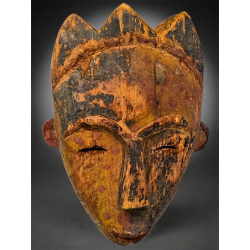
« THE MOST HOSPITABLE WOMAN OF A VILLAGE IS THE CUSTODIAN OF THIS SACRED SPOON: A MASTERPIECE OF DAN ARTISTRY. »
In Dan society, the most hospitable woman of a village is honored with the title of Wunkirle (the "most generous woman"). She is the custodian of this sacred spoon, which serves as her badge of office. During great festivals, the Wunkirle dances with this spoon, using it to symbolically distribute rice and wealth to the community, proving that her spirit is as vast as the vessel itself.
This specific piece is exceptionally rare due to the seated figure atop the handle. The woman is depicted on a European-style "prestige chair," a visual signifier of high status and successful cross-cultural trade during the colonial era. She holds her braided beard—a symbol of wisdom and elderhood—signifying that she is not merely a provider, but a judge and a matriarch.
The object is a single-block carving conceived as a vertical composition in three interlocking registers, each legible independently but constituting a unified sculptural argument when read together. The formal intelligence of the piece — the balance of mass, negative space, and figurative detail across 49 centimetres — places it firmly in the upper register of Dan feast-ladle production. The bowl (lower register) is large, deep, and oval, its interior worn to a high sheen by extended use. The outer rim carries incised geometric banding — a characteristic Dan ornamental register reading as textile or woven pattern, connecting the object to the domestic and agricultural economy it was made to celebrate. The transition from bowl to handle is anchored by a compact, frontal secondary head: closed eyes, indicated coiffure, composed expression. This secondary face is the threshold between the functional zone (the bowl) and the symbolic zone above — a guardian presence at the pivot point of the object. The handle (middle register) narrows above the secondary head into a columnar shaft, then widens into a raised platform supporting the stool and upper figure. The platform rim is incised with hatching that mirrors the bowl's geometric language, creating a visual echo between the two horizontal registers and giving the object its internal formal coherence. The figure (upper register) is a seated female on a multi-legged prestige stool. The hairstyle — fine parallel incised ridges sweeping from a central part into a pronounced rear chignon — is the standard Dan female coiffure, diagnostic for this attribution. The face is an elongated oval: high forehead, subtly modelled brow ridges, almond eyes, fine nose with indicated nostrils, lips slightly parted in composed presence. One hand engages near the face; the other rests. The figure reads as an active social agent, not a passive emblem. The stool is rendered with precision — seat platform, multiple legs, cross-members — at a scale that makes it iconographically legible as a prestige object. This is not decorative shorthand: it signals that the woman represented is a wunkirle, a Dan feast hostess of recognised social standing within her community.
The Dan Attribution -- Four Diagnostic Markers
1. Hairstyle. The most decisive single marker. The figure's hair is rendered in fine parallel incised ridges sweeping from a central part and gathered into a pronounced rear chignon. This is the canonical Dan female coiffure, found consistently across the Dan figural corpus -- masks, figurines, and feast spoons. It is not the Guro coiffure convention, which tends toward higher-relief and more architecturally independent hair elements.
2. Facial typology. The elongated oval face, high forehead, subtly modelled brow, almond eyes, and fine nose with indicated nostrils are consistent Dan facial conventions. The composed, slightly inward expression -- not the more frontal, assertive quality of Guro faces -- confirms the Dan reading.
3. Secondary face convention. The secondary face at the bowl-neck junction, compact and composed, with indicated coiffure and closed eyes, is more canonical in Dan feast spoon production than in Guro equivalents, where it appears with less regularity and in a slightly different morphological register.
4. Stool form. The multi-legged prestige stool with cross-members, rendered at precise iconographic scale, is a marker of Dan social vocabulary around the wunkirle institution. The stool type rendered here corresponds more closely to the Dan prestige stool than to Guro equivalents.
Dating -- c. 1920-1950
The dating of c. 1920-1950 (first half of the twentieth century) is supported by three convergent observations. First, the depth and character of the palm-oil patina: the near-black darkening of the bowl interior and the handle, with reddish-brown tones surviving at the less-handled surfaces, is consistent with decades of regular ritual use. Second, the overall surface biography -- handled smooth in use zones, retaining tool marks in sheltered areas -- argues against both a very recent production and an implausibly early date. Third, the Dan wunkirmian tradition was most actively produced and institutionally functional from the late nineteenth century through to the mid-twentieth, with the finest documented examples in museum collections attributable to this window. A nineteenth-century date is possible but requires physical analysis (wood sampling or thermoluminescence) to defend on the market. The 1920-1950 window is the defensible dating under current evidence.
The wunkirmian (literally 'the spoon that dances') is one of the most institutionally significant objects in Dan material culture, and one of the most celebrated in the African art canon. Understanding what it is requires understanding what it does -- and what it represents within the social fabric of the Dan community.
The institution of the Wunkirle. In Dan society, the wunkirle ('feast owner' or 'feast hostess') is a woman who has earned a social title through repeated acts of extraordinary generosity -- hosting large communal feasts, feeding the community during periods of hardship, supporting masquerade ceremonies, and maintaining the reciprocal networks of hospitality that constitute the moral economy of Dan village life. The title is not inherited; it is earned. A woman who achieves it occupies one of the highest social positions available to a Dan woman.
The ladle as emblem and instrument. The wunkirmian is both the instrument of the feast and its emblem. It is the object with which rice is scooped and served -- a practical implement -- and simultaneously the portable symbol of the hostess's title, her status, and the social capital accumulated through her generosity. The figural carving on the handle is not decoration; it is the visual statement of the woman who owns it. The seated figure on the prestige stool IS the wunkirle -- she is literally depicted on the instrument of her authority.
Ritual and ceremonial function. The wunkirmian was used at major Dan celebrations: harvest feasts, masquerade ceremonies, the reception of important visitors, the resolution of disputes. At these events, the wunkirle served food publicly with the ladle, a performative act that displayed her status and renewed her social contract with the community. The ladle was also displayed -- hung in the house, brought out at ceremonies, passed between hostesses when a title changed hands. Some examples received libations and acquired a sacred patina over their working lives.
Was this object used? Almost certainly yes. The deep, reddish-brown to near-black palm-oil patina in the bowl interior -- worn smooth by the repeated action of scooping rice -- is not achievable by artificial means at this depth and consistency. The lighter reddish tones surviving at the less-handled areas of the handle confirm that the dark zones are use-related, not applied. The surface biography is that of an object that lived an active ritual life across decades.
Overall assessment
Structurally sound and stable. No active deterioration detected. The surface is original and untouched — no restoration, no cleaning, no applied wax or varnish visible. The object presents the honest accumulated surface of an actively used ritual implement across several decades.
Bowl (lower register)
The interior of the bowl is the primary use zone and shows the deepest patina — a near-black, high-sheen palm-oil surface worn smooth by the repeated action of scooping. This interior darkening is fully original and consistent with decades of functional use. The rim of the bowl retains its incised geometric banding, legible on all visible faces. Minor surface erosion at the rim high points is consistent with handling and age. No cracks, splits, or structural losses in the bowl.
Secondary face (bowl-handle junction)
The compact secondary face at the junction of bowl and handle is structurally intact. Surface detail — coiffure indication, brow, eyes — is preserved and legible, though slightly smoothed by handling at the high points (brow ridge, nose). No losses to the face or to the surrounding junction zone.
Handle shaft (middle register)
The columnar shaft shows a deep, even reddish-brown to near-black patina consistent with long-term hand contact. The incised hatching on the platform rim is intact and legible. No cracks or splits in the shaft.
Platform and stool
The raised platform and the stool structure are intact. The stool legs and cross-members are all present and unbroken. Minor surface detail softening at the stool elements is consistent with age and the natural compression of patina over time — not damage.
Upper figure
The seated female figure is structurally complete. All primary elements are present: head, torso, arms, legs, feet. The hairstyle incisions are preserved and legible across the cranium and into the rear chignon. The face of the upper figure retains fine surface detail — brow ridges, almond eyes, indicated nostrils, parted lips — with slight softening at the highest points (brow, nose tip, cheekbones) consistent with age and handling. The arm posture is intact; both arms are present and unbroken.
Cracks and splits
Minor age-related shrinkage cracks are visible in several locations, consistent with the natural drying and contraction of tropical hardwood over decades. These are all stable, longitudinal cracks following the wood grain — not structural fractures. Specifically: a fine crack is visible along the rear of the handle shaft (visible in the back view), and minor surface crazing is present at the junction between the platform and the figure base. None of these compromise the structural integrity of the object or require intervention.
Wood and surface
The wood is dense, hard, and shows no evidence of active insect damage (no fresh boring holes, no frass, no friable zones). Historical surface texture — the tool marks preserved in sheltered areas, the compressed grain at high-contact zones — is consistent with an object of the proposed age. No areas of structural softness or delamination detected.
Summary of losses
No significant losses to the figural or ornamental programme are detected. The object is complete as carved.
Intervention history
No restoration, no fill, no repaint, no applied surface treatment is detected. The object is presented as found.
An iconic form in African art. The Dan wunkirmian is not a peripheral object type: it is one of the defining forms of West African sculptural production and is represented in the Metropolitan Museum, the British Museum, the Musee du quai Branly, and virtually every major African art collection in the world. Acquiring a working example at gallery level places the collector directly in that canon.
Exceptional carving quality. The precision of the secondary face, the stool rendering, the hairstyle incision, the incised geometric banding on bowl and platform, and the overall formal balance of the composition place this piece above the median for Dan feast-ladle production. It is the work of a master carver, not a workshop journeyman.
Authentic, untouched use patina. The deep palm-oil patina is not reproducible by artificial means at this depth and consistency. The collector receives an object with its ritual biography intact -- an increasingly rare quality as the market fills with cleaned or restored pieces.
Scale and presence. At 49 cm, this is a large and fully present example of the type. Small Dan feast spoons (under 35 cm) are more common; pieces of this scale with full figurative complexity are less frequently encountered.