


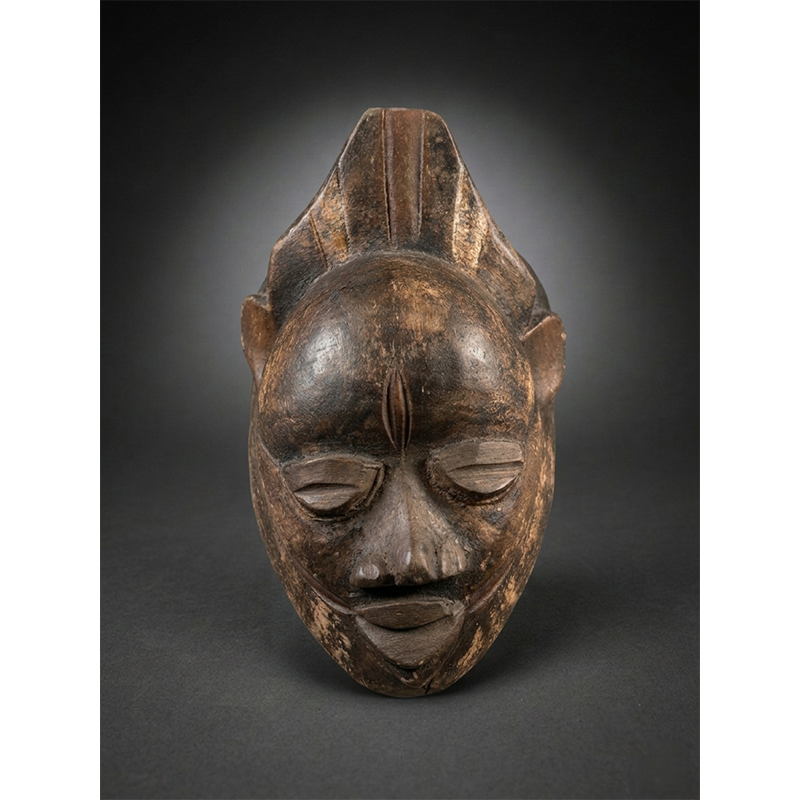


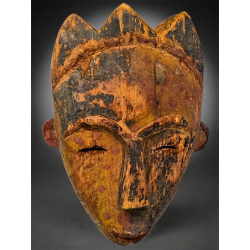
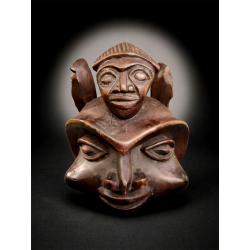
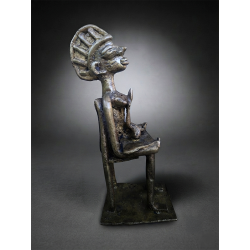
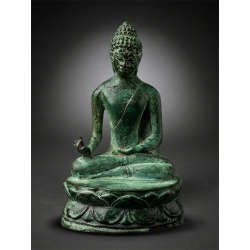
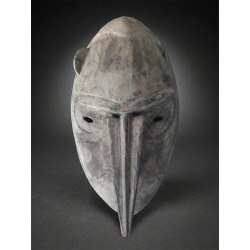
ARTIFACT: Gelede Masquerade Headpiece (Masque Gélédé) Yoruba face mask, Nigeria. Carved hardwood with hollowed back, originally worn in ceremonial dance performance.
PEOPLE: Attributed to the Yoruba. One of the largest ethnic groups in West Africa (approximately 50 million people), with one of the most celebrated and continuously documented sculptural traditions in African art. Yoruba carving has been internationally studied since the early 20th century, with major collections at the Musée du quai Branly, the Metropolitan Museum, the Smithsonian, and the British Museum.
REGION: Western Yoruba region, borderland area between Southwestern Nigeria and Eastern Benin (likely Ketu, Sabé, or Nago subgroup area).
COUNTRY: Southwestern Nigeria / Eastern Benin.
ESTIMATED PERIOD: Mid-20th century (c. 1920–1960). Dating supported by the genuine accumulated handling patina on the high points of the face (cheekbones, brow, lips), the worn-through cord-attachment holes on the interior (direct evidence of repeated wearing), the dry desiccated wood character, and the canonical Yoruba iconographic vocabulary. Specialist confirmation may refine the dating toward the earlier portion of this range.
MATERIALS: Carved tropical hardwood — most likely Iroko (Milicia excelsa) or Apa (Afzelia africana), the preferred woods of Yoruba carvers for wearable masks, selected for their durability and relative lightness. The piece is comparatively light in the hand for its size (432 g for 28 cm height), consistent with the wearability requirement of an authentic Yoruba dance mask; native pigments, organic oil/patina.
STYLE & CRAFT: Single-piece subtractive carving from a solid block, executed with adze and knife. Hollowed reverse with visible tool marks, retaining the original carved interior surface. Pierced perimeter holes (worn through from the inside) for attaching the mask to its costume. The face is composed in the canonical Yoruba serene aesthetic: heart-shaped concave face, downcast almond eyes under carved heavy lids, slender straight nose, small full pursed mouth, and crested ridged coiffure suggesting an elaborate hairstyle.
ICONOGRAPHY: Oval concave face with downcast almond eyes — the Yoruba ideal of ìfarabal (composure, inner stillness). Vertical leaf-form scarification between the brows — the documented Yoruba ila mark, used both as personal identification and as ritual scarification. Tall ridged coiffure or crest, suggesting an elaborate plaited hairstyle. Small projecting ears. Refined modeling of nose and lips conveying the Yoruba aesthetic ideal of ewà (beauty) inseparable from ìwà (character).
DIMENSIONS: Height: 28 cm · Width: 18.5 cm · Depth: 11 cm.
CONDITION: Good condition (see condition report below).
PROVENANCE: Ex-Private collection Nagar, acquired on the secondary market.
The Yoruba of southwestern Nigeria and the eastern Republic of Benin have produced one of the most refined, most prolific, and most internationally celebrated sculptural traditions in African art. From the classical Ife terracottas and bronzes of the 12th–15th centuries — among the most technically and artistically accomplished sculptures of the medieval African world — through the rich masking and figurative traditions of the 19th and 20th centuries, Yoruba art has been continuously studied, collected, and revered. Picasso owned a Yoruba ibeji twin figure; the Metropolitan Museum, the British Museum, and the Musée du quai Branly all hold important Yoruba collections; and the recent scholarly literature, from Robert Farris Thompson to Henry John Drewal, has illuminated the Yoruba aesthetic philosophy in depth.
The Yoruba produce a wide vocabulary of masks for different ritual and ceremonial contexts. Each tradition has its iconographic vocabulary, its dance context, and its specific social function:
Across these traditions, certain aesthetic principles recur. The Yoruba ideal of ìfarabal — composure, inner stillness, dignified self-possession — is expressed in the serene downcast gaze, the small composed mouth, and the symmetry of the face. The forehead is often marked with ila, the vertical scarification lines that identify lineage, community, or ritual status. The coiffure is rendered with care, reflecting the Yoruba attention to personal beauty (ewà) as an outward expression of inner character (ìwà). The present mask preserves this canonical vocabulary in a clear and recognisable form.
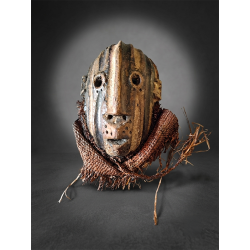
The serene oval face with downcast almond eyes establishes the meditative composure of ìfarabal. The vertical leaf-form scarification between the brows is the Yoruba ila — a documented ritual mark used both as personal identification and as an expression of ceremonial status. The carved coiffure with its ridged crest suggests an elaborate plaited hairstyle of the kind worn by Yoruba women, particularly in ceremonial contexts. The small projecting ears, the refined nose, and the full carved lips together compose a portrait of dignified beauty in the Yoruba idiom.
The present mask carries direct material evidence that it was made for use, not for sale:
The mask is offered in good condition consistent with age and authentic use — fully intact, structurally sound, and presenting a coherent, attractive surface suitable for immediate display.
Offered at a transparent price reflecting what we can confirm: correct Yoruba iconography, light appropriate wood, direct evidence of ritual use, mid-20th-century surface character, and no named European collection provenance. The buyer pays strictly for what is verifiably here.
 Security policy
Transactions protected by 256-bit SSL through 3D-Secure gateways—we never store your card details.
 Delivery policy
All items are professionally packed and shipped via premium, fully tracked carrier services.
 Return policy
If you are not entirely satisfied, you can return your acquisition within 15 days for a full refund.
Data sheet
ARTIFACT: Gelede Masquerade Headpiece (Masque Gélédé) Yoruba face mask, Nigeria. Carved hardwood with hollowed back, originally worn in ceremonial dance performance.
PEOPLE: Attributed to the Yoruba. One of the largest ethnic groups in West Africa (approximately 50 million people), with one of the most celebrated and continuously documented sculptural traditions in African art. Yoruba carving has been internationally studied since the early 20th century, with major collections at the Musée du quai Branly, the Metropolitan Museum, the Smithsonian, and the British Museum.
REGION: Western Yoruba region, borderland area between Southwestern Nigeria and Eastern Benin (likely Ketu, Sabé, or Nago subgroup area).
COUNTRY: Southwestern Nigeria / Eastern Benin.
ESTIMATED PERIOD: Mid-20th century (c. 1920–1960). Dating supported by the genuine accumulated handling patina on the high points of the face (cheekbones, brow, lips), the worn-through cord-attachment holes on the interior (direct evidence of repeated wearing), the dry desiccated wood character, and the canonical Yoruba iconographic vocabulary. Specialist confirmation may refine the dating toward the earlier portion of this range.
MATERIALS: Carved tropical hardwood — most likely Iroko (Milicia excelsa) or Apa (Afzelia africana), the preferred woods of Yoruba carvers for wearable masks, selected for their durability and relative lightness. The piece is comparatively light in the hand for its size (432 g for 28 cm height), consistent with the wearability requirement of an authentic Yoruba dance mask; native pigments, organic oil/patina.
STYLE & CRAFT: Single-piece subtractive carving from a solid block, executed with adze and knife. Hollowed reverse with visible tool marks, retaining the original carved interior surface. Pierced perimeter holes (worn through from the inside) for attaching the mask to its costume. The face is composed in the canonical Yoruba serene aesthetic: heart-shaped concave face, downcast almond eyes under carved heavy lids, slender straight nose, small full pursed mouth, and crested ridged coiffure suggesting an elaborate hairstyle.
ICONOGRAPHY: Oval concave face with downcast almond eyes — the Yoruba ideal of ìfarabal (composure, inner stillness). Vertical leaf-form scarification between the brows — the documented Yoruba ila mark, used both as personal identification and as ritual scarification. Tall ridged coiffure or crest, suggesting an elaborate plaited hairstyle. Small projecting ears. Refined modeling of nose and lips conveying the Yoruba aesthetic ideal of ewà (beauty) inseparable from ìwà (character).
DIMENSIONS: Height: 28 cm · Width: 18.5 cm · Depth: 11 cm.
CONDITION: Good condition (see condition report below).
PROVENANCE: Ex-Private collection Nagar, acquired on the secondary market.
The Yoruba of southwestern Nigeria and the eastern Republic of Benin have produced one of the most refined, most prolific, and most internationally celebrated sculptural traditions in African art. From the classical Ife terracottas and bronzes of the 12th–15th centuries — among the most technically and artistically accomplished sculptures of the medieval African world — through the rich masking and figurative traditions of the 19th and 20th centuries, Yoruba art has been continuously studied, collected, and revered. Picasso owned a Yoruba ibeji twin figure; the Metropolitan Museum, the British Museum, and the Musée du quai Branly all hold important Yoruba collections; and the recent scholarly literature, from Robert Farris Thompson to Henry John Drewal, has illuminated the Yoruba aesthetic philosophy in depth.
The Yoruba produce a wide vocabulary of masks for different ritual and ceremonial contexts. Each tradition has its iconographic vocabulary, its dance context, and its specific social function:
Across these traditions, certain aesthetic principles recur. The Yoruba ideal of ìfarabal — composure, inner stillness, dignified self-possession — is expressed in the serene downcast gaze, the small composed mouth, and the symmetry of the face. The forehead is often marked with ila, the vertical scarification lines that identify lineage, community, or ritual status. The coiffure is rendered with care, reflecting the Yoruba attention to personal beauty (ewà) as an outward expression of inner character (ìwà). The present mask preserves this canonical vocabulary in a clear and recognisable form.
The serene oval face with downcast almond eyes establishes the meditative composure of ìfarabal. The vertical leaf-form scarification between the brows is the Yoruba ila — a documented ritual mark used both as personal identification and as an expression of ceremonial status. The carved coiffure with its ridged crest suggests an elaborate plaited hairstyle of the kind worn by Yoruba women, particularly in ceremonial contexts. The small projecting ears, the refined nose, and the full carved lips together compose a portrait of dignified beauty in the Yoruba idiom.
The present mask carries direct material evidence that it was made for use, not for sale:
The mask is offered in good condition consistent with age and authentic use — fully intact, structurally sound, and presenting a coherent, attractive surface suitable for immediate display.
Offered at a transparent price reflecting what we can confirm: correct Yoruba iconography, light appropriate wood, direct evidence of ritual use, mid-20th-century surface character, and no named European collection provenance. The buyer pays strictly for what is verifiably here.