


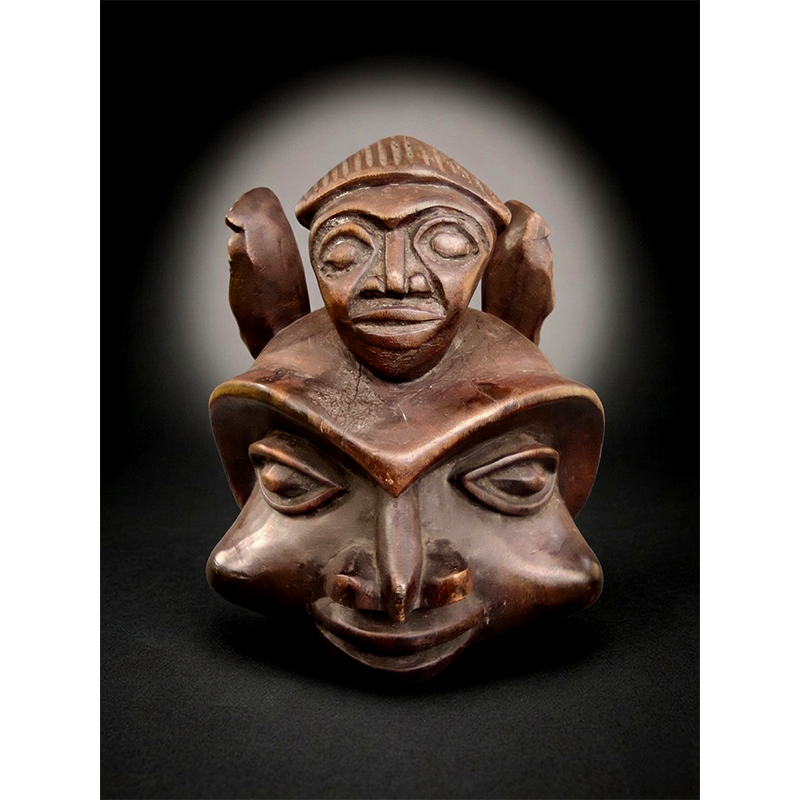


"A Royal Helmet of the Grassfields. The initiate seen from every angle at once, the omniscience of royal authority made visible in carved wood."
In the chiefdom societies of the Cameroon Grassfields, masks of the multi-face typology belong to a circuit of ritual occasions clustered around the figure of the fon — the sacred chief — and the regulatory secret societies that frame his authority. The principal documented contexts are royal funerary masquerade, the installation of a new fon, and the seasonal danced appearances of the regulatory societies (Kuosi, Kungang, Manjong and others, depending on the kingdom). In each of these contexts the masked dancer does not represent his own self: he carries, for the duration of the dance, a persona of authority — chief, ancestor, or judge — and the iconography of the mask declares which.
The four cardinal faces are the visible mark of the all-seeing chief. In the political theology of the Grassfields chiefdoms, the fon's office requires that nothing within his territory escape his notice — including the witchcraft (famla in Bamileke idiom) that threatens the lineage and the kingdom. The multi-face helmet makes this claim literal. To wear it is to be unable to be approached from behind, because there is no behind — only further fronts.
Each face wears the same incised cap. The vertical striations represent the cloth or basketry headgear of a person of rank — chief, notable, or initiate of a regulatory society. By giving all four cardinal faces the same cap, the carver asserts that they are not four different beings.
The Cameroon Grassfields — known in French scholarship as the Grasslands or Hauts Plateaux de l'Ouest — form an elevated savannah zone of the western Cameroonian highlands inhabited by a constellation of related peoples: Bamileke, Bangwa, Bamum, Tikar and others, today numbering some eight million. The region is structured politically into chiefdoms — fondoms — each ruled by a sacred chief (fon) advised by a hierarchy of notables and regulated by a network of secret societies. This political form, more centralised than the segmentary lineage systems of the equatorial forest to the south, generates an art of royal display: large carved doorposts, beaded thrones and stools, elephant masks of the Kuosi society, and the multi-face helmets to which the present work belongs.
Among the Bamileke, the chief's compound is the spatial centre of ritual and political life. Within it, the regulatory societies — Kuosi for prestige and royal celebration, Kungang for anti-witchcraft action, Manjong for warrior organisation — hold their dances and judgements. The Bangwa, on the wooded western escarpment of the same highlands, maintain a stylistically continuous tradition with their Bamileke neighbours, with whom they share major iconographic types including ancestral effigies and the multi-face helmet. The attribution of a given work between Bamileke proper and Bangwa is sometimes possible only on close stylistic grounds — and in many cases is left, as here, at the regional level.
The Grassfields entered the European collecting record in the German colonial period (Kamerun, 1884–1916), through Hutter, Conrau and the Berlin ethnographic mission. After 1945 the corpus was rebuilt scholarly by Pierre Harter, whose Arts Anciens du Cameroun (1986) remains the foundational reference work. Subsequent contributions by Tamara Northern (The Sign of the Leopard, 1975), Hans-Joachim Koloss, and the exhibitions Cameroon, Art and Kings (Zurich 2008) and African Master (Brussels, de Grunne) have placed the royal art of the Grassfields among the most consistently valued African corpora on the international market.
The work reads stylistically as Cameroon Grassfields and falls within the Bamileke / Bangwa multi-face helmet tradition. Several features support this attribution: the rounded, projecting face planes (not the heart-shaped concave plane of Fang Ngontang); the modulated, separately carved brow and nose volumes (not a continuous T-bar ridge); the full, fleshy lips with defined corners; the carved upper and lower eyelids describing full almond-shaped eyes; the cubic, fleshy mass; and the applied red-brown camwood and earth pigment patina characteristic of the Grassfields royal corpus.
The patina is even and well-developed but does not show the deeply layered, smoke-darkened accretion of pre-1900 ceremonial use. In the absence of laboratory dating and without a written collection history with date markers, the Shyu house policy is to date the work to the mid-twentieth century (c. 1940–1970), with explicit acknowledgement that an earlier dating — first quarter of the twentieth century, contemporary with the late German and early French colonial periods — is possible and would require expert authentication to substantiate.
We name only what the work itself supports. The attribution to the Cameroon Grassfields and to the Bamileke / Bangwa multi-face helmet typology is stated with confidence on stylistic grounds. The choice between Bamileke proper and Bangwa is left open at the regional level — the two traditions are stylistically continuous and a finer attribution would require expert consultation. An alternative attribution to a Fang Ngontang quadrifrons helmet from northern Gabon has been considered and is recorded here for transparency, since the multi-face helmet typology is famously documented in the Ngontang literature; however, the face geometry, brow-nose modelling, eye treatment, lip definition and surface pigment all read more strongly as Grassfields than as Fang. Should a specialist of the Grassfields corpus — for example the network around Bernard de Grunne, Didier Claes or Jean-Pierre Jernander in Brussels — confirm an earlier dating or a more specific workshop or fondom attribution, the gallery valuation will be revised upward accordingly.
The multi-faced helmet sits at the demanding end of the Grassfields royal corpus. Single-face ancestor masks and prestige objects are widely available; quadrifrons helmets are comparatively rare, and those carrying a crowning fifth face are rarer still. Acquiring this piece is acquiring the conceptually most articulated form of the Grassfields multi-face programme.
The red-brown camwood-and-earth patina, more saturated at the principal face and slightly worn at the high points of the secondary faces, is the visible record of a danced object — not the even matt finish of a recent decorative production. The interior carries the long-handling polish that no recent workshop replicates.
At 22 × 23 × 22 cm, the helmet is large enough to anchor a display — to be a centerpiece rather than a sideshow — yet small enough for a private interior. Multi-faced helmets often run larger and become difficult to live with; the present scale is the right one for a collector's interior.
The Grassfields royal art has been progressively assembled and documented by Pierre Harter (1986), Tamara Northern (1975), Hans-Joachim Koloss and the great Zurich and Brussels exhibitions of the past two decades. A Grassfields multi-face helmet joins a corpus that is rigorously studied, regularly exhibited, and supported by a deep collector base in Europe and North America.
 Security policy
Transactions protected by 256-bit SSL through 3D-Secure gateways—we never store your card details.
 Delivery policy
All items are professionally packed and shipped via premium, fully tracked carrier services.
 Return policy
If you are not entirely satisfied, you can return your acquisition within 15 days for a full refund.
Data sheet
"A Royal Helmet of the Grassfields. The initiate seen from every angle at once, the omniscience of royal authority made visible in carved wood."
In the chiefdom societies of the Cameroon Grassfields, masks of the multi-face typology belong to a circuit of ritual occasions clustered around the figure of the fon — the sacred chief — and the regulatory secret societies that frame his authority. The principal documented contexts are royal funerary masquerade, the installation of a new fon, and the seasonal danced appearances of the regulatory societies (Kuosi, Kungang, Manjong and others, depending on the kingdom). In each of these contexts the masked dancer does not represent his own self: he carries, for the duration of the dance, a persona of authority — chief, ancestor, or judge — and the iconography of the mask declares which.
The four cardinal faces are the visible mark of the all-seeing chief. In the political theology of the Grassfields chiefdoms, the fon's office requires that nothing within his territory escape his notice — including the witchcraft (famla in Bamileke idiom) that threatens the lineage and the kingdom. The multi-face helmet makes this claim literal. To wear it is to be unable to be approached from behind, because there is no behind — only further fronts.
Each face wears the same incised cap. The vertical striations represent the cloth or basketry headgear of a person of rank — chief, notable, or initiate of a regulatory society. By giving all four cardinal faces the same cap, the carver asserts that they are not four different beings.
The Cameroon Grassfields — known in French scholarship as the Grasslands or Hauts Plateaux de l'Ouest — form an elevated savannah zone of the western Cameroonian highlands inhabited by a constellation of related peoples: Bamileke, Bangwa, Bamum, Tikar and others, today numbering some eight million. The region is structured politically into chiefdoms — fondoms — each ruled by a sacred chief (fon) advised by a hierarchy of notables and regulated by a network of secret societies. This political form, more centralised than the segmentary lineage systems of the equatorial forest to the south, generates an art of royal display: large carved doorposts, beaded thrones and stools, elephant masks of the Kuosi society, and the multi-face helmets to which the present work belongs.
Among the Bamileke, the chief's compound is the spatial centre of ritual and political life. Within it, the regulatory societies — Kuosi for prestige and royal celebration, Kungang for anti-witchcraft action, Manjong for warrior organisation — hold their dances and judgements. The Bangwa, on the wooded western escarpment of the same highlands, maintain a stylistically continuous tradition with their Bamileke neighbours, with whom they share major iconographic types including ancestral effigies and the multi-face helmet. The attribution of a given work between Bamileke proper and Bangwa is sometimes possible only on close stylistic grounds — and in many cases is left, as here, at the regional level.
The Grassfields entered the European collecting record in the German colonial period (Kamerun, 1884–1916), through Hutter, Conrau and the Berlin ethnographic mission. After 1945 the corpus was rebuilt scholarly by Pierre Harter, whose Arts Anciens du Cameroun (1986) remains the foundational reference work. Subsequent contributions by Tamara Northern (The Sign of the Leopard, 1975), Hans-Joachim Koloss, and the exhibitions Cameroon, Art and Kings (Zurich 2008) and African Master (Brussels, de Grunne) have placed the royal art of the Grassfields among the most consistently valued African corpora on the international market.
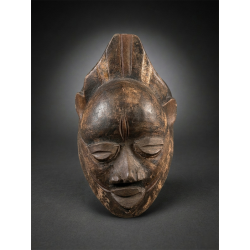
The work reads stylistically as Cameroon Grassfields and falls within the Bamileke / Bangwa multi-face helmet tradition. Several features support this attribution: the rounded, projecting face planes (not the heart-shaped concave plane of Fang Ngontang); the modulated, separately carved brow and nose volumes (not a continuous T-bar ridge); the full, fleshy lips with defined corners; the carved upper and lower eyelids describing full almond-shaped eyes; the cubic, fleshy mass; and the applied red-brown camwood and earth pigment patina characteristic of the Grassfields royal corpus.
The patina is even and well-developed but does not show the deeply layered, smoke-darkened accretion of pre-1900 ceremonial use. In the absence of laboratory dating and without a written collection history with date markers, the Shyu house policy is to date the work to the mid-twentieth century (c. 1940–1970), with explicit acknowledgement that an earlier dating — first quarter of the twentieth century, contemporary with the late German and early French colonial periods — is possible and would require expert authentication to substantiate.
We name only what the work itself supports. The attribution to the Cameroon Grassfields and to the Bamileke / Bangwa multi-face helmet typology is stated with confidence on stylistic grounds. The choice between Bamileke proper and Bangwa is left open at the regional level — the two traditions are stylistically continuous and a finer attribution would require expert consultation. An alternative attribution to a Fang Ngontang quadrifrons helmet from northern Gabon has been considered and is recorded here for transparency, since the multi-face helmet typology is famously documented in the Ngontang literature; however, the face geometry, brow-nose modelling, eye treatment, lip definition and surface pigment all read more strongly as Grassfields than as Fang. Should a specialist of the Grassfields corpus — for example the network around Bernard de Grunne, Didier Claes or Jean-Pierre Jernander in Brussels — confirm an earlier dating or a more specific workshop or fondom attribution, the gallery valuation will be revised upward accordingly.
The multi-faced helmet sits at the demanding end of the Grassfields royal corpus. Single-face ancestor masks and prestige objects are widely available; quadrifrons helmets are comparatively rare, and those carrying a crowning fifth face are rarer still. Acquiring this piece is acquiring the conceptually most articulated form of the Grassfields multi-face programme.
The red-brown camwood-and-earth patina, more saturated at the principal face and slightly worn at the high points of the secondary faces, is the visible record of a danced object — not the even matt finish of a recent decorative production. The interior carries the long-handling polish that no recent workshop replicates.
At 22 × 23 × 22 cm, the helmet is large enough to anchor a display — to be a centerpiece rather than a sideshow — yet small enough for a private interior. Multi-faced helmets often run larger and become difficult to live with; the present scale is the right one for a collector's interior.
The Grassfields royal art has been progressively assembled and documented by Pierre Harter (1986), Tamara Northern (1975), Hans-Joachim Koloss and the great Zurich and Brussels exhibitions of the past two decades. A Grassfields multi-face helmet joins a corpus that is rigorously studied, regularly exhibited, and supported by a deep collector base in Europe and North America.