




"In the language of the Ogooué forest peoples, the mask is not a representation – it is a presence. The spirit takes the wood as its body, and the dancer becomes the bridge between the visible and invisible worlds."
In the connoisseurship of African masks, no single feature is more diagnostic than the interior. The external face – carved, painted, displayed to the world – can be replicated by any skilled workshop. The interior – never seen by the audience, never intended to be admired – is where the mask's true history is recorded. A genuine danced mask develops, over years and sometimes decades of use, an interior surface that no recent carving can replicate: a soft polish at the points of contact with the dancer's forehead, cheeks and chin; a darkening of the wood by skin oils, sweat and ritual unguents; a softening and rounding of the original adze marks; and characteristic wear at the holes or slots where the costume and head-strap were attached.
Taken together, these features support an attribution to the mid-20th century – c. 1940–1960 – and indicate a mask that was carved for use rather than for the export market, although we acknowledge that without metallurgical/dendrochronological analysis or documented field-collection history, definitive dating of African wooden sculpture remains intrinsically difficult.
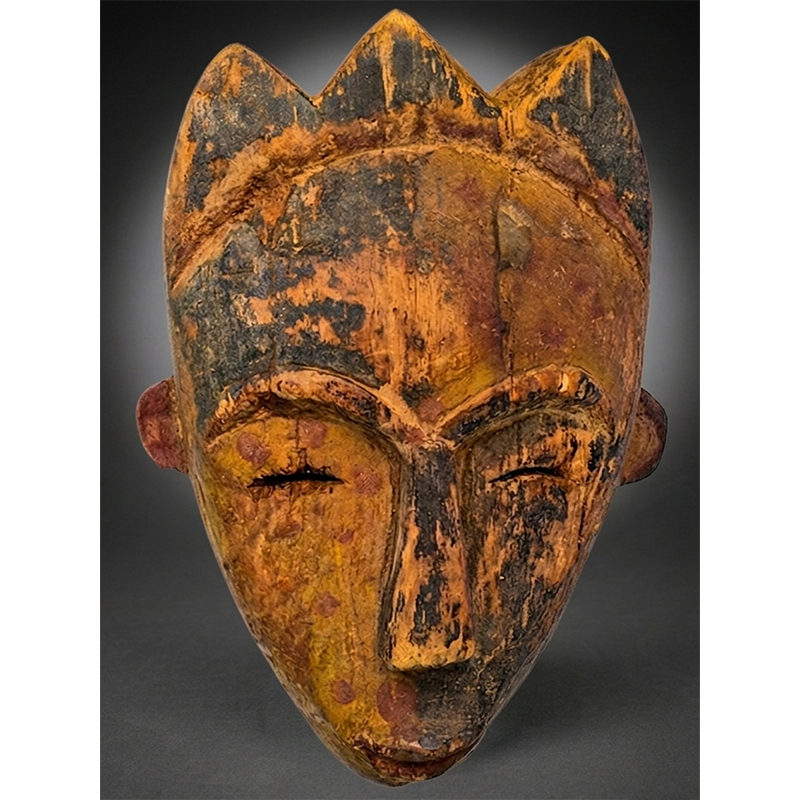
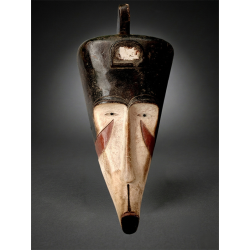
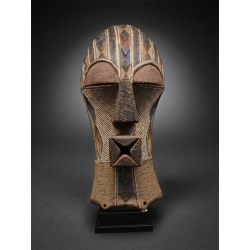
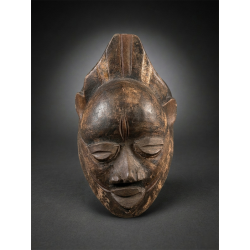
The face masks of southern and central Gabon are among the most internationally celebrated of all African sculptural traditions. Their distinctive aesthetic – the serene heart-shaped face, the closed slit eyes that seem to look inward rather than out, the smooth high forehead, the small precisely modelled mouth – has been recognised by Western artists and connoisseurs since the early 20th century. Picasso, Modigliani and Brâncuși all studied these forms; their influence is woven into the genealogy of European modernism. The present mask belongs unambiguously to this canon. The face is conceived as a perfect heart-shape, the cheeks falling away in soft concave planes from a central vertical ridge that constitutes the nose; the eyes are reduced to elegant horizontal slits, suggesting the closed gaze of trance, of dream, of communion with the ancestral world. The forehead rises high and pure, surmounted by a multi-peaked crested coiffure rendered in deep blue-black. The lower face is bathed in a warm yellow ochre, and small touches of red-pink mark the lips and certain accents – the colour vocabulary of the Ogooué spirit world.
Masks of this type were danced in the public ceremonies of the okuyi or mukudji societies (in Punu contexts) or the parallel ritual societies of the Tsogho. The dancer – always a man, even when the mask represents a feminine spirit – was elevated above the ground on tall stilts, his body veiled in a fibre costume, only the carved face emerging into the world of the living. The masked figure represented a beautiful young woman returning from the realm of the dead, embodying the continuity between the ancestors and the living. The performance combined acrobatic virtuosity – stilt-dancing of extraordinary skill – with sober ritual purpose: the purification of the village, the celebration of important social occasions, the renewal of relations with the ancestral world.
The mask is carved from a light-density tropical wood, almost certainly Alstonia congensis (local names ebo or nkulungu) – the preferred medium of Gabonese mask-makers for its lightness (essential for stilt-dancing), its fine grain that takes detail well, and its receptivity to applied pigment. The polychrome was applied directly to the prepared wood surface using locally obtained pigments: yellow from ochre earths or, in some cases, the pulverised wood of the padouk tree; blue-black from charcoal mixed with kaolin, or in some cases imported indigo from the trade networks of the colonial period; red-pink from tukula (camwood) powder, the substance of beauty and ritual significance throughout central Africa. The pigments are today partially eroded, integrating into the wood surface in the manner of a true painted mask that has lived its life rather than a recent decorative carving.
The mask is offered in good ethnographic condition – fully intact, structurally sound, and displaying the marks of a working ceremonial object rather than the unblemished surface of a recent carving.
The polychrome decoration shows naturally integrated wear – partial fading and erosion, areas of exposed wood where contact has worn the pigment through, and a soft fading of the original colour intensity that is characteristic of mid-20th-century painted masks. The pigment is impregnated into the wood rather than sitting on top of it, indicating that the colour is not a recent application. The interplay of yellow, blue-black and red-pink across the worn surface produces the kind of atmospheric, layered visual richness that collectors specifically seek.
AESTHETIC PEDIGREE : The Punu-Tsogho heart-shaped mask is one of the most internationally celebrated forms in all of African sculpture, admired by major artists and collectors since the early 20th century. Its serene, contemplative beauty crosses cultures effortlessly.
AUTHENTIC USE : The interior wear and integrated polychrome erosion provide credible evidence of authentic ceremonial use rather than recent decorative production – a meaningful distinction in a market increasingly crowded with workshop carvings made for export.
POLYCHROME RARITY : Whereas classical Punu okuyi masks are kaolin-white, the present polychrome example offers the rarer chromatic vocabulary associated with the Mukudji dance and with central Gabonese (Tsogho) practice – a less common form on the international market.
SCALE : At 30 cm in height, the mask occupies an ideal collector's scale – substantial enough to command a wall or pedestal as a major piece, intimate enough to live comfortably in a domestic interior.
INVESTMENT PROFILE : Gabonese masks have been one of the most consistently appreciating categories in African tribal art over the past two decades, with classical Punu/Tsogho examples regularly setting auction records. Mid-range, honestly attributed pieces in the €1,000–€3,000 segment have shown steady demand from a broad collector base.
HONEST PRICING : This piece is offered at a transparent, defensible price reflecting what we can and cannot confirm about its history. The buyer pays for what is here, with no inflation of uncertain claims – an approach that builds long-term confidence in the gallery and in the piece itself.
 Security policy
Transactions protected by 256-bit SSL through 3D-Secure gateways—we never store your card details.
 Delivery policy
All items are professionally packed and shipped via premium, fully tracked carrier services.
 Return policy
If you are not entirely satisfied, you can return your acquisition within 15 days for a full refund.
Data sheet
"In the language of the Ogooué forest peoples, the mask is not a representation – it is a presence. The spirit takes the wood as its body, and the dancer becomes the bridge between the visible and invisible worlds."
In the connoisseurship of African masks, no single feature is more diagnostic than the interior. The external face – carved, painted, displayed to the world – can be replicated by any skilled workshop. The interior – never seen by the audience, never intended to be admired – is where the mask's true history is recorded. A genuine danced mask develops, over years and sometimes decades of use, an interior surface that no recent carving can replicate: a soft polish at the points of contact with the dancer's forehead, cheeks and chin; a darkening of the wood by skin oils, sweat and ritual unguents; a softening and rounding of the original adze marks; and characteristic wear at the holes or slots where the costume and head-strap were attached.
Taken together, these features support an attribution to the mid-20th century – c. 1940–1960 – and indicate a mask that was carved for use rather than for the export market, although we acknowledge that without metallurgical/dendrochronological analysis or documented field-collection history, definitive dating of African wooden sculpture remains intrinsically difficult.
The face masks of southern and central Gabon are among the most internationally celebrated of all African sculptural traditions. Their distinctive aesthetic – the serene heart-shaped face, the closed slit eyes that seem to look inward rather than out, the smooth high forehead, the small precisely modelled mouth – has been recognised by Western artists and connoisseurs since the early 20th century. Picasso, Modigliani and Brâncuși all studied these forms; their influence is woven into the genealogy of European modernism. The present mask belongs unambiguously to this canon. The face is conceived as a perfect heart-shape, the cheeks falling away in soft concave planes from a central vertical ridge that constitutes the nose; the eyes are reduced to elegant horizontal slits, suggesting the closed gaze of trance, of dream, of communion with the ancestral world. The forehead rises high and pure, surmounted by a multi-peaked crested coiffure rendered in deep blue-black. The lower face is bathed in a warm yellow ochre, and small touches of red-pink mark the lips and certain accents – the colour vocabulary of the Ogooué spirit world.
Masks of this type were danced in the public ceremonies of the okuyi or mukudji societies (in Punu contexts) or the parallel ritual societies of the Tsogho. The dancer – always a man, even when the mask represents a feminine spirit – was elevated above the ground on tall stilts, his body veiled in a fibre costume, only the carved face emerging into the world of the living. The masked figure represented a beautiful young woman returning from the realm of the dead, embodying the continuity between the ancestors and the living. The performance combined acrobatic virtuosity – stilt-dancing of extraordinary skill – with sober ritual purpose: the purification of the village, the celebration of important social occasions, the renewal of relations with the ancestral world.
The mask is carved from a light-density tropical wood, almost certainly Alstonia congensis (local names ebo or nkulungu) – the preferred medium of Gabonese mask-makers for its lightness (essential for stilt-dancing), its fine grain that takes detail well, and its receptivity to applied pigment. The polychrome was applied directly to the prepared wood surface using locally obtained pigments: yellow from ochre earths or, in some cases, the pulverised wood of the padouk tree; blue-black from charcoal mixed with kaolin, or in some cases imported indigo from the trade networks of the colonial period; red-pink from tukula (camwood) powder, the substance of beauty and ritual significance throughout central Africa. The pigments are today partially eroded, integrating into the wood surface in the manner of a true painted mask that has lived its life rather than a recent decorative carving.
The mask is offered in good ethnographic condition – fully intact, structurally sound, and displaying the marks of a working ceremonial object rather than the unblemished surface of a recent carving.
The polychrome decoration shows naturally integrated wear – partial fading and erosion, areas of exposed wood where contact has worn the pigment through, and a soft fading of the original colour intensity that is characteristic of mid-20th-century painted masks. The pigment is impregnated into the wood rather than sitting on top of it, indicating that the colour is not a recent application. The interplay of yellow, blue-black and red-pink across the worn surface produces the kind of atmospheric, layered visual richness that collectors specifically seek.
AESTHETIC PEDIGREE : The Punu-Tsogho heart-shaped mask is one of the most internationally celebrated forms in all of African sculpture, admired by major artists and collectors since the early 20th century. Its serene, contemplative beauty crosses cultures effortlessly.
AUTHENTIC USE : The interior wear and integrated polychrome erosion provide credible evidence of authentic ceremonial use rather than recent decorative production – a meaningful distinction in a market increasingly crowded with workshop carvings made for export.
POLYCHROME RARITY : Whereas classical Punu okuyi masks are kaolin-white, the present polychrome example offers the rarer chromatic vocabulary associated with the Mukudji dance and with central Gabonese (Tsogho) practice – a less common form on the international market.
SCALE : At 30 cm in height, the mask occupies an ideal collector's scale – substantial enough to command a wall or pedestal as a major piece, intimate enough to live comfortably in a domestic interior.
INVESTMENT PROFILE : Gabonese masks have been one of the most consistently appreciating categories in African tribal art over the past two decades, with classical Punu/Tsogho examples regularly setting auction records. Mid-range, honestly attributed pieces in the €1,000–€3,000 segment have shown steady demand from a broad collector base.
HONEST PRICING : This piece is offered at a transparent, defensible price reflecting what we can and cannot confirm about its history. The buyer pays for what is here, with no inflation of uncertain claims – an approach that builds long-term confidence in the gallery and in the piece itself.