




« AN EMPOWERED CADAVER PLANTED IN THE EARTH TO INTERCEPT MISFORTUNE — ONE OF THE MOST PHILOSOPHICALLY CHARGED OBJECTS IN ALL OF WEST AFRICAN ART, NOW IN ITS RARE AND DRAMATIC STAFF FORM. »
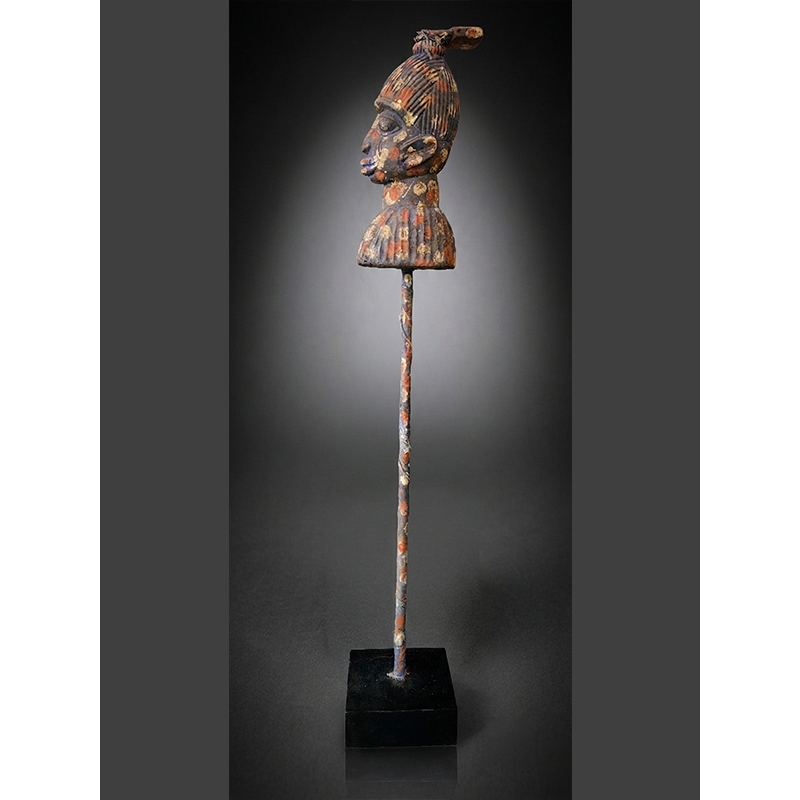
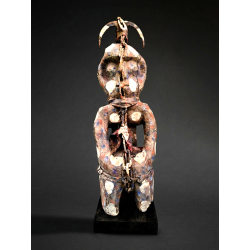
A tall composite power staff of 64 cm total height, composed of two principal elements: a carved hardwood figural head of approximately 12–14 cm functioning as the finial, and a long iron shaft/stake of approximately 50 cm, twisted in its lower third and terminating in a pointed tip designed to be driven into the ground. The object is presented on a modern black display stand (not original) which raises it to display height. The figural head is the heart of the object: a powerful carved bust presenting a broad, rounded face with strongly modelled brow ridges, large almond-shaped eyes set under prominent supraorbital arches, a broad nose with flared nostrils, and a wide mouth with slightly parted lips — the expression is one of intense, watchful concentration, characteristic of what Harvard art historian Suzanne Preston Blier has described as the bocio's 'aesthetic of raw energy.' The coiffure is rendered as parallel ribbed ridges swept upward and back, surmounted by a flat disc or platform from which a horizontal iron pin or rod passes through the skull from side to side — a critical empowerment element (see section below). The neck expands into a ribbed collar or ruff, also with parallel incised ridges consistent with scarification or necklace representation. Below the collar the figure reduces to a waisted shoulder form transitioning to the iron shaft. The entire surface of the head and upper body carries a dramatic layered polychrome: indigo-blue as the dominant ground colour, overlaid with passages of iron-oxide red-orange concentrated in the coiffure ridges, eyes, and collar register, with kaolin white applied as discrete spots and dashes across the face and shoulders, and carbon black accenting the incised lines. This polychrome is not decorative — each colour is a cosmological signal in Fon Vodun practice. The iron shaft below shows remnants of the same pigment scheme where it emerges from the neck, fading to bare oxidised iron toward the pointed tip.
The horizontal iron pin driven through the skull is the most diagnostically important element of this object. In Fon bocio practice, iron insertions — pins, nails, blades, hooks — are not decorations but records of ritual activation. Each insertion represents a specific intervention by the bokonon (diviner) or vodun priest who empowered the object: a desire stated, a danger named, a force commanded. The parallel with the iron nail of the Kongo nkondi is direct but independent — both traditions developed the same logic of materialised intention in iron. The iron shaft itself is equally significant: the bocio staff-form is specifically designed to be planted — driven into the earth at the boundary of a path, a field, or a family compound. Bocio are strategically situated along paths, roadways, agricultural fields, and near family compounds, or placed inside homes and shrines. The pointed iron tip is not a weapon but a planting tool — the act of driving the staff into the ground is the act of deployment, of setting the empowered cadaver to its watch. The twisted iron shaft (visible in the full-view image) suggests this particular object was hammered and re-seated multiple times, consistent with repeated active use at a boundary post.
The indigo-blue ground is the colour most directly associated in Fon Vodun cosmology with the night world, the liminal zone between the living and the dead, and the activated state of a bocio. It signals that the figure has crossed from the mundane to the empowered. Iron-oxide red, concentrated in the ridges of the coiffure, is the colour of sacrificial activation — blood, palm oil, and iron-rich earth are the primary libation substances applied to bocio during charging ceremonies. Kaolin white spots replicate the dotted pattern of spiritual calling — white clay (mpemba in Kongo; a parallel substance in Fon practice) marks the boundary between this world and the ancestral realm. The overall polychrome is consistent with documented bocio examples at the Metropolitan Museum, the Michael C. Carlos Museum, and in Susan Preston Blier's fieldwork documentation from Abomey.
The Fon are the dominant ethnic group of the Republic of Benin (formerly the Kingdom of Dahomey), constituting approximately 40% of the population and the founding people of the Dahomey kingdom, which rose to regional power in the 17th century and lasted until French colonial conquest in 1894. The Fon are among the most important practitioners of Vodun — the West African religious tradition from which Haitian Voodoo and related New World practices descend. The bocio (boci in Fon orthography, also rendered bocio, bochio, botchio) is literally 'empowered cadaver' — from bo (empowered) and ci (cadaver). As the MetMuseum catalogue states, bocio 'served as a protective device, ensuring its owner's health and well-being, and safeguarding against potential harm. Ending in a pointed stake, it was hammered into the ground.' The Yale University Art Gallery's bocio documentation adds: 'Vodun sculptures not only protect humans but also empower them. Cords and binding are prominent features of bocios and possibly are references to the trauma resulting from violence suffered in the slave trade.' The bocio served as a decoy or surrogate — drawing harmful forces (witchcraft, enemies' sorcery, disease spirits) away from living persons and absorbing them into the empowered figure instead. The staff form of bocio is specifically deployed in exterior protective contexts: planted at the entrance to a compound, at a crossroads, along a field boundary, or beside a road. The figure stands guard at the threshold — the most vulnerable point in traditional Fon spatial cosmology, where the inside (protected) meets the outside (dangerous). Its polychrome and iron elements mark it as charged and active to any approaching force, human or spiritual.
The attribution to the early–mid 20th century (c. 1900–1950) rests on: (a) the multi-layer polychrome showing age-appropriate wear and integration, with the indigo-blue ground abraded to a consistent weathered tone rather than the vivid blue of fresh application; (b) the iron shaft shows stable, uniform oxidation throughout its length consistent with 60–100 years of environmental exposure; (c) the iron pin through the skull shows equivalent corrosion integration; (d) the carved wood head displays stable, settled patina with no fresh or mechanically applied areas; (e) the style and carving quality — the powerful modelling, the ribbed coiffure, the ribbed collar — are consistent with the documented bocio tradition of the Abomey plateau in its active prewar–postwar production period. A 19th-century dating is possible for the form but cannot be confirmed without radiocarbon analysis or documented field-collection history. The Dorotheum sale of a comparable Fon bocio (29.5 cm, Agonly style, early 20th century, ex Jacques Kerchache collection) in 2017 at €1,750 establishes a benchmark for dated comparable examples.
There is a category of African art that Western modernity has struggled to accommodate: objects that are not beautiful in any conventional sense, that are designed to be unbeautiful, that deploy ugliness, rawness, and material disorder as strategic tools. The bocio is the Fon answer to a question that every culture asks: how do you fight invisible harm? You build a decoy. You build something so charged, so bristling with iron and pigment and sacrificial matter, that the harmful force loses interest in you and fixates on your surrogate. This staff was planted — driven into the earth at a threshold. For years, possibly decades, it stood at that boundary, absorbing whatever came. The indigo paint weathered. The iron pin in the skull rusted into the wood. The shaft twisted slightly from being hammered and re-seated. These are not signs of deterioration; they are the biography of an object that was working. A bocio that looks pristine was never deployed. This one was.
For the collector, the staff bocio is the rare form. The freestanding figure bocio is the type most commonly encountered in European private and institutional collections. The staff form — iron-shafted, designed for planting, with a pointed deployment tip — is more specifically functional and consequently less frequently preserved intact. At 64 cm, with the iron horizontal pin element and the full polychrome scheme still legible, this is a complete working example of one of Vodun's most viscerally charged object types.
 Security policy
Transactions protected by 256-bit SSL through 3D-Secure gateways—we never store your card details.
 Delivery policy
All items are professionally packed and shipped via premium, fully tracked carrier services.
 Return policy
If you are not entirely satisfied, you can return your acquisition within 15 days for a full refund.
Data sheet
« AN EMPOWERED CADAVER PLANTED IN THE EARTH TO INTERCEPT MISFORTUNE — ONE OF THE MOST PHILOSOPHICALLY CHARGED OBJECTS IN ALL OF WEST AFRICAN ART, NOW IN ITS RARE AND DRAMATIC STAFF FORM. »
A tall composite power staff of 64 cm total height, composed of two principal elements: a carved hardwood figural head of approximately 12–14 cm functioning as the finial, and a long iron shaft/stake of approximately 50 cm, twisted in its lower third and terminating in a pointed tip designed to be driven into the ground. The object is presented on a modern black display stand (not original) which raises it to display height. The figural head is the heart of the object: a powerful carved bust presenting a broad, rounded face with strongly modelled brow ridges, large almond-shaped eyes set under prominent supraorbital arches, a broad nose with flared nostrils, and a wide mouth with slightly parted lips — the expression is one of intense, watchful concentration, characteristic of what Harvard art historian Suzanne Preston Blier has described as the bocio's 'aesthetic of raw energy.' The coiffure is rendered as parallel ribbed ridges swept upward and back, surmounted by a flat disc or platform from which a horizontal iron pin or rod passes through the skull from side to side — a critical empowerment element (see section below). The neck expands into a ribbed collar or ruff, also with parallel incised ridges consistent with scarification or necklace representation. Below the collar the figure reduces to a waisted shoulder form transitioning to the iron shaft. The entire surface of the head and upper body carries a dramatic layered polychrome: indigo-blue as the dominant ground colour, overlaid with passages of iron-oxide red-orange concentrated in the coiffure ridges, eyes, and collar register, with kaolin white applied as discrete spots and dashes across the face and shoulders, and carbon black accenting the incised lines. This polychrome is not decorative — each colour is a cosmological signal in Fon Vodun practice. The iron shaft below shows remnants of the same pigment scheme where it emerges from the neck, fading to bare oxidised iron toward the pointed tip.
The horizontal iron pin driven through the skull is the most diagnostically important element of this object. In Fon bocio practice, iron insertions — pins, nails, blades, hooks — are not decorations but records of ritual activation. Each insertion represents a specific intervention by the bokonon (diviner) or vodun priest who empowered the object: a desire stated, a danger named, a force commanded. The parallel with the iron nail of the Kongo nkondi is direct but independent — both traditions developed the same logic of materialised intention in iron. The iron shaft itself is equally significant: the bocio staff-form is specifically designed to be planted — driven into the earth at the boundary of a path, a field, or a family compound. Bocio are strategically situated along paths, roadways, agricultural fields, and near family compounds, or placed inside homes and shrines. The pointed iron tip is not a weapon but a planting tool — the act of driving the staff into the ground is the act of deployment, of setting the empowered cadaver to its watch. The twisted iron shaft (visible in the full-view image) suggests this particular object was hammered and re-seated multiple times, consistent with repeated active use at a boundary post.
The indigo-blue ground is the colour most directly associated in Fon Vodun cosmology with the night world, the liminal zone between the living and the dead, and the activated state of a bocio. It signals that the figure has crossed from the mundane to the empowered. Iron-oxide red, concentrated in the ridges of the coiffure, is the colour of sacrificial activation — blood, palm oil, and iron-rich earth are the primary libation substances applied to bocio during charging ceremonies. Kaolin white spots replicate the dotted pattern of spiritual calling — white clay (mpemba in Kongo; a parallel substance in Fon practice) marks the boundary between this world and the ancestral realm. The overall polychrome is consistent with documented bocio examples at the Metropolitan Museum, the Michael C. Carlos Museum, and in Susan Preston Blier's fieldwork documentation from Abomey.
The Fon are the dominant ethnic group of the Republic of Benin (formerly the Kingdom of Dahomey), constituting approximately 40% of the population and the founding people of the Dahomey kingdom, which rose to regional power in the 17th century and lasted until French colonial conquest in 1894. The Fon are among the most important practitioners of Vodun — the West African religious tradition from which Haitian Voodoo and related New World practices descend. The bocio (boci in Fon orthography, also rendered bocio, bochio, botchio) is literally 'empowered cadaver' — from bo (empowered) and ci (cadaver). As the MetMuseum catalogue states, bocio 'served as a protective device, ensuring its owner's health and well-being, and safeguarding against potential harm. Ending in a pointed stake, it was hammered into the ground.' The Yale University Art Gallery's bocio documentation adds: 'Vodun sculptures not only protect humans but also empower them. Cords and binding are prominent features of bocios and possibly are references to the trauma resulting from violence suffered in the slave trade.' The bocio served as a decoy or surrogate — drawing harmful forces (witchcraft, enemies' sorcery, disease spirits) away from living persons and absorbing them into the empowered figure instead. The staff form of bocio is specifically deployed in exterior protective contexts: planted at the entrance to a compound, at a crossroads, along a field boundary, or beside a road. The figure stands guard at the threshold — the most vulnerable point in traditional Fon spatial cosmology, where the inside (protected) meets the outside (dangerous). Its polychrome and iron elements mark it as charged and active to any approaching force, human or spiritual.
The attribution to the early–mid 20th century (c. 1900–1950) rests on: (a) the multi-layer polychrome showing age-appropriate wear and integration, with the indigo-blue ground abraded to a consistent weathered tone rather than the vivid blue of fresh application; (b) the iron shaft shows stable, uniform oxidation throughout its length consistent with 60–100 years of environmental exposure; (c) the iron pin through the skull shows equivalent corrosion integration; (d) the carved wood head displays stable, settled patina with no fresh or mechanically applied areas; (e) the style and carving quality — the powerful modelling, the ribbed coiffure, the ribbed collar — are consistent with the documented bocio tradition of the Abomey plateau in its active prewar–postwar production period. A 19th-century dating is possible for the form but cannot be confirmed without radiocarbon analysis or documented field-collection history. The Dorotheum sale of a comparable Fon bocio (29.5 cm, Agonly style, early 20th century, ex Jacques Kerchache collection) in 2017 at €1,750 establishes a benchmark for dated comparable examples.
There is a category of African art that Western modernity has struggled to accommodate: objects that are not beautiful in any conventional sense, that are designed to be unbeautiful, that deploy ugliness, rawness, and material disorder as strategic tools. The bocio is the Fon answer to a question that every culture asks: how do you fight invisible harm? You build a decoy. You build something so charged, so bristling with iron and pigment and sacrificial matter, that the harmful force loses interest in you and fixates on your surrogate. This staff was planted — driven into the earth at a threshold. For years, possibly decades, it stood at that boundary, absorbing whatever came. The indigo paint weathered. The iron pin in the skull rusted into the wood. The shaft twisted slightly from being hammered and re-seated. These are not signs of deterioration; they are the biography of an object that was working. A bocio that looks pristine was never deployed. This one was.
For the collector, the staff bocio is the rare form. The freestanding figure bocio is the type most commonly encountered in European private and institutional collections. The staff form — iron-shafted, designed for planting, with a pointed deployment tip — is more specifically functional and consequently less frequently preserved intact. At 64 cm, with the iron horizontal pin element and the full polychrome scheme still legible, this is a complete working example of one of Vodun's most viscerally charged object types.