




Geometry Raised to the Power of Vision — The Songye Kifwebe and the Architecture of the Sacred
Among the great mask traditions of Central Africa, the kifwebe of the Songye people occupies a singular position: nowhere else in the vast sculptural corpus of the Congo basin does formal abstraction achieve quite this degree of controlled ferocity. This is not a face. It is a cosmological proposition rendered in wood, pigment, and incised line — a visual argument about the nature of power, the boundary between the living and the dead, and the mechanisms by which human society regulates itself through the controlled terror of the sacred.
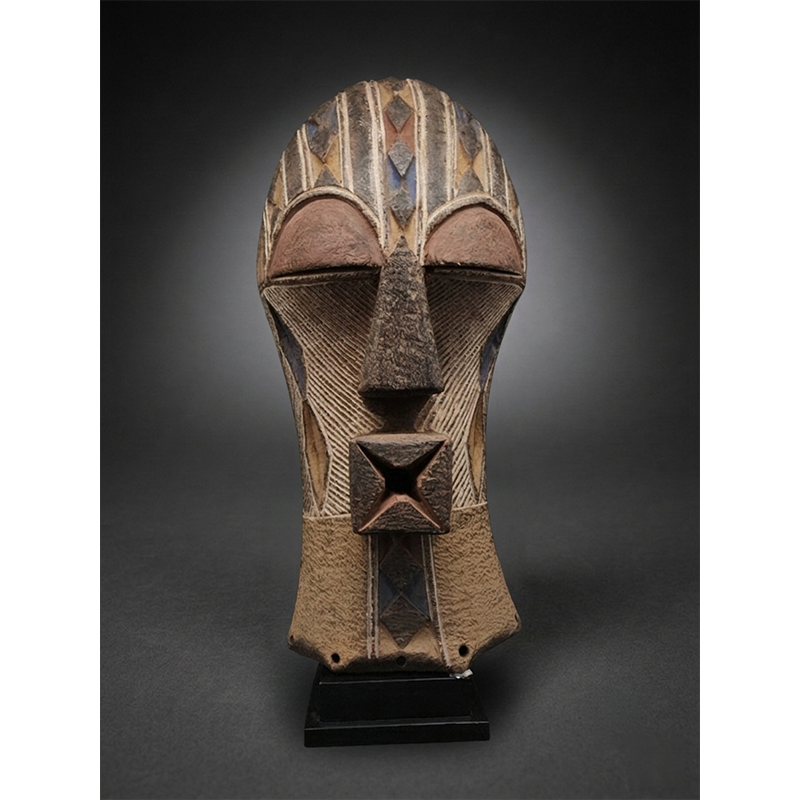
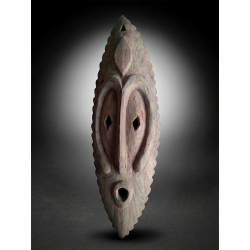
The present mask is a male kifwebe, designated kilume in the Songye language. At 60 centimetres, it is a substantial object — significantly larger than the average surviving example — and its scale is commensurate with its formal authority. The domed cranium rises like a helmet above the face, creating the characteristic silhouette that specialists recognise at a glance. Below it, the face is organised into a series of bold geometric planes: two large hemispherical eye-domes in deep reddish-ochre, a sharply triangular nose, and the most architecturally extraordinary feature — the projecting cubic mouth with its concave hourglass void at centre. This is an abstraction so complete that it has severed all connection with naturalistic representation: we are in the domain of pure formal power.
The kifwebe mask functions within the bwadi bwa kifwebe society, a men's association whose reach extended across Songye social and political life. The mask type is fundamentally dualistic: male masks (kilume) embody aggressive, uncontrollable, potentially dangerous power — they appear at night, move erratically, and are associated with social enforcement, the punishment of wrongdoers, and the transition of chiefs. Female masks (kibinda) are calmer, predominantly white, associated with fertility and beneficial power. The visual distinction is immediately legible: the present mask's pronounced dome, bold polychromy (white with red and blue-black accents), and large-scale incised geometry confirm the kilume classification without ambiguity.
The surface is covered from crown to neck in a dense, systematic network of incised hachure — parallel diagonal lines, lozenges, triangles, and arched bands. This is not decoration in any Western sense. Each incised line corresponds to a path (nzila) connecting the human world to the world of the ancestors (vidye). The white pigment (kaolin) represents the spirit world and moral purity; the red (ochre) represents blood, vitality, and danger; the blue-black (charcoal or indigo) represents night, death, and the power of the chiefs. Together they constitute a chromatic map of the Songye cosmological order.
The carving of a kifwebe was a specialised and ritually charged act, undertaken by a sculptor (the sangwa) who was himself a member of the bwadi bwa kifwebe society. The work begins with the selection of the wood — a light, easily carved timber whose specific identity is prescribed by tradition. The hollow helmet form requires confident spatial thinking: the interior must fit a human head while the exterior geometry achieves its formal programme. The adze work visible on this example is assured and decisive. The incised lines are executed with a narrow blade in a consistent, rapid rhythm that produces the vibrating visual field the mask is known for. The pigmentation was applied in stages, with white kaolin as the base, followed by red ochre and black accents, refreshed at each ceremonial use — the layered, worn state of the pigment on this mask is direct evidence of that repeated ritual engagement.
The back view of this mask is among its most compelling features for the specialist. The deep hollow interior shows significant craquelure — a network of fine shrinkage cracks produced by repeated cycles of humidity and dryness over decades. The interior walls bear the accumulated contact patina of a human face: the oils, perspiration, and ritual preparations absorbed by the wood during use. The lateral apertures along the edges are the original attachment points for the fibre skirt and costume that completed the dancer's transformation: what you see here is the mask as it existed in the field, not as a stripped object prepared for the market. The interior craquelure pattern, the colour and texture of the internal patina, and the overall dryness of the wood are the primary indicators of age that specialists examine in the hand. On photographic evidence, they are consistent with a dating of circa 1920–1950.
A kifwebe did not appear casually. Its emergence was an event that reorganised social space: people moved, hierarchies became visible, the boundary between the ordinary world and the world of the spirits became permeable. The male kilume mask performed at the death and investiture of chiefs, at the initiation of young men into the bwadi bwa kifwebe society, and when the society was called to enforce social norms — to punish theft, adultery, or violations of community law. The dancer wearing the mask was understood to have ceased to be an individual: he had become the spirit embodied in the object. Speaking to the mask was speaking to that spirit. This is what it means to say that the kifwebe is a living object: it was not made to represent power, but to be the instrument through which power was exercised.
Within Songye society, this mask was a living instrument of cosmic law and social control, worn exclusively by initiates of the Bwadi bwa Kifwebe association. Unlike the passive, gentler female masks (Kikashi), the male Kilume mask was danced with erratic, aggressive, and highly energetic movements.
Accompanied by a heavy woven fiber costume and a massive skirt of wild raffia, the masquerader wielded supernatural power (basha masende) to enforce judicial sentences, extract taxes, protect the village from witchcraft (ndoshi), and mark the investiture or funerals of elite chiefs. The encrusted deposits within the grooves suggest a history of ritual washing and empowerment through medicine before entering the public arena.
The mask is offered in excellent and entirely authentic condition, with no restorations, no replaced elements, no artificial ageing, and no interventions of any kind.
WOOD: Fully intact structurally. Dry and stable. The interior presents deep craquelure and shrinkage cracking consistent with extended age in a tropical climate. No active wood-boring insect activity. No splits penetrating to the exterior surface.
PIGMENTATION: Original polychrome survives across all registers: white kaolin, red ocre, blue-black. Pigment is worn, abraded at high points, and layered in a manner consistent with repeated ceremonial application and use. No modern repainting. The worn state of the pigment is itself evidence of authenticity and field use.
SURFACE PATINA: The exterior surface carries a dense, compacted use-patina developed through handling, ceremonial application, and environmental exposure over decades. Interior surfaces show absorbed contact patina from extended wear. Both are stable and dry.
APERTURES: The lateral edges of the lower section present several small circular apertures — original attachment points for the fibre costume. These are integral to the object and constitute evidence of field use, not damage. Two small apertures are also visible at the lower front corners of the base section, consistent with costume attachment.
CANONICAL FORM: The kifwebe is one of the defining mask types in the entire history of African art — recognised immediately by collectors, curators, and scholars worldwide. This example displays every defining characteristic of the tradition at its most authoritative: the helmet form, the domed cranium, the bold cubic mouth, the dense hachure, the tricolour palette.
SCALE AND PRESENCE: At 60 cm, this is a substantial object. The largest and most formally resolved kifwebe examples command the highest prices and the greatest collector interest. Scale in a kifwebe is not merely aesthetic: it correlates with the importance of the ceremony for which the mask was made.
AUTHENTIC FIELD USE: The interior craquelure, the layered pigment, the absorption patina, and the attachment apertures all confirm that this mask was made to be worn, was worn, and was used in its intended ceremonial context. It is not a workshop production made for the market. That distinction is fundamental to its value and to its meaning.
POLYCHROME INTEGRITY: Original polychrome surviving in this state — worn but complete, layered but not restored — is increasingly rare. Masks whose colour has been refreshed or whose pigment has been partially cleaned lose a dimension of their evidential and aesthetic character that cannot be recovered.
A MASTERPIECE OF MODERNIST INFLUENCE: The extraordinary graphic power of the Kifwebe style makes it one of the most visually compelling and sought-after genres in African art. It bridges the gap between ancient tribal mysticism and 20th-century geometric abstraction.
INVESTMENT PROFILE: Songye kifwebe masks have maintained consistent institutional and collector demand for more than six decades. Major examples appear regularly at Sotheby's, Christie's, Bonhams, and Drouot. The market for authentic Central African material continues to deepen, driven by institutional acquisitions and growing African diaspora collecting.
 Security policy
Transactions protected by 256-bit SSL through 3D-Secure gateways—we never store your card details.
 Delivery policy
All items are professionally packed and shipped via premium, fully tracked carrier services.
 Return policy
If you are not entirely satisfied, you can return your acquisition within 15 days for a full refund.
Data sheet
Geometry Raised to the Power of Vision — The Songye Kifwebe and the Architecture of the Sacred
Among the great mask traditions of Central Africa, the kifwebe of the Songye people occupies a singular position: nowhere else in the vast sculptural corpus of the Congo basin does formal abstraction achieve quite this degree of controlled ferocity. This is not a face. It is a cosmological proposition rendered in wood, pigment, and incised line — a visual argument about the nature of power, the boundary between the living and the dead, and the mechanisms by which human society regulates itself through the controlled terror of the sacred.
The present mask is a male kifwebe, designated kilume in the Songye language. At 60 centimetres, it is a substantial object — significantly larger than the average surviving example — and its scale is commensurate with its formal authority. The domed cranium rises like a helmet above the face, creating the characteristic silhouette that specialists recognise at a glance. Below it, the face is organised into a series of bold geometric planes: two large hemispherical eye-domes in deep reddish-ochre, a sharply triangular nose, and the most architecturally extraordinary feature — the projecting cubic mouth with its concave hourglass void at centre. This is an abstraction so complete that it has severed all connection with naturalistic representation: we are in the domain of pure formal power.
The kifwebe mask functions within the bwadi bwa kifwebe society, a men's association whose reach extended across Songye social and political life. The mask type is fundamentally dualistic: male masks (kilume) embody aggressive, uncontrollable, potentially dangerous power — they appear at night, move erratically, and are associated with social enforcement, the punishment of wrongdoers, and the transition of chiefs. Female masks (kibinda) are calmer, predominantly white, associated with fertility and beneficial power. The visual distinction is immediately legible: the present mask's pronounced dome, bold polychromy (white with red and blue-black accents), and large-scale incised geometry confirm the kilume classification without ambiguity.
The surface is covered from crown to neck in a dense, systematic network of incised hachure — parallel diagonal lines, lozenges, triangles, and arched bands. This is not decoration in any Western sense. Each incised line corresponds to a path (nzila) connecting the human world to the world of the ancestors (vidye). The white pigment (kaolin) represents the spirit world and moral purity; the red (ochre) represents blood, vitality, and danger; the blue-black (charcoal or indigo) represents night, death, and the power of the chiefs. Together they constitute a chromatic map of the Songye cosmological order.
The carving of a kifwebe was a specialised and ritually charged act, undertaken by a sculptor (the sangwa) who was himself a member of the bwadi bwa kifwebe society. The work begins with the selection of the wood — a light, easily carved timber whose specific identity is prescribed by tradition. The hollow helmet form requires confident spatial thinking: the interior must fit a human head while the exterior geometry achieves its formal programme. The adze work visible on this example is assured and decisive. The incised lines are executed with a narrow blade in a consistent, rapid rhythm that produces the vibrating visual field the mask is known for. The pigmentation was applied in stages, with white kaolin as the base, followed by red ochre and black accents, refreshed at each ceremonial use — the layered, worn state of the pigment on this mask is direct evidence of that repeated ritual engagement.
The back view of this mask is among its most compelling features for the specialist. The deep hollow interior shows significant craquelure — a network of fine shrinkage cracks produced by repeated cycles of humidity and dryness over decades. The interior walls bear the accumulated contact patina of a human face: the oils, perspiration, and ritual preparations absorbed by the wood during use. The lateral apertures along the edges are the original attachment points for the fibre skirt and costume that completed the dancer's transformation: what you see here is the mask as it existed in the field, not as a stripped object prepared for the market. The interior craquelure pattern, the colour and texture of the internal patina, and the overall dryness of the wood are the primary indicators of age that specialists examine in the hand. On photographic evidence, they are consistent with a dating of circa 1920–1950.
A kifwebe did not appear casually. Its emergence was an event that reorganised social space: people moved, hierarchies became visible, the boundary between the ordinary world and the world of the spirits became permeable. The male kilume mask performed at the death and investiture of chiefs, at the initiation of young men into the bwadi bwa kifwebe society, and when the society was called to enforce social norms — to punish theft, adultery, or violations of community law. The dancer wearing the mask was understood to have ceased to be an individual: he had become the spirit embodied in the object. Speaking to the mask was speaking to that spirit. This is what it means to say that the kifwebe is a living object: it was not made to represent power, but to be the instrument through which power was exercised.
Within Songye society, this mask was a living instrument of cosmic law and social control, worn exclusively by initiates of the Bwadi bwa Kifwebe association. Unlike the passive, gentler female masks (Kikashi), the male Kilume mask was danced with erratic, aggressive, and highly energetic movements.
Accompanied by a heavy woven fiber costume and a massive skirt of wild raffia, the masquerader wielded supernatural power (basha masende) to enforce judicial sentences, extract taxes, protect the village from witchcraft (ndoshi), and mark the investiture or funerals of elite chiefs. The encrusted deposits within the grooves suggest a history of ritual washing and empowerment through medicine before entering the public arena.
The mask is offered in excellent and entirely authentic condition, with no restorations, no replaced elements, no artificial ageing, and no interventions of any kind.
WOOD: Fully intact structurally. Dry and stable. The interior presents deep craquelure and shrinkage cracking consistent with extended age in a tropical climate. No active wood-boring insect activity. No splits penetrating to the exterior surface.
PIGMENTATION: Original polychrome survives across all registers: white kaolin, red ocre, blue-black. Pigment is worn, abraded at high points, and layered in a manner consistent with repeated ceremonial application and use. No modern repainting. The worn state of the pigment is itself evidence of authenticity and field use.
SURFACE PATINA: The exterior surface carries a dense, compacted use-patina developed through handling, ceremonial application, and environmental exposure over decades. Interior surfaces show absorbed contact patina from extended wear. Both are stable and dry.
APERTURES: The lateral edges of the lower section present several small circular apertures — original attachment points for the fibre costume. These are integral to the object and constitute evidence of field use, not damage. Two small apertures are also visible at the lower front corners of the base section, consistent with costume attachment.
CANONICAL FORM: The kifwebe is one of the defining mask types in the entire history of African art — recognised immediately by collectors, curators, and scholars worldwide. This example displays every defining characteristic of the tradition at its most authoritative: the helmet form, the domed cranium, the bold cubic mouth, the dense hachure, the tricolour palette.
SCALE AND PRESENCE: At 60 cm, this is a substantial object. The largest and most formally resolved kifwebe examples command the highest prices and the greatest collector interest. Scale in a kifwebe is not merely aesthetic: it correlates with the importance of the ceremony for which the mask was made.
AUTHENTIC FIELD USE: The interior craquelure, the layered pigment, the absorption patina, and the attachment apertures all confirm that this mask was made to be worn, was worn, and was used in its intended ceremonial context. It is not a workshop production made for the market. That distinction is fundamental to its value and to its meaning.
POLYCHROME INTEGRITY: Original polychrome surviving in this state — worn but complete, layered but not restored — is increasingly rare. Masks whose colour has been refreshed or whose pigment has been partially cleaned lose a dimension of their evidential and aesthetic character that cannot be recovered.
A MASTERPIECE OF MODERNIST INFLUENCE: The extraordinary graphic power of the Kifwebe style makes it one of the most visually compelling and sought-after genres in African art. It bridges the gap between ancient tribal mysticism and 20th-century geometric abstraction.
INVESTMENT PROFILE: Songye kifwebe masks have maintained consistent institutional and collector demand for more than six decades. Major examples appear regularly at Sotheby's, Christie's, Bonhams, and Drouot. The market for authentic Central African material continues to deepen, driven by institutional acquisitions and growing African diaspora collecting.