




« A POWERFUL MELANESIAN ANCESTRAL MANIFESTATION, CHARACTERIZED BY BOLD GEOMETRIC VOLUMES AND ENERGETIC RITUAL PATINA. »
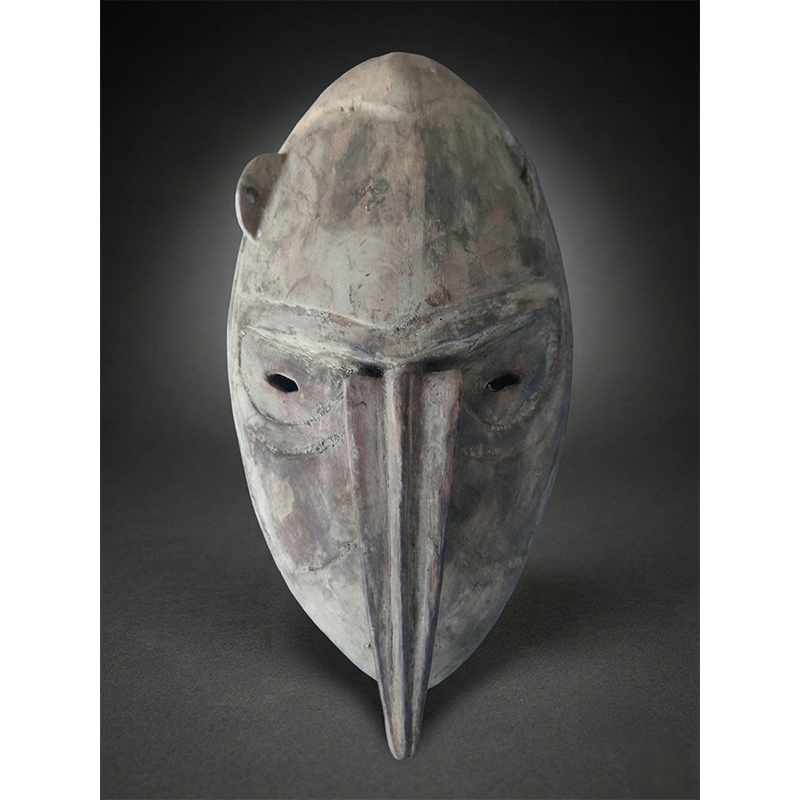
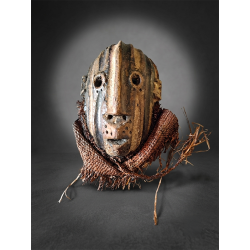
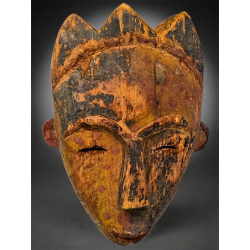
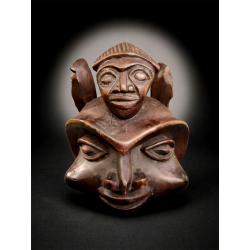
This superb mid-century dance mask originates from the remote Sassoia sector of the Prince Alexander Mountains, presenting a powerful archetype of Boiken sacred carving. An ovoid helmet-form mask carved from a single piece of softwood, notable for its marked three-dimensionality: the volume extends nearly 11 cm in depth, making it substantially more sculptural than the shallow face-plate tradition common to adjacent Sepik groups. The front presents a dramatically projecting beak-like nose — the defining diagnostic of the coastal Boiken long-nosed style, consistent with the Britannica and Metropolitan Museum reference examples — rendered as a narrow tapering ridge descending from a flattened brow plane, terminating in a pronounced downward hook. The brow itself is articulated by two curved ridges creating a visor-like "helmet" framing, flanked by small circular ear-like projections at the temples. The eye sockets are small, almond-shaped, deeply cut apertures aligned symmetrically left and right of the nasal ridge — not pierced for a dancer's sightline (they exit through the shallow concave interior), which is characteristic of Boiken masks worn mounted on a cane framework rather than face-worn. The mouth plane is undifferentiated, surface-absorbed into the lower beak structure. The exterior surface carries a worn, layered polychrome: a base of white kaolin overlaid with passages of iron-oxide red-purple and areas of graphite black, all substantially abraded to a pale dove-grey aggregate tone giving the object its characteristic ghostly presence. Streaking on the right lateral face is consistent with moisture infiltration or ritual liquid application during ceremonial use.
The interior shows the deeply concave hollowed-out cavity with dense, even tool marks and a dark, oily patina of organic matter — consistent with extended use and storage in a men's ceremonial house. Multiple chiselled (not drilled) perforation points are visible around the perimeter, the attachment points for the cane armature and fibre costume. A collector's label ("59") is affixed to the interior. The wood shows stable longitudinal cracking on the rear face and differential weathering: exterior patina lighter/more abraded than interior, consistent with the mask having been repeatedly handled, painted, and stored over decades. No active woodworm. No structural repair or restoration visible.
Coastal Boiken groups created masks known as wale or ware, representing a variety of male and female spirits. Used by men during ceremonial performances, they were not placed directly on the face but were attached to a basketry framework covering the dancer's head, worn with a knee-length grass skirt. When not in use, the masks were kept as sacred objects within the men's ceremonial house. According to coastal Boiken oral tradition, the first wale were made by a man named Pantjapong, who dived beneath the water and encountered spirits wearing large masks. When he returned to the village, the other men asked him to carve masks like those he had seen, and these became the original wale. In historic times, as masks decayed and needed to be replaced, members of the men's house commissioned an artist called a duo wale nare sugo to produce a new example. Boiken styles are relatively little known; the masks of the coastal Boiken were made in a distinctive long-nosed style, and figure sculpture was rare among them. The Boiken had rich traditions of pottery making, and their ceremonial houses followed on a smaller scale the pattern of Abelam houses to the west.
The long nose is not merely aesthetic: among Sepik groups generally, enormously exaggerated noses signify masculinity, with females rendered with short noses. This mask, by its projecting beak, therefore represents a male spirit — most likely an ancestral or cosmological being belonging to the men's sacred house inventory. Boiken masks of this type are a rare form; examples that have been ritually used show layers of worn pigments, and the piercings for attachment to a frame are chiselled rather than drilled. All three criteria are met by this piece.
Dating to the mid–20th century (c. 1940–1960) is supported by the convergence of several physical indicators: the deep, consistently developed interior patina; the multi-layer polychrome wear suggesting repeated ceremonial repainting cycles; the absence of any synthetic paint or post-colonial material intervention; and the stable cracking pattern consistent with 60–80 years of environmental cycling. The chiselled (not drilled) perforations align with pre-power-tool production methods documented in pre-1970s field collections. A 19th-century date cannot be confirmed without thermoluminescence testing and would require specialist opinion; the conservative mid-20th century attribution is defensible under current physical evidence.
Outstanding, authentic field condition. The mask features a deeply oxidized, dry interior reverse with clear friction and contact wear from its historical mounting. The exterior exhibits a multi-layered matte patina of red ochre, charcoal, and lime wash, displaying stable native desiccation lines, historical weathering, and minor pigment erosion that perfectly underscore its active ceremonial history.
Coastal Boiken masks are among the rarest documented forms within the Sepik corpus. The Metropolitan Museum of Art, New York holds a closely comparable example (inv. 1978.412.770, H. 35.6 cm), reproduced in Eric Kjellgren's 2007 Oceania: Art of the Pacific Islands in The Metropolitan Museum of Art, establishing the institutional benchmark for this type. Field-collected examples in European private hands are uncommon, and the helmet form — fully three-dimensional, with an intact polychrome surface, interior use-patina, and documented cane-attachment perforations — represents the complete typological specimen rather than a simplified face-plate. At 39.5 cm this piece exceeds the Met example in scale. It is an object for the Oceanic specialist or the collector building a Sepik River reference suite, not a decorative acquisition.
 Security policy
Transactions protected by 256-bit SSL through 3D-Secure gateways—we never store your card details.
 Delivery policy
All items are professionally packed and shipped via premium, fully tracked carrier services.
 Return policy
If you are not entirely satisfied, you can return your acquisition within 15 days for a full refund.
Data sheet
« A POWERFUL MELANESIAN ANCESTRAL MANIFESTATION, CHARACTERIZED BY BOLD GEOMETRIC VOLUMES AND ENERGETIC RITUAL PATINA. »
This superb mid-century dance mask originates from the remote Sassoia sector of the Prince Alexander Mountains, presenting a powerful archetype of Boiken sacred carving. An ovoid helmet-form mask carved from a single piece of softwood, notable for its marked three-dimensionality: the volume extends nearly 11 cm in depth, making it substantially more sculptural than the shallow face-plate tradition common to adjacent Sepik groups. The front presents a dramatically projecting beak-like nose — the defining diagnostic of the coastal Boiken long-nosed style, consistent with the Britannica and Metropolitan Museum reference examples — rendered as a narrow tapering ridge descending from a flattened brow plane, terminating in a pronounced downward hook. The brow itself is articulated by two curved ridges creating a visor-like "helmet" framing, flanked by small circular ear-like projections at the temples. The eye sockets are small, almond-shaped, deeply cut apertures aligned symmetrically left and right of the nasal ridge — not pierced for a dancer's sightline (they exit through the shallow concave interior), which is characteristic of Boiken masks worn mounted on a cane framework rather than face-worn. The mouth plane is undifferentiated, surface-absorbed into the lower beak structure. The exterior surface carries a worn, layered polychrome: a base of white kaolin overlaid with passages of iron-oxide red-purple and areas of graphite black, all substantially abraded to a pale dove-grey aggregate tone giving the object its characteristic ghostly presence. Streaking on the right lateral face is consistent with moisture infiltration or ritual liquid application during ceremonial use.
The interior shows the deeply concave hollowed-out cavity with dense, even tool marks and a dark, oily patina of organic matter — consistent with extended use and storage in a men's ceremonial house. Multiple chiselled (not drilled) perforation points are visible around the perimeter, the attachment points for the cane armature and fibre costume. A collector's label ("59") is affixed to the interior. The wood shows stable longitudinal cracking on the rear face and differential weathering: exterior patina lighter/more abraded than interior, consistent with the mask having been repeatedly handled, painted, and stored over decades. No active woodworm. No structural repair or restoration visible.
Coastal Boiken groups created masks known as wale or ware, representing a variety of male and female spirits. Used by men during ceremonial performances, they were not placed directly on the face but were attached to a basketry framework covering the dancer's head, worn with a knee-length grass skirt. When not in use, the masks were kept as sacred objects within the men's ceremonial house. According to coastal Boiken oral tradition, the first wale were made by a man named Pantjapong, who dived beneath the water and encountered spirits wearing large masks. When he returned to the village, the other men asked him to carve masks like those he had seen, and these became the original wale. In historic times, as masks decayed and needed to be replaced, members of the men's house commissioned an artist called a duo wale nare sugo to produce a new example. Boiken styles are relatively little known; the masks of the coastal Boiken were made in a distinctive long-nosed style, and figure sculpture was rare among them. The Boiken had rich traditions of pottery making, and their ceremonial houses followed on a smaller scale the pattern of Abelam houses to the west.
The long nose is not merely aesthetic: among Sepik groups generally, enormously exaggerated noses signify masculinity, with females rendered with short noses. This mask, by its projecting beak, therefore represents a male spirit — most likely an ancestral or cosmological being belonging to the men's sacred house inventory. Boiken masks of this type are a rare form; examples that have been ritually used show layers of worn pigments, and the piercings for attachment to a frame are chiselled rather than drilled. All three criteria are met by this piece.
Dating to the mid–20th century (c. 1940–1960) is supported by the convergence of several physical indicators: the deep, consistently developed interior patina; the multi-layer polychrome wear suggesting repeated ceremonial repainting cycles; the absence of any synthetic paint or post-colonial material intervention; and the stable cracking pattern consistent with 60–80 years of environmental cycling. The chiselled (not drilled) perforations align with pre-power-tool production methods documented in pre-1970s field collections. A 19th-century date cannot be confirmed without thermoluminescence testing and would require specialist opinion; the conservative mid-20th century attribution is defensible under current physical evidence.
Outstanding, authentic field condition. The mask features a deeply oxidized, dry interior reverse with clear friction and contact wear from its historical mounting. The exterior exhibits a multi-layered matte patina of red ochre, charcoal, and lime wash, displaying stable native desiccation lines, historical weathering, and minor pigment erosion that perfectly underscore its active ceremonial history.
Coastal Boiken masks are among the rarest documented forms within the Sepik corpus. The Metropolitan Museum of Art, New York holds a closely comparable example (inv. 1978.412.770, H. 35.6 cm), reproduced in Eric Kjellgren's 2007 Oceania: Art of the Pacific Islands in The Metropolitan Museum of Art, establishing the institutional benchmark for this type. Field-collected examples in European private hands are uncommon, and the helmet form — fully three-dimensional, with an intact polychrome surface, interior use-patina, and documented cane-attachment perforations — represents the complete typological specimen rather than a simplified face-plate. At 39.5 cm this piece exceeds the Met example in scale. It is an object for the Oceanic specialist or the collector building a Sepik River reference suite, not a decorative acquisition.