




"In the equatorial forest of the upper Lualaba, the mask is not an antiquity but a presence. It is carved when needed, danced when called, and only afterwards does it pass into the world of objects."
This is an incredibly rare Yela (or Yela-Kela) initiation mask from the central-eastern equatorial forest regions of the Democratic Republic of the Congo (DRC).
For decades, Western scholarship erroneously believed that the Yela (a subgroup closely related to the Mongo and neighboring the Mbole, Metoko, and Lengola) produced no masks. It was only later in the 20th century that field collections confirmed a secret corpus of Yela masks. Because their initiation rites occurred entirely in the deep forest away from the eyes of outsiders—and because masks were frequently discarded or ritually hidden in nature after use—exceptionally few survived to enter early Western collections.
Dating: Circa Mid-20th Century (c. 1940s–1950s). The structural erosion around the perforations, the deeply oxidized internal wood coloration seen in d.png, and the authentic, layered crusted patina confirm significant age and ritual utility.
Deep within the dense, humid rainforests along the Tshuapa and Lomami rivers, the Yela people operated under the absolute social, moral, and juridical authority of the Lilwa secret society. This mask did not perform for public entertainment; it emerged exclusively from the shadows during the clandestine male initiations (Ibole) and solemn judicial tribunals.
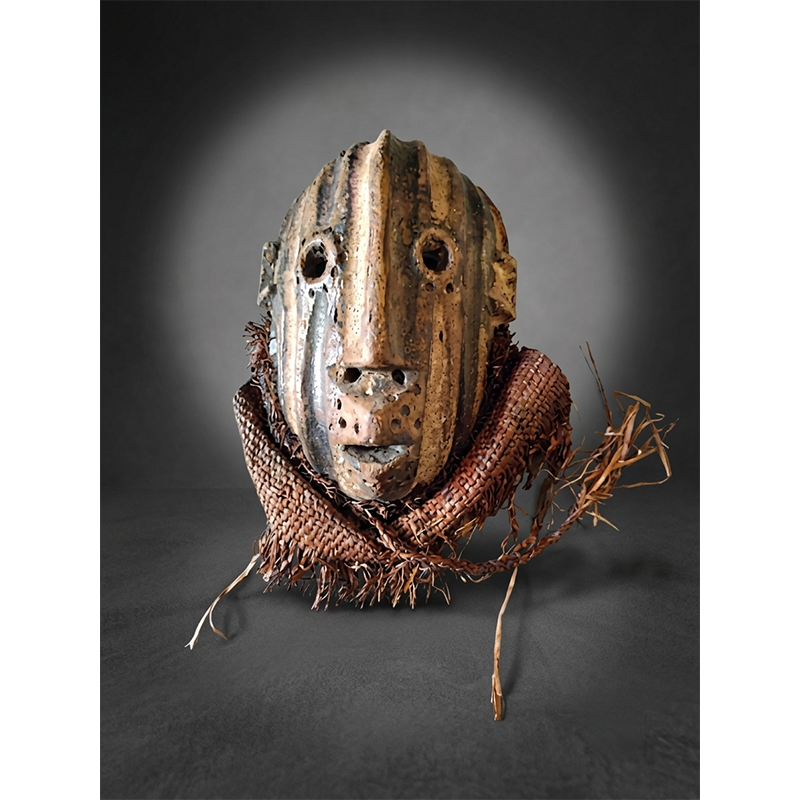
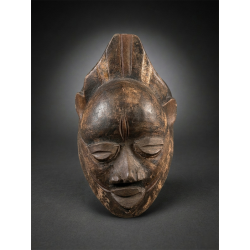
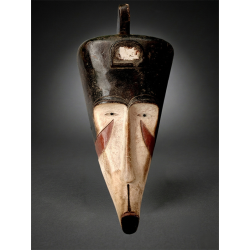
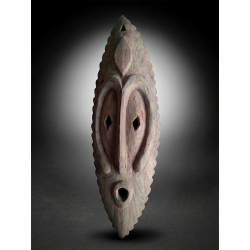
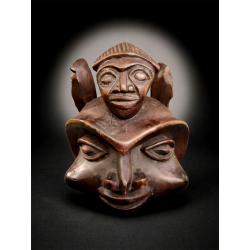
Carved with absolute minimalist restraint, the face is defined by a series of powerful, deep vertical grooves that symbolize traditional ancestral scarifications. The stark, hollowed eyes and mouthless or semi-open simian expression pierce through the veil between humanity and the primordial bush spirits. The prominent, sweeping crest running over the cranium anchors the facial symmetry, capturing a state of tranced, hyper-focused spiritual authority.
The heavy raffia collar enclosing the mask was designed to completely obscure the boundary where the wood met human flesh. When worn by the high-ranking elders or the Kumi (the judicial executioners of the Lilwa society), this mask served as the physical manifestation of customary law, supernatural judgment, and the absolute maintenance of tribal secrets.
The Yela people occupy one of the most remote regions of the Democratic Republic of Congo – the dense equatorial forest of the upper Lualaba River basin, in the modern provinces of Maniema and Tshopo. They are a small Bantu-speaking population whose material culture has received less international scholarly attention than that of their famous neighbours – the Songye to the south, the Mongo to the north, the Lega and Bembe to the east. Yet the Yela belong to a coherent cultural complex that the Belgian ethnographer Daniel Biebuyck identified as the Lega-Bembe-Mbole-Metoko stylistic family of the Maniema forest region – a constellation of related forest peoples whose masking traditions are tied to graded initiation societies, secret knowledge transmission, and the spiritual order of the village.
Within the Yela cosmogony, socio-religious life and justice are governed by the powerful Lilwa secret society. Long overlooked by colonial authorities and early ethno-collectors because they were discarded in the bush or ritually hidden after ceremonies (with the first specimens only being documented in the 1970s), these masks were deployed during sacred male initiations and the adjudication of major customary infractions.
The face is structured by commanding, parallel vertical striations that evoke the traditional scarifications of the clan. This striking graphic quality, combined with the hollowed-out circular eye orbits, heightens the spectral presence of the piece. Worn by high-ranking dignitaries or the Kumi (the society's judicial executioner), this mask embodies the mystical transition between man, ancestor, and the sacred forces of the equatorial forest.
Unlike many of the famous masking traditions of West and Central Africa, which have largely ceased active production due to colonisation, missionary activity, or social change, certain forest-zone traditions of the eastern DRC remain genuinely living. In the remote villages of Maniema, ritual masking continues to function as it has for centuries – masks are commissioned when needed, carved by specialists, danced in their proper season, retired when their power is exhausted. The present piece belongs to this living continuity. It is not a museum object representing a vanished past; it is a ritual implement of a continuing present. This is, for many sophisticated collectors, more valuable than antiquity.
Superb, ritually weathered field condition. The wooden core features an encrusted, oxidized polychrome patina with expected hairline structural drying splits that do not compromise its stability. The hand-woven raffia structural collar is magnificently preserved, retaining its original fibers, knots, and genuine smoke/sweat saturation from active handling.
Stable, structurally sound, with no significant cracks affecting the integrity of the piece. The exterior pigment shows naturally integrated wear – partial erosion on high points, preservation in recesses, soft fading of the original colour intensity. Fine surface texture from genuine use. Minor edge wear consistent with handling and use.
The original integrated woven fibre costume is intact, attached through the original perimeter cordage stitching. The fibre shows genuine ageing: natural fading, accumulated dust in the weave, partial fibre breakage at the edges, evidence of multiple in-place repair phases. The costume has aged with the mask, in the same environment, over the same period – this is not a recent display addition but a ritual ensemble. Fibre condition is good for a working costume; some fragility at the lower edges is consistent with extended use and handling.
Dark oily patina across the entire interior surface; smoothed polish at forehead and cheek contact points; aged cordage stitching with multiple repair phases; real wood ageing throughout. The interior is the strongest single piece of evidence of authentic ceremonial use and lifts this piece clearly above the category of recent decorative carvings.
Unlike most African masks on the international market – which are either antique pieces whose ritual context ended generations ago, or recent decorative carvings made for export – this mask was actually used in real Yela ceremonial contexts in the DRC before its collection. The interior wear, the aged costume, the integrated repair phases all confirm this. For collectors who prioritise authenticity of use over antiquity of date, this is a category of object increasingly difficult to obtain.
The Yela masking tradition is one of relatively few African ritual contexts that has continued to function actively into the 21st century. To own a piece from this living continuity is to participate in a different relationship with African art than the museum-collected antique paradigm – one centred on continuing presence rather than vanished past.
The piece is offered as an intact mask-and-costume ensemble. Many African masks reach the market without their original costumes, which were lost or separated during colonial-era collection or subsequent dealer handling. The presence of the original integrated fibre costume, aged in place, is a substantial value addition and a rare presentation.
Yela / Lengola / Mbole material is significantly less internationally famous than Songye, Fang, Punu, or Kota – which means it is significantly less faked. The fake market targets the famous categories where high prices justify the effort. Pieces from less-celebrated forest peoples occupy a more secure authenticity zone, and offer collectors aesthetic distinction at more accessible prices.
 Security policy
Transactions protected by 256-bit SSL through 3D-Secure gateways—we never store your card details.
 Delivery policy
All items are professionally packed and shipped via premium, fully tracked carrier services.
 Return policy
If you are not entirely satisfied, you can return your acquisition within 15 days for a full refund.
Data sheet
"In the equatorial forest of the upper Lualaba, the mask is not an antiquity but a presence. It is carved when needed, danced when called, and only afterwards does it pass into the world of objects."
This is an incredibly rare Yela (or Yela-Kela) initiation mask from the central-eastern equatorial forest regions of the Democratic Republic of the Congo (DRC).
For decades, Western scholarship erroneously believed that the Yela (a subgroup closely related to the Mongo and neighboring the Mbole, Metoko, and Lengola) produced no masks. It was only later in the 20th century that field collections confirmed a secret corpus of Yela masks. Because their initiation rites occurred entirely in the deep forest away from the eyes of outsiders—and because masks were frequently discarded or ritually hidden in nature after use—exceptionally few survived to enter early Western collections.
Dating: Circa Mid-20th Century (c. 1940s–1950s). The structural erosion around the perforations, the deeply oxidized internal wood coloration seen in d.png, and the authentic, layered crusted patina confirm significant age and ritual utility.
Deep within the dense, humid rainforests along the Tshuapa and Lomami rivers, the Yela people operated under the absolute social, moral, and juridical authority of the Lilwa secret society. This mask did not perform for public entertainment; it emerged exclusively from the shadows during the clandestine male initiations (Ibole) and solemn judicial tribunals.
Carved with absolute minimalist restraint, the face is defined by a series of powerful, deep vertical grooves that symbolize traditional ancestral scarifications. The stark, hollowed eyes and mouthless or semi-open simian expression pierce through the veil between humanity and the primordial bush spirits. The prominent, sweeping crest running over the cranium anchors the facial symmetry, capturing a state of tranced, hyper-focused spiritual authority.
The heavy raffia collar enclosing the mask was designed to completely obscure the boundary where the wood met human flesh. When worn by the high-ranking elders or the Kumi (the judicial executioners of the Lilwa society), this mask served as the physical manifestation of customary law, supernatural judgment, and the absolute maintenance of tribal secrets.
The Yela people occupy one of the most remote regions of the Democratic Republic of Congo – the dense equatorial forest of the upper Lualaba River basin, in the modern provinces of Maniema and Tshopo. They are a small Bantu-speaking population whose material culture has received less international scholarly attention than that of their famous neighbours – the Songye to the south, the Mongo to the north, the Lega and Bembe to the east. Yet the Yela belong to a coherent cultural complex that the Belgian ethnographer Daniel Biebuyck identified as the Lega-Bembe-Mbole-Metoko stylistic family of the Maniema forest region – a constellation of related forest peoples whose masking traditions are tied to graded initiation societies, secret knowledge transmission, and the spiritual order of the village.
Within the Yela cosmogony, socio-religious life and justice are governed by the powerful Lilwa secret society. Long overlooked by colonial authorities and early ethno-collectors because they were discarded in the bush or ritually hidden after ceremonies (with the first specimens only being documented in the 1970s), these masks were deployed during sacred male initiations and the adjudication of major customary infractions.
The face is structured by commanding, parallel vertical striations that evoke the traditional scarifications of the clan. This striking graphic quality, combined with the hollowed-out circular eye orbits, heightens the spectral presence of the piece. Worn by high-ranking dignitaries or the Kumi (the society's judicial executioner), this mask embodies the mystical transition between man, ancestor, and the sacred forces of the equatorial forest.
Unlike many of the famous masking traditions of West and Central Africa, which have largely ceased active production due to colonisation, missionary activity, or social change, certain forest-zone traditions of the eastern DRC remain genuinely living. In the remote villages of Maniema, ritual masking continues to function as it has for centuries – masks are commissioned when needed, carved by specialists, danced in their proper season, retired when their power is exhausted. The present piece belongs to this living continuity. It is not a museum object representing a vanished past; it is a ritual implement of a continuing present. This is, for many sophisticated collectors, more valuable than antiquity.
Superb, ritually weathered field condition. The wooden core features an encrusted, oxidized polychrome patina with expected hairline structural drying splits that do not compromise its stability. The hand-woven raffia structural collar is magnificently preserved, retaining its original fibers, knots, and genuine smoke/sweat saturation from active handling.
Stable, structurally sound, with no significant cracks affecting the integrity of the piece. The exterior pigment shows naturally integrated wear – partial erosion on high points, preservation in recesses, soft fading of the original colour intensity. Fine surface texture from genuine use. Minor edge wear consistent with handling and use.
The original integrated woven fibre costume is intact, attached through the original perimeter cordage stitching. The fibre shows genuine ageing: natural fading, accumulated dust in the weave, partial fibre breakage at the edges, evidence of multiple in-place repair phases. The costume has aged with the mask, in the same environment, over the same period – this is not a recent display addition but a ritual ensemble. Fibre condition is good for a working costume; some fragility at the lower edges is consistent with extended use and handling.
Dark oily patina across the entire interior surface; smoothed polish at forehead and cheek contact points; aged cordage stitching with multiple repair phases; real wood ageing throughout. The interior is the strongest single piece of evidence of authentic ceremonial use and lifts this piece clearly above the category of recent decorative carvings.
Unlike most African masks on the international market – which are either antique pieces whose ritual context ended generations ago, or recent decorative carvings made for export – this mask was actually used in real Yela ceremonial contexts in the DRC before its collection. The interior wear, the aged costume, the integrated repair phases all confirm this. For collectors who prioritise authenticity of use over antiquity of date, this is a category of object increasingly difficult to obtain.
The Yela masking tradition is one of relatively few African ritual contexts that has continued to function actively into the 21st century. To own a piece from this living continuity is to participate in a different relationship with African art than the museum-collected antique paradigm – one centred on continuing presence rather than vanished past.
The piece is offered as an intact mask-and-costume ensemble. Many African masks reach the market without their original costumes, which were lost or separated during colonial-era collection or subsequent dealer handling. The presence of the original integrated fibre costume, aged in place, is a substantial value addition and a rare presentation.
Yela / Lengola / Mbole material is significantly less internationally famous than Songye, Fang, Punu, or Kota – which means it is significantly less faked. The fake market targets the famous categories where high prices justify the effort. Pieces from less-celebrated forest peoples occupy a more secure authenticity zone, and offer collectors aesthetic distinction at more accessible prices.