




Among the Dogon of Mali, metal is the medium of the most important ritual objects. Bronze and iron sculpture is the exclusive craft of the jèm — a hereditary caste of blacksmiths who occupy a distinct and ritually charged position in Dogon society. The blacksmith is feared and respected: he commands the transformative power of fire, he produces the iron tools that allow Dogon agriculture, he forges the ritual implements of the priests, and he casts in bronze the miniature altar objects, hogon figures, equestrians, ladders, and ritual pendants that populate the family and lineage shrines of the village. The Dogon blacksmith uses the lost-wax casting technique (cire perdue) — a method of extraordinary antiquity in sub-Saharan Africa, practiced continuously by West African metalsmiths for many centuries prior to European contact.
The hogon is the supreme spiritual officeholder of the Dogon village — a semi-divine office combining priestly, judicial, and political authority. The hogon is the keeper of the ancestral shrines, the principal intermediary between the village and the founding ancestors, the figure whose prayers and offerings ensure the wellbeing of the community and the fertility of the land. The hogon lives apart from the ordinary village, in a dwelling marked with ritual signs, and conducts ceremonial functions beneath canopies and shelters specific to his office. The figure of the hogon — bearded, dignified, seated or standing beneath his shelter — is a recurring iconographic subject in Dogon sculpture across the wood and bronze corpus.
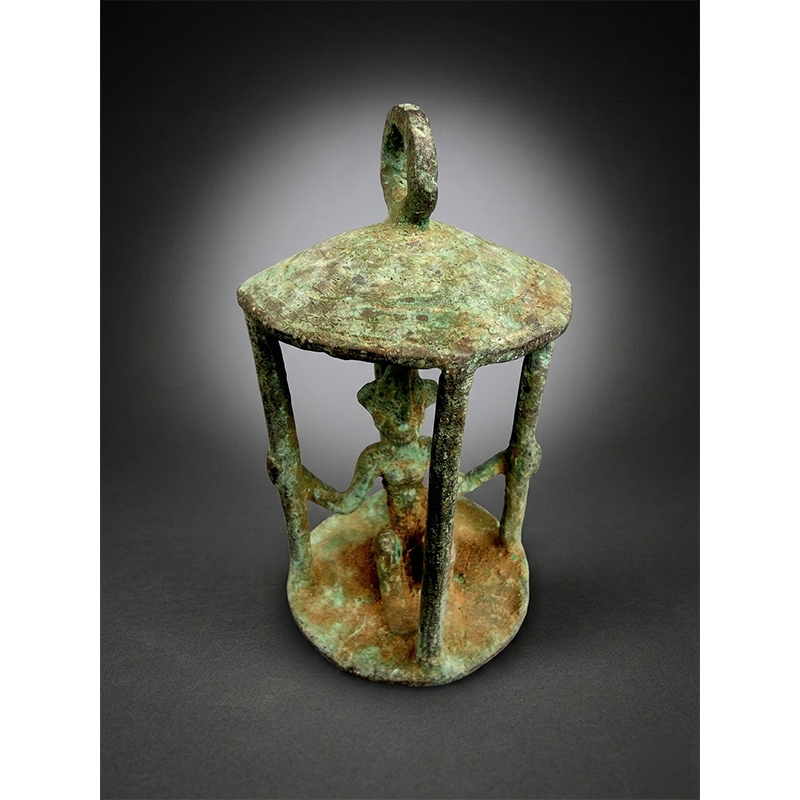
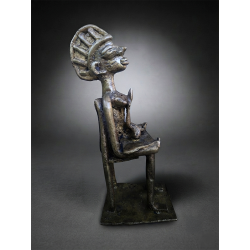
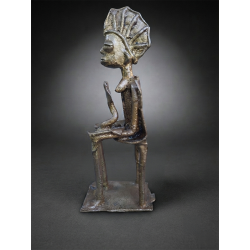
The present miniature represents a central figure seated beneath a four-pillar canopied structure surmounted by a domed roof with concentric ring decoration and a suspension loop. The composition reads as a hogon beneath his ceremonial shelter — the central figure dignified and frontal, the canopy elevated above him, and the architectural framing isolating him as a figure of ritual authority. The smaller form at the base of the central figure may represent an attendant or secondary cult element. The integrated suspension ring at the apex indicates that the object was hung — most plausibly on a shrine wall or from an altar structure — rather than displayed free-standing. This hanging context is consistent with the Dogon practice of populating family altars with arrays of miniature ritual objects, each playing a specific role in the cult of the lineage ancestors and the soul vessel (nyama jar) of the family head.
The material evidence on the present piece is consistent with substantial age and altar-context use. The patina is a deep mature green verdigris (basic copper carbonates and oxychlorides) with visible reddish-brown cuprite undertones where the oxidation has progressed unevenly — a multi-layered surface that takes many decades to develop under ambient conditions and is characteristic of bronzes with extended exposure to moisture and air. The recesses of the composition show powdery oxidation and integrated earth and sand deposits, consistent with altar exposure where the object would have received libations, sacrificial substances, and accumulated dust over generations, or with burial-context exposure where the object would have been in direct earth contact. The patina is stable — there is no evidence of active bronze disease (chloride corrosion), which would manifest as bright green powdery efflorescence requiring conservation. The stability of the patina indicates that the corrosion process has long since equilibrated, consistent with substantial age.
The present piece was acquired with a written certificate of authenticity issued by Galerie Guerrin, Brussels — one of the established Belgian specialist tribal art galleries, founded in 2009 as Mondes d'Hier and renamed Galerie Guerrin in 2021. The gallery is located at 166 Rue Blaes, 1000 Brussels, at the heart of the Marolles tribal art district adjacent to the Place du Jeu de Balles flea market — a historic center for the Belgian trade in African material from the colonial-era and post-colonial private collections that constitute one of the most important secondary markets for African art in Europe. The gallery is directed by Yvan Guerrin, who collaborates with auction houses as seller and expert in African Art, and has curated specialist auctions of important Belgian private collections — notably the 2021 Ibeji auction of the Dr. Fernand Leroy collection (twenty-seven Yoruba twin figures, some previously exhibited at the Musée Vivant des Arts et Civilisations d'Afrique de Nantes in 2017). The Guerrin certificate of authenticity, while issued by the dealer rather than by an independent expert, carries the professional weight of a recognized specialist with sustained engagement in scholarly auction practice.
The piece is offered in condition consistent with substantial age and authentic ritual use. Structurally sound and presenting a coherent, attractive surface suitable for immediate display.
Iconic Tradition. Dogon bronze is among the most respected of West African metal sculpture traditions, the work of the jèm blacksmith caste who occupy a distinct and ritually charged position in Dogon society. Dogon bronze miniatures are held at the Metropolitan Museum, the Musée du quai Branly, and the major specialist galleries of Paris and Brussels.
Hogon Iconography. The figure beneath the canopy reads as a hogon — the supreme spiritual officeholder of the Dogon village. Hogon imagery is a recurring and central subject of Dogon sculpture, immediately recognizable to the informed eye and carrying the full weight of Dogon religious authority.
Specialist Gallery Provenance. Acquired with a written certificate of authenticity from Galerie Guerrin (Brussels), one of the established Belgian specialist tribal art galleries. The Guerrin provenance is itself a meaningful commercial asset — collectors value pieces with documented dealer chains, and the Brussels-Marolles secondary market is one of the principal sources of authentic African material in Europe.
Authentic Patina. The deep mature verdigris with cuprite undertones and integrated earth deposits is the strongest authentication signal available on a small bronze. This patina takes many decades to develop and is associated with extended altar or burial-context exposure. It is the principal distinguishing feature between authentic field-collected Dogon bronze and recent foundry production.
Honest Positioning. Offered at a price that reflects what we can confirm: Dogon iconography, lost-wax bronze casting, mature authentic patina, Galerie Guerrin certificate of authenticity. A refined sub-attribution within the Mali bronze corpus could materially refine the position upward.
 Security policy
Transactions protected by 256-bit SSL through 3D-Secure gateways—we never store your card details.
 Delivery policy
All items are professionally packed and shipped via premium, fully tracked carrier services.
 Return policy
If you are not entirely satisfied, you can return your acquisition within 15 days for a full refund.
Data sheet
Among the Dogon of Mali, metal is the medium of the most important ritual objects. Bronze and iron sculpture is the exclusive craft of the jèm — a hereditary caste of blacksmiths who occupy a distinct and ritually charged position in Dogon society. The blacksmith is feared and respected: he commands the transformative power of fire, he produces the iron tools that allow Dogon agriculture, he forges the ritual implements of the priests, and he casts in bronze the miniature altar objects, hogon figures, equestrians, ladders, and ritual pendants that populate the family and lineage shrines of the village. The Dogon blacksmith uses the lost-wax casting technique (cire perdue) — a method of extraordinary antiquity in sub-Saharan Africa, practiced continuously by West African metalsmiths for many centuries prior to European contact.
The hogon is the supreme spiritual officeholder of the Dogon village — a semi-divine office combining priestly, judicial, and political authority. The hogon is the keeper of the ancestral shrines, the principal intermediary between the village and the founding ancestors, the figure whose prayers and offerings ensure the wellbeing of the community and the fertility of the land. The hogon lives apart from the ordinary village, in a dwelling marked with ritual signs, and conducts ceremonial functions beneath canopies and shelters specific to his office. The figure of the hogon — bearded, dignified, seated or standing beneath his shelter — is a recurring iconographic subject in Dogon sculpture across the wood and bronze corpus.
The present miniature represents a central figure seated beneath a four-pillar canopied structure surmounted by a domed roof with concentric ring decoration and a suspension loop. The composition reads as a hogon beneath his ceremonial shelter — the central figure dignified and frontal, the canopy elevated above him, and the architectural framing isolating him as a figure of ritual authority. The smaller form at the base of the central figure may represent an attendant or secondary cult element. The integrated suspension ring at the apex indicates that the object was hung — most plausibly on a shrine wall or from an altar structure — rather than displayed free-standing. This hanging context is consistent with the Dogon practice of populating family altars with arrays of miniature ritual objects, each playing a specific role in the cult of the lineage ancestors and the soul vessel (nyama jar) of the family head.
The material evidence on the present piece is consistent with substantial age and altar-context use. The patina is a deep mature green verdigris (basic copper carbonates and oxychlorides) with visible reddish-brown cuprite undertones where the oxidation has progressed unevenly — a multi-layered surface that takes many decades to develop under ambient conditions and is characteristic of bronzes with extended exposure to moisture and air. The recesses of the composition show powdery oxidation and integrated earth and sand deposits, consistent with altar exposure where the object would have received libations, sacrificial substances, and accumulated dust over generations, or with burial-context exposure where the object would have been in direct earth contact. The patina is stable — there is no evidence of active bronze disease (chloride corrosion), which would manifest as bright green powdery efflorescence requiring conservation. The stability of the patina indicates that the corrosion process has long since equilibrated, consistent with substantial age.
The present piece was acquired with a written certificate of authenticity issued by Galerie Guerrin, Brussels — one of the established Belgian specialist tribal art galleries, founded in 2009 as Mondes d'Hier and renamed Galerie Guerrin in 2021. The gallery is located at 166 Rue Blaes, 1000 Brussels, at the heart of the Marolles tribal art district adjacent to the Place du Jeu de Balles flea market — a historic center for the Belgian trade in African material from the colonial-era and post-colonial private collections that constitute one of the most important secondary markets for African art in Europe. The gallery is directed by Yvan Guerrin, who collaborates with auction houses as seller and expert in African Art, and has curated specialist auctions of important Belgian private collections — notably the 2021 Ibeji auction of the Dr. Fernand Leroy collection (twenty-seven Yoruba twin figures, some previously exhibited at the Musée Vivant des Arts et Civilisations d'Afrique de Nantes in 2017). The Guerrin certificate of authenticity, while issued by the dealer rather than by an independent expert, carries the professional weight of a recognized specialist with sustained engagement in scholarly auction practice.
The piece is offered in condition consistent with substantial age and authentic ritual use. Structurally sound and presenting a coherent, attractive surface suitable for immediate display.
Iconic Tradition. Dogon bronze is among the most respected of West African metal sculpture traditions, the work of the jèm blacksmith caste who occupy a distinct and ritually charged position in Dogon society. Dogon bronze miniatures are held at the Metropolitan Museum, the Musée du quai Branly, and the major specialist galleries of Paris and Brussels.
Hogon Iconography. The figure beneath the canopy reads as a hogon — the supreme spiritual officeholder of the Dogon village. Hogon imagery is a recurring and central subject of Dogon sculpture, immediately recognizable to the informed eye and carrying the full weight of Dogon religious authority.
Specialist Gallery Provenance. Acquired with a written certificate of authenticity from Galerie Guerrin (Brussels), one of the established Belgian specialist tribal art galleries. The Guerrin provenance is itself a meaningful commercial asset — collectors value pieces with documented dealer chains, and the Brussels-Marolles secondary market is one of the principal sources of authentic African material in Europe.
Authentic Patina. The deep mature verdigris with cuprite undertones and integrated earth deposits is the strongest authentication signal available on a small bronze. This patina takes many decades to develop and is associated with extended altar or burial-context exposure. It is the principal distinguishing feature between authentic field-collected Dogon bronze and recent foundry production.
Honest Positioning. Offered at a price that reflects what we can confirm: Dogon iconography, lost-wax bronze casting, mature authentic patina, Galerie Guerrin certificate of authenticity. A refined sub-attribution within the Mali bronze corpus could materially refine the position upward.