




« A refined workshop carving — an object of craft and atmosphere for the connoisseur of Southeast Asian decorative arts. »
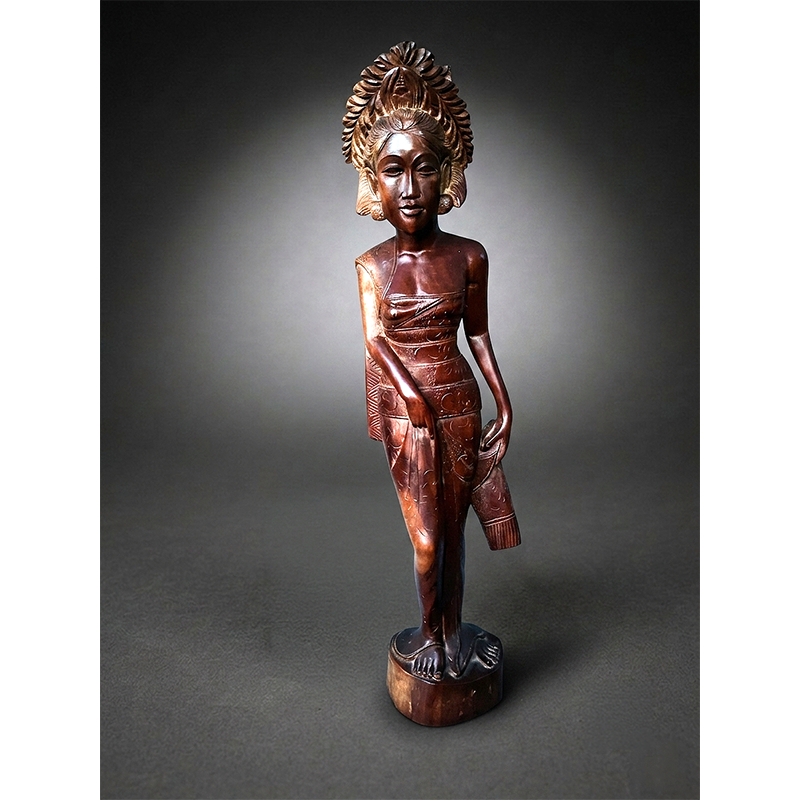
Captured in a moment of supreme, meditative poise, this majestic 50 cm sculpture stands as an elite manifestation of the Balinese Art Deco renaissance. The figure depicts an idealized noblewoman or a sacred temple dancer (reminiscent of the legendary Legong), exuding an otherworldly grace through her highly stylized, elongated physical form. Every line of this sculpture flows with rhythmic harmony: the gentle, asymmetrical sway of her torso, the delicate tilt of her head, and the fluid, elongated arms that terminate in extraordinarily refined fingers.
The level of craftsmanship elevates this piece far beyond standard regional production. The serene, confident facial modeling is paired with a finely undercut, multi-layered traditional headdress that showcases the carver's absolute mastery of depth. Below the elegant torso, the sarong is adorned with meticulous, hand-incised low-relief traditional patterns (ukiran) and delicate, hand-stippled punch-work mimicking fine royal batik textiles, characteristic of an elite workshop production.
The sculptural depth is beautifully enhanced by the master carver's play of contrasts. Her serene, aristocratic face features downcast almond eyes and a sublime, enigmatic smile, framed by large circular ear ornaments (subeng). Above her brow rises an astonishingly intricate, fan-like gelung headdress, carved in dense low-relief with floral motifs that catch the light with exquisite delicacy. She wears a tightly wrapped sabuk around her torso, and a long, sweeping kamben (sarong) that cascade gracefully down her long legs. The master artisan has treated the wood surface as a fine textile canvas, painstakingly texturing the garment with incised scrolls and stippled dot patterns that beautifully contrast against the flawlessly smooth, high-gloss burnished skin of the figure. As documented in the pristine photographic series, the piece possesses a breathtaking physical presence. Under controlled lighting, the dark wood's natural grain reveals rich, multi-layered reddish-brown undertones, highlighting the impeccable geometric harmony and fluid lines from every angle.
To understand the exact origin of this masterpiece, one must look to the artistic revolution that transformed Bali in the 1930s. Prior to this period, Balinese woodcarving was strictly communal, functional, and deeply religious, dedicated almost exclusively to temple architecture, deities (pratima), and ritual objects. The arrival of influential Western artists such as Walter Spies, Rudolf Bonnet, and Miguel Covarrubias sparked a historic cross-cultural synergy. In 1936, the Pita Maha (meaning "Great Shining Spirit") artists' cooperative was founded in Ubud by the prince Cokorda Gede Agung Sukawati, alongside Spies and Bonnet. This collective encouraged local master carvers to explore autonomous, individual artistic expressions. Breaking free from rigid traditional canonical proportions, artists from centers like Mas and Ubud developed a highly stylized, avant-garde aesthetic that beautifully fused centuries-old Hindu-Balinese mythology with the clean, streamlined geometry of international Art Deco. This sculpture represents the absolute zenith of that golden era. It is not an artifact made for the modern mass tourist trade; its refined proportions, extraordinary 50 cm height, and time-intensive craftsmanship point to a prestige commission or a high-end gallery piece created during the height of this mid-century stylistic movement.
From a functional standpoint, this sculpture belongs to the historical category of autonomous art objects born from the Pita Maha movement, meaning it was not placed inside a temple shrine to receive direct physical offerings like traditional pratima figures. However, to categorize it as purely secular would be an error in the context of the Balinese worldview. In Bali, woodcarving is a spiritual act governed by strict rituals. A master carver (Undagi) must select the wood according to cosmic calendars and invoke the gods before making the first cut. Most importantly, this piece is heavily imbued with Taksu—a fundamental Balinese concept defined as divine charisma, spiritual power, or a heavenly spark that enters an object when created with absolute devotion. The iconography itself is inherently sacred, channeling the divine harmony of Hindu epics and temple ceremonies. The figure's posture embodies the concept of Ajeg Bali (cultural and spiritual preservation), turning this sculpture into an active visual meditation and a channel for cosmic equilibrium.
STRUCTURE: Stable. No active splits or structural failure.
HEADDRESS: Fully intact. All undercut leaf/feather elements present, no losses.
SURFACE: Deep, even hand-polished patina throughout. No fresh or refinished areas.
INCISED DETAIL: Textile pattern incisions clear and well-preserved across torso and sarong.
HANDS/FINGERS: Intact. Fan held in left hand present and undamaged.
FEET/BASE: Intact. Stable on oval plinth base. Minor wear consistent with handling.
LOSSES: No significant losses. Minor surface wear at extremities consistent with age and handling.
RESTORATION: None visible.
 Security policy
Transactions protected by 256-bit SSL through 3D-Secure gateways—we never store your card details.
 Delivery policy
All items are professionally packed and shipped via premium, fully tracked carrier services.
 Return policy
If you are not entirely satisfied, you can return your acquisition within 15 days for a full refund.
Data sheet
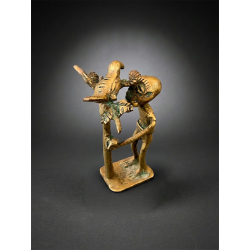
« A refined workshop carving — an object of craft and atmosphere for the connoisseur of Southeast Asian decorative arts. »
Captured in a moment of supreme, meditative poise, this majestic 50 cm sculpture stands as an elite manifestation of the Balinese Art Deco renaissance. The figure depicts an idealized noblewoman or a sacred temple dancer (reminiscent of the legendary Legong), exuding an otherworldly grace through her highly stylized, elongated physical form. Every line of this sculpture flows with rhythmic harmony: the gentle, asymmetrical sway of her torso, the delicate tilt of her head, and the fluid, elongated arms that terminate in extraordinarily refined fingers.
The level of craftsmanship elevates this piece far beyond standard regional production. The serene, confident facial modeling is paired with a finely undercut, multi-layered traditional headdress that showcases the carver's absolute mastery of depth. Below the elegant torso, the sarong is adorned with meticulous, hand-incised low-relief traditional patterns (ukiran) and delicate, hand-stippled punch-work mimicking fine royal batik textiles, characteristic of an elite workshop production.
The sculptural depth is beautifully enhanced by the master carver's play of contrasts. Her serene, aristocratic face features downcast almond eyes and a sublime, enigmatic smile, framed by large circular ear ornaments (subeng). Above her brow rises an astonishingly intricate, fan-like gelung headdress, carved in dense low-relief with floral motifs that catch the light with exquisite delicacy. She wears a tightly wrapped sabuk around her torso, and a long, sweeping kamben (sarong) that cascade gracefully down her long legs. The master artisan has treated the wood surface as a fine textile canvas, painstakingly texturing the garment with incised scrolls and stippled dot patterns that beautifully contrast against the flawlessly smooth, high-gloss burnished skin of the figure. As documented in the pristine photographic series, the piece possesses a breathtaking physical presence. Under controlled lighting, the dark wood's natural grain reveals rich, multi-layered reddish-brown undertones, highlighting the impeccable geometric harmony and fluid lines from every angle.
To understand the exact origin of this masterpiece, one must look to the artistic revolution that transformed Bali in the 1930s. Prior to this period, Balinese woodcarving was strictly communal, functional, and deeply religious, dedicated almost exclusively to temple architecture, deities (pratima), and ritual objects. The arrival of influential Western artists such as Walter Spies, Rudolf Bonnet, and Miguel Covarrubias sparked a historic cross-cultural synergy. In 1936, the Pita Maha (meaning "Great Shining Spirit") artists' cooperative was founded in Ubud by the prince Cokorda Gede Agung Sukawati, alongside Spies and Bonnet. This collective encouraged local master carvers to explore autonomous, individual artistic expressions. Breaking free from rigid traditional canonical proportions, artists from centers like Mas and Ubud developed a highly stylized, avant-garde aesthetic that beautifully fused centuries-old Hindu-Balinese mythology with the clean, streamlined geometry of international Art Deco. This sculpture represents the absolute zenith of that golden era. It is not an artifact made for the modern mass tourist trade; its refined proportions, extraordinary 50 cm height, and time-intensive craftsmanship point to a prestige commission or a high-end gallery piece created during the height of this mid-century stylistic movement.
From a functional standpoint, this sculpture belongs to the historical category of autonomous art objects born from the Pita Maha movement, meaning it was not placed inside a temple shrine to receive direct physical offerings like traditional pratima figures. However, to categorize it as purely secular would be an error in the context of the Balinese worldview. In Bali, woodcarving is a spiritual act governed by strict rituals. A master carver (Undagi) must select the wood according to cosmic calendars and invoke the gods before making the first cut. Most importantly, this piece is heavily imbued with Taksu—a fundamental Balinese concept defined as divine charisma, spiritual power, or a heavenly spark that enters an object when created with absolute devotion. The iconography itself is inherently sacred, channeling the divine harmony of Hindu epics and temple ceremonies. The figure's posture embodies the concept of Ajeg Bali (cultural and spiritual preservation), turning this sculpture into an active visual meditation and a channel for cosmic equilibrium.
STRUCTURE: Stable. No active splits or structural failure.
HEADDRESS: Fully intact. All undercut leaf/feather elements present, no losses.
SURFACE: Deep, even hand-polished patina throughout. No fresh or refinished areas.
INCISED DETAIL: Textile pattern incisions clear and well-preserved across torso and sarong.
HANDS/FINGERS: Intact. Fan held in left hand present and undamaged.
FEET/BASE: Intact. Stable on oval plinth base. Minor wear consistent with handling.
LOSSES: No significant losses. Minor surface wear at extremities consistent with age and handling.
RESTORATION: None visible.