


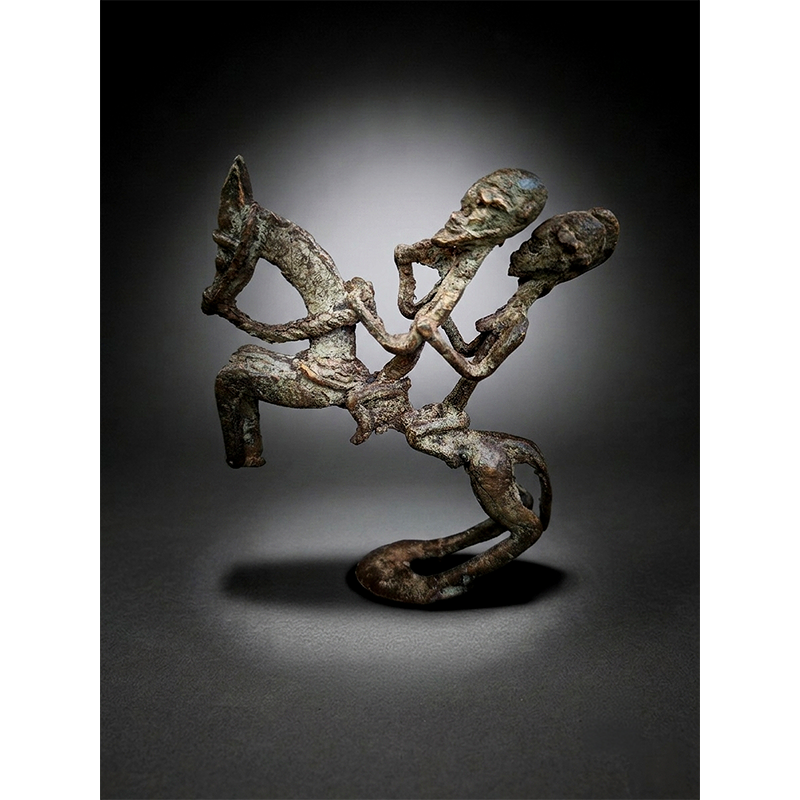


« A RARE MULTI-FIGURE EQUESTRIAN COMPOSITION IN LOST-WAX BRONZE — THE HORSE-AND-RIDER MOTIF THAT HAS PERSISTED IN DOGON COSMOLOGY FOR OVER A THOUSAND YEARS, HERE RENDERED WITH EXCEPTIONAL SCULPTURAL DYNAMISM. »
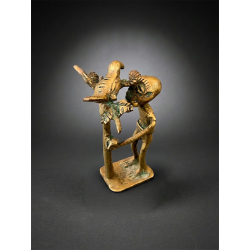
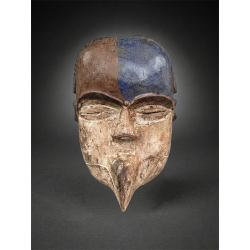
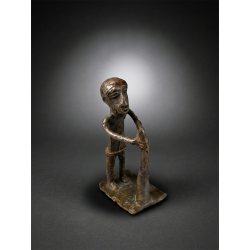
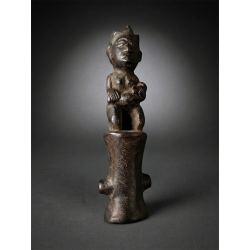
A small but formally complex lost-wax bronze group measuring 13 × 11 × 2 cm. The composition centres on a horse rendered with long, slightly splayed legs, a well-defined head with pricked ears and clearly modelled eye sockets, and — most distinctively — a tail that spirals into a large, flat-coiled scroll form visible in the base view (Image 4). This coiled tail is the object's most individually distinctive formal element: it creates a stable resting point when the group is placed horizontally and also functions as a compositional anchor for the entire dynamic group. Three anthropomorphic figures are present in varying degrees of attachment to the horse: a primary rider seated on the horse's back in the frontal position, with attenuated torso, small schematic head with tilted-back skull form, and legs hanging at the flanks; a second figure engaged in dynamic torsion — leaning or falling — whose body intersects with the horse's neck/shoulder zone; and a third figure visible in the right lateral view, smaller and more abbreviated, attached at the group's trailing edge. The overall composition reads differently from every angle: from the front as a controlled equestrian scene; from the side as a swirling, energetic tangle of limbs and bodies; from above as an almost abstract interweaving of line and form. This multi-directional dynamic is characteristic of the finest Dogon metal casting tradition. The patina is authentic and differentiated: the upper exposed surfaces carry a natural verdigris green — the copper-carbonate corrosion product of genuine aged bronze in an open-air environment — while the lower, more sheltered areas retain the warm reddish-brown base metal tone. There is no artificially applied black or brown patination. The casting shows the characteristic slightly rough, textured surface of direct lost-wax process without extensive post-cast finishing — consistent with Dogon irim production.
The scrolled, coiled tail visible in the base view is not a random formal choice. In Dogon bronze and carved-wood equestrian representations, the tail is often stylised as a looping or spiralling element — a formal vocabulary that appears consistently in the Hamill Gallery's documented corpus of Dogon bronze riders and in MetMuseum inv. 1979.206.85 (equestrian figure, Dogon or Tellem peoples). The spiral in Dogon cosmology references the helical structure of the Nommo's descent — the coiled ark, the water-snake, the vortex of creation. Its presence on the horse's tail, rendered at this scale with this precision, elevates the formal reading of the piece from functional to cosmologically literate.
The object was produced by the irim — the Dogon blacksmith and bronze-caster caste, an endogamous group occupying a specific social position as mediators between the earthly and spiritual worlds. The irim are responsible for all metal production in Dogon society, from agricultural implements to sacred objects. Their lost-wax process follows ancient West African precedent: a wax model is built by hand, sometimes over a clay core for larger pieces (solid casting for small ones like this); a clay investment mould is formed around it; the wax is melted out; molten bronze or brass is poured into the void; the mould is broken away to reveal the unique cast form. Each lost-wax piece is therefore intrinsically unique — no two are identical. The textured, slightly rough surface of this group confirms direct casting without extensive hand-finishing, a hallmark of authentic irim production.
The Dogon people of the Bandiagara Escarpment in Mali are among the most studied peoples in African anthropology, primarily through Marcel Griaule's fieldwork beginning in 1931. Their cosmological system is among the most complex documented in West Africa, structured around the creation narrative of Amma (the creator god), the eight Nommo (primordial water-spirits / ancestors), and the sacrifice and resurrection of the Nommo whose body became the foundation of the world. The horse's presence in the region has been documented as early as the 11th century with the birth of West Africa's great medieval empires. These objects evince the sitter's social prestige and exceptional capabilities. In the Dogon creation myth, the resurrected Nommo descended to earth using an ark that metamorphosed into a horse — making the horse simultaneously a cosmological vehicle, an ancestral symbol, and an emblem of the Hogon (the supreme religious leader), who paraded on horseback at his enthronement because by custom he should not place his feet directly on the ground. Equestrian figures express status, prestige and power. They would bring honour to the ancestors, the current leadership and the owner of the sculpture. The multi-figure composition of this bronze — with what appear to be multiple attendants or subsidiary figures around the principal rider — could represent the Hogon's enthronement procession, a warrior chief with retainers, or a mythological scene from the Dogon oral tradition.
STRUCTURE: Fully intact. All figure elements and the horse present. No detached or missing components.
CASTING: Sound throughout. No hairline fractures or casting failures.
PATINA: Natural verdigris green on upper/exposed surfaces. Warm reddish-brown on lower/sheltered surfaces.
FIGURES: All three anthropomorphic figures present and intact. No heads, limbs, or other elements missing.
HORSE: Intact. All four legs present. Coiled tail intact. Head intact with ear forms present.
LOSSES: No structural losses.
CLEANING: Do not chemically clean — the verdigris patina is an authenticity marker and is part of the object's value.
RESTORATION: None visible.
In 1931, Marcel Griaule crossed the Sahara and reached the Bandiagara Escarpment. What he found there was not a 'primitive' society but one of the most elaborately structured cosmological systems ever documented by an anthropologist: a people who had spent centuries encoding their understanding of creation, duality, sacrifice, and resurrection into the objects they made. The horse, which cannot survive in the rocky inaccessible terrain of the Bandiagara cliffs, became precisely because of its impossibility the perfect vehicle for the divine — an animal that belongs to the world of power and prestige, not of daily life. This small bronze group performs a remarkable formal feat: at 13 cm, it contains a horse, three human figures, a coiled cosmological tail, and the dynamic energy of an entire mythological narrative. The irim who cast it understood that lost-wax process is irreversible — you commit the form in wax, invest it in clay, melt it away, fill the void, and break the mould. What emerges is singular. This group is that singular cast — the accidental and deliberate record of one craftsman's intention, made unique by the process itself. For the collector of Dogon material, equestrian bronzes occupy a specific and desirable category. The multi-figure composition — three riders or figures around a single horse — is substantially rarer than the standard single horse-and-rider format. The coiled tail adds a formal and cosmological dimension not present in straight-tail examples. At 13 cm this is precisely the scale for the Dogon 'small bronze' tradition — dense, solid, intrinsically unique, and requiring no stand or armature to display effectively.
 Security policy
Transactions protected by 256-bit SSL through 3D-Secure gateways—we never store your card details.
 Delivery policy
All items are professionally packed and shipped via premium, fully tracked carrier services.
 Return policy
If you are not entirely satisfied, you can return your acquisition within 15 days for a full refund.
Data sheet
« A RARE MULTI-FIGURE EQUESTRIAN COMPOSITION IN LOST-WAX BRONZE — THE HORSE-AND-RIDER MOTIF THAT HAS PERSISTED IN DOGON COSMOLOGY FOR OVER A THOUSAND YEARS, HERE RENDERED WITH EXCEPTIONAL SCULPTURAL DYNAMISM. »
A small but formally complex lost-wax bronze group measuring 13 × 11 × 2 cm. The composition centres on a horse rendered with long, slightly splayed legs, a well-defined head with pricked ears and clearly modelled eye sockets, and — most distinctively — a tail that spirals into a large, flat-coiled scroll form visible in the base view (Image 4). This coiled tail is the object's most individually distinctive formal element: it creates a stable resting point when the group is placed horizontally and also functions as a compositional anchor for the entire dynamic group. Three anthropomorphic figures are present in varying degrees of attachment to the horse: a primary rider seated on the horse's back in the frontal position, with attenuated torso, small schematic head with tilted-back skull form, and legs hanging at the flanks; a second figure engaged in dynamic torsion — leaning or falling — whose body intersects with the horse's neck/shoulder zone; and a third figure visible in the right lateral view, smaller and more abbreviated, attached at the group's trailing edge. The overall composition reads differently from every angle: from the front as a controlled equestrian scene; from the side as a swirling, energetic tangle of limbs and bodies; from above as an almost abstract interweaving of line and form. This multi-directional dynamic is characteristic of the finest Dogon metal casting tradition. The patina is authentic and differentiated: the upper exposed surfaces carry a natural verdigris green — the copper-carbonate corrosion product of genuine aged bronze in an open-air environment — while the lower, more sheltered areas retain the warm reddish-brown base metal tone. There is no artificially applied black or brown patination. The casting shows the characteristic slightly rough, textured surface of direct lost-wax process without extensive post-cast finishing — consistent with Dogon irim production.
The scrolled, coiled tail visible in the base view is not a random formal choice. In Dogon bronze and carved-wood equestrian representations, the tail is often stylised as a looping or spiralling element — a formal vocabulary that appears consistently in the Hamill Gallery's documented corpus of Dogon bronze riders and in MetMuseum inv. 1979.206.85 (equestrian figure, Dogon or Tellem peoples). The spiral in Dogon cosmology references the helical structure of the Nommo's descent — the coiled ark, the water-snake, the vortex of creation. Its presence on the horse's tail, rendered at this scale with this precision, elevates the formal reading of the piece from functional to cosmologically literate.
The object was produced by the irim — the Dogon blacksmith and bronze-caster caste, an endogamous group occupying a specific social position as mediators between the earthly and spiritual worlds. The irim are responsible for all metal production in Dogon society, from agricultural implements to sacred objects. Their lost-wax process follows ancient West African precedent: a wax model is built by hand, sometimes over a clay core for larger pieces (solid casting for small ones like this); a clay investment mould is formed around it; the wax is melted out; molten bronze or brass is poured into the void; the mould is broken away to reveal the unique cast form. Each lost-wax piece is therefore intrinsically unique — no two are identical. The textured, slightly rough surface of this group confirms direct casting without extensive hand-finishing, a hallmark of authentic irim production.
The Dogon people of the Bandiagara Escarpment in Mali are among the most studied peoples in African anthropology, primarily through Marcel Griaule's fieldwork beginning in 1931. Their cosmological system is among the most complex documented in West Africa, structured around the creation narrative of Amma (the creator god), the eight Nommo (primordial water-spirits / ancestors), and the sacrifice and resurrection of the Nommo whose body became the foundation of the world. The horse's presence in the region has been documented as early as the 11th century with the birth of West Africa's great medieval empires. These objects evince the sitter's social prestige and exceptional capabilities. In the Dogon creation myth, the resurrected Nommo descended to earth using an ark that metamorphosed into a horse — making the horse simultaneously a cosmological vehicle, an ancestral symbol, and an emblem of the Hogon (the supreme religious leader), who paraded on horseback at his enthronement because by custom he should not place his feet directly on the ground. Equestrian figures express status, prestige and power. They would bring honour to the ancestors, the current leadership and the owner of the sculpture. The multi-figure composition of this bronze — with what appear to be multiple attendants or subsidiary figures around the principal rider — could represent the Hogon's enthronement procession, a warrior chief with retainers, or a mythological scene from the Dogon oral tradition.
STRUCTURE: Fully intact. All figure elements and the horse present. No detached or missing components.
CASTING: Sound throughout. No hairline fractures or casting failures.
PATINA: Natural verdigris green on upper/exposed surfaces. Warm reddish-brown on lower/sheltered surfaces.
FIGURES: All three anthropomorphic figures present and intact. No heads, limbs, or other elements missing.
HORSE: Intact. All four legs present. Coiled tail intact. Head intact with ear forms present.
LOSSES: No structural losses.
CLEANING: Do not chemically clean — the verdigris patina is an authenticity marker and is part of the object's value.
RESTORATION: None visible.
In 1931, Marcel Griaule crossed the Sahara and reached the Bandiagara Escarpment. What he found there was not a 'primitive' society but one of the most elaborately structured cosmological systems ever documented by an anthropologist: a people who had spent centuries encoding their understanding of creation, duality, sacrifice, and resurrection into the objects they made. The horse, which cannot survive in the rocky inaccessible terrain of the Bandiagara cliffs, became precisely because of its impossibility the perfect vehicle for the divine — an animal that belongs to the world of power and prestige, not of daily life. This small bronze group performs a remarkable formal feat: at 13 cm, it contains a horse, three human figures, a coiled cosmological tail, and the dynamic energy of an entire mythological narrative. The irim who cast it understood that lost-wax process is irreversible — you commit the form in wax, invest it in clay, melt it away, fill the void, and break the mould. What emerges is singular. This group is that singular cast — the accidental and deliberate record of one craftsman's intention, made unique by the process itself. For the collector of Dogon material, equestrian bronzes occupy a specific and desirable category. The multi-figure composition — three riders or figures around a single horse — is substantially rarer than the standard single horse-and-rider format. The coiled tail adds a formal and cosmological dimension not present in straight-tail examples. At 13 cm this is precisely the scale for the Dogon 'small bronze' tradition — dense, solid, intrinsically unique, and requiring no stand or armature to display effectively.