


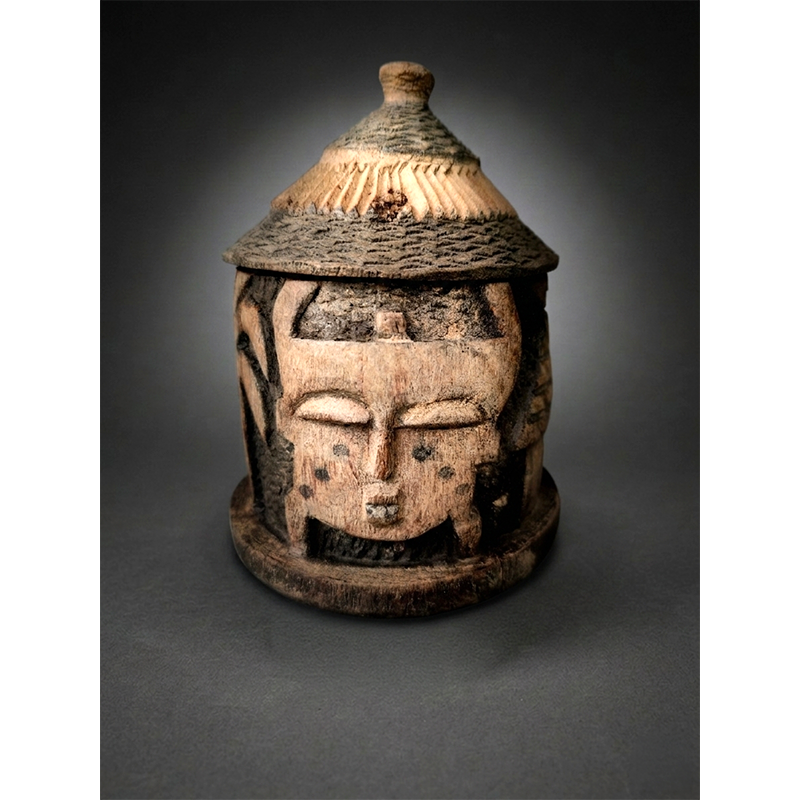


A compelling lidded ritual vessel from the Tshokwe (Chokwe) people of northeastern Angola, conceived as a miniature architectural reliquary: a cylindrical body surmounted by a conical lid carved to evoke the layered thatch of a Chokwe chiefly hut, crowned by a turned central finial. Within Chokwe material culture, lidded wooden vessels of this kind served as containers for snuff tobacco (mata), medicinal preparations of the nganga diviner-healer, the red tukula (camwood) powder used as cosmetic and unguent, and the personal small valuables of titled men and women of the Mwana Ngana lineage system. The body is articulated into figurative panels divided by stylized palm trees rendered in raised relief — a quintessentially Chokwe iconographic motif evoking the oil palm whose products (palm wine, oil, fronds) lie at the heart of Chokwe economic and ritual life. The negative ground is deepened and blackened by pyrography to throw the carved imagery into sharp chiaroscuro. One panel presents a frontal anthropomorphic face with almond eyes, narrow nose, and pursed mouth, recalling the ancestral countenances of Chokwe ancestor figures (mahamba). A second panel shows a small schematic standing figure — likely an ancestor or hunter, in the narrative tradition of Chokwe decorative arts where genre scenes from court and forest life populate carved surfaces. The lid is dressed in two registers of incised hatching imitating woven thatch, terminating in the turned finial that reads as both a roof apex and a stylized ceramic pot — a recurring Chokwe pictorial convention.
Carved from a single block of dense tropical hardwood, hollowed by adze and finished by knife. The piece is notably heavy for its scale (824 g for 18 cm), confirming the use of a close-grained, high-density wood typical of Lunda-region Chokwe work. The decoration combines three techniques: raised-relief carving for the figurative motifs, fine incised line for the thatch pattern of the lid, and pyrography (controlled burning with a heated iron) for the dark recessed ground — a hallmark of Chokwe surface ornament well documented in the works of Marie-Louise Bastin and Manuel Jordán. The interior of the vessel retains an old organic residue with a distinct woody scent, consistent with prolonged storage of pulverized vegetal matter, most plausibly tukula powder or aromatic snuff.
The Tshokwe (also written Chokwe, Cokwe, Quioco) are a Bantu people whose territory spans northeastern Angola, southwestern Democratic Republic of Congo, and northwestern Zambia. Originally part of the Lunda empire, they emerged as a distinct cultural force in the 18th and 19th centuries, becoming renowned across Central Africa for the refinement of their wood sculpture, the prestige of their chiefly arts, and the prolific output of their professional sculptors (songi). Chokwe court art reaches its apex in the famous chibinda ilunga hunter-chief figures, the mwana pwo female masks, and the elaborately decorated chiefly chairs (ngundja) — but the broader corpus also includes a rich variety of smaller domestic-ritual objects: tobacco mortars, divining trays, combs, staffs of office, and the present category of lidded containers. The hut-form lid is iconographically significant: in Chokwe pictorial logic, the conical roof of the chiefly residence represents the threshold between the lived world of the village and the ancestral world above. A container shaped as a chief's house thus reads as a domesticated ancestor-shrine — a vessel in which substances of personal power could be stored under the symbolic protection of the lineage. The combination of ancestral face, narrative figure, and palm-tree motif compresses, into a single object, the three pillars of Chokwe self-understanding: the ancestors, the social actor, and the forest economy that sustains them. Such pieces entered European collections in significant numbers from the late colonial period (1940s–1960s) onward, through Portuguese administrators, missionaries, and the diamond-mining company personnel of Diamang in Lunda Norte. Production continued through the civil war years and into the present, though pieces of genuine age and use-patina such as the present example are increasingly difficult to source.
Very good state of preservation given the age and the climate of origin. Honest wood-movement crack running vertically through body and lid — structural but stable, characteristic of long-dried tropical hardwood subjected to European indoor climates. Minor surface losses at the base rim. Pyrography is dry and well-set into the wood (not recent application). Interior retains old organic residue and patina, woody scent on the inside. No restoration, no repainting, no consolidant. The piece presents as found.
Chokwe lidded vessels with this kind of architectural conception are a refined and relatively scarce sub-category within Chokwe material culture. The present example offers a combination rarely seen at this scale:
(1) a complete and intact two-part structure (body and original lid still mating),
(2) a rich combinatorial decorative program drawing on the full vocabulary of Chokwe ornament (ancestral face, narrative figure, palm-tree motif, geometric infill, pyrography), and
(3) honest interior residue suggesting genuine ritual or domestic deployment rather than display-only production.
For collectors building depth in Chokwe art beyond the canonical figure-and-mask categories, lidded vessels remain an undervalued and aesthetically rewarding field, with strong upside as connoisseurship of Angolan tribal art continues to mature in the European market.
 Security policy
Transactions protected by 256-bit SSL through 3D-Secure gateways—we never store your card details.
 Delivery policy
All items are professionally packed and shipped via premium, fully tracked carrier services.
 Return policy
If you are not entirely satisfied, you can return your acquisition within 15 days for a full refund.
Data sheet
A compelling lidded ritual vessel from the Tshokwe (Chokwe) people of northeastern Angola, conceived as a miniature architectural reliquary: a cylindrical body surmounted by a conical lid carved to evoke the layered thatch of a Chokwe chiefly hut, crowned by a turned central finial. Within Chokwe material culture, lidded wooden vessels of this kind served as containers for snuff tobacco (mata), medicinal preparations of the nganga diviner-healer, the red tukula (camwood) powder used as cosmetic and unguent, and the personal small valuables of titled men and women of the Mwana Ngana lineage system. The body is articulated into figurative panels divided by stylized palm trees rendered in raised relief — a quintessentially Chokwe iconographic motif evoking the oil palm whose products (palm wine, oil, fronds) lie at the heart of Chokwe economic and ritual life. The negative ground is deepened and blackened by pyrography to throw the carved imagery into sharp chiaroscuro. One panel presents a frontal anthropomorphic face with almond eyes, narrow nose, and pursed mouth, recalling the ancestral countenances of Chokwe ancestor figures (mahamba). A second panel shows a small schematic standing figure — likely an ancestor or hunter, in the narrative tradition of Chokwe decorative arts where genre scenes from court and forest life populate carved surfaces. The lid is dressed in two registers of incised hatching imitating woven thatch, terminating in the turned finial that reads as both a roof apex and a stylized ceramic pot — a recurring Chokwe pictorial convention.
Carved from a single block of dense tropical hardwood, hollowed by adze and finished by knife. The piece is notably heavy for its scale (824 g for 18 cm), confirming the use of a close-grained, high-density wood typical of Lunda-region Chokwe work. The decoration combines three techniques: raised-relief carving for the figurative motifs, fine incised line for the thatch pattern of the lid, and pyrography (controlled burning with a heated iron) for the dark recessed ground — a hallmark of Chokwe surface ornament well documented in the works of Marie-Louise Bastin and Manuel Jordán. The interior of the vessel retains an old organic residue with a distinct woody scent, consistent with prolonged storage of pulverized vegetal matter, most plausibly tukula powder or aromatic snuff.
The Tshokwe (also written Chokwe, Cokwe, Quioco) are a Bantu people whose territory spans northeastern Angola, southwestern Democratic Republic of Congo, and northwestern Zambia. Originally part of the Lunda empire, they emerged as a distinct cultural force in the 18th and 19th centuries, becoming renowned across Central Africa for the refinement of their wood sculpture, the prestige of their chiefly arts, and the prolific output of their professional sculptors (songi). Chokwe court art reaches its apex in the famous chibinda ilunga hunter-chief figures, the mwana pwo female masks, and the elaborately decorated chiefly chairs (ngundja) — but the broader corpus also includes a rich variety of smaller domestic-ritual objects: tobacco mortars, divining trays, combs, staffs of office, and the present category of lidded containers. The hut-form lid is iconographically significant: in Chokwe pictorial logic, the conical roof of the chiefly residence represents the threshold between the lived world of the village and the ancestral world above. A container shaped as a chief's house thus reads as a domesticated ancestor-shrine — a vessel in which substances of personal power could be stored under the symbolic protection of the lineage. The combination of ancestral face, narrative figure, and palm-tree motif compresses, into a single object, the three pillars of Chokwe self-understanding: the ancestors, the social actor, and the forest economy that sustains them. Such pieces entered European collections in significant numbers from the late colonial period (1940s–1960s) onward, through Portuguese administrators, missionaries, and the diamond-mining company personnel of Diamang in Lunda Norte. Production continued through the civil war years and into the present, though pieces of genuine age and use-patina such as the present example are increasingly difficult to source.
Very good state of preservation given the age and the climate of origin. Honest wood-movement crack running vertically through body and lid — structural but stable, characteristic of long-dried tropical hardwood subjected to European indoor climates. Minor surface losses at the base rim. Pyrography is dry and well-set into the wood (not recent application). Interior retains old organic residue and patina, woody scent on the inside. No restoration, no repainting, no consolidant. The piece presents as found.
Chokwe lidded vessels with this kind of architectural conception are a refined and relatively scarce sub-category within Chokwe material culture. The present example offers a combination rarely seen at this scale:
(1) a complete and intact two-part structure (body and original lid still mating),
(2) a rich combinatorial decorative program drawing on the full vocabulary of Chokwe ornament (ancestral face, narrative figure, palm-tree motif, geometric infill, pyrography), and
(3) honest interior residue suggesting genuine ritual or domestic deployment rather than display-only production.
For collectors building depth in Chokwe art beyond the canonical figure-and-mask categories, lidded vessels remain an undervalued and aesthetically rewarding field, with strong upside as connoisseurship of Angolan tribal art continues to mature in the European market.