




« A rare prestige object of the Luba aristocracy — a fully functional water pipe whose form encodes the aesthetic values, social hierarchy, and sculptural mastery of one of Central Africa's most sophisticated court traditions. »
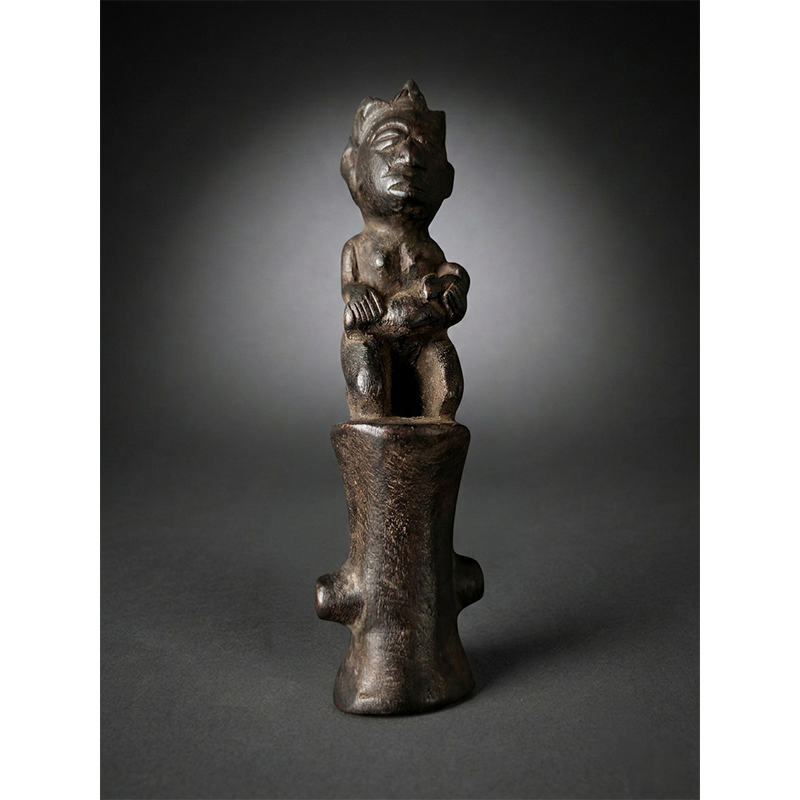
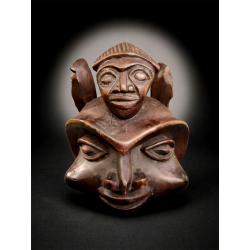
This exquisite prestige object, documented thoroughly in images 1, 2, 3, 4, and 5, represents an intimate masterpiece of Luba miniature carving. Standing at a refined 16 cm, the composition seamlessly marries functional architecture with sacred royal iconography.
The lower portion of the object forms the functional core of a water or prestige pipe, showcasing a flaring cylindrical neck and lateral structural bosses designed to interface with a cane stem or gourd water container. Surmounting this column is a beautifully realized Luba woman kneeling in a posture of profound poise.
As captured in the detailed close-up, the woman holds a baby securely across her lap, her elongated, elegant fingers gently securing the infant. Her face reflects the classic Luba idealized countenance—almond-shaped, heavy-lidded eyes downcast in meditation, a broad forehead, and a serene, closed mouth, conveying inner spiritual power.
The reverse view reveals the true virtuosic hallmark of the artist: an elaborate, tiered coiffure deeply incised with precise chevron and cross-hatched patterns, mimicking the complex braided hairstyles reserved for elite Luba women of high social standing. The wood grain curves naturally along the contours of the figure, highlighted by an authentic, highly reflective, satiny dark-brown patina born from generations of ritual prestige use.
In Luba society, women are viewed as the ultimate spiritual vessels. They are the only beings deemed pure enough to hold the spirits of divine kings (Mulopwe) and act as mediums (Mwadi) between the living and the ancestral realms. The maternity motif (Mwana) depicted here is not merely a secular domestic scene; it is a profound declaration of lineage continuity, divine transformation, and the spiritual foundation of Luba political authority.
Prestige pipes (mututshi or mueshi) were far more than utilitarian smoking implements. Owned exclusively by chiefs, titleholders, and bilumbu (diviners), these pipes were smoked during highly charged political assemblies, investitures, and sacred consultations. Tobacco or hemp (bhang) was consumed to induce altered states of consciousness, allowing the leader or diviner to communicate directly with the ancestors. The act of drawing smoke through a vessel crowned by a sacred mother effectively meant inhaling ancestral wisdom through the source of life itself.
For the discerning collector, Luba art represents the peak of Central African courtly sophistication. While large-scale masks and caryatid stools capture the public eye, it is in miniature prestige objects like this pipe finial where the artist's finest technical skills are laid bare.
To hold this object is to feel the weight of its history. Every contour of the kneeling mother, from the gentle swell of her back to the elaborate architecture of her hair, has been softened and polished by the touch of a Luba noble. The inclusion of the child elevates this piece into an incredibly rare tier of luxury prestige items—most traditional Luba pipes feature single female heads or simple standing figures. A full maternity composition at this scale is an exceptional find.
 Security policy
Transactions protected by 256-bit SSL through 3D-Secure gateways—we never store your card details.
 Delivery policy
All items are professionally packed and shipped via premium, fully tracked carrier services.
 Return policy
If you are not entirely satisfied, you can return your acquisition within 15 days for a full refund.
Data sheet
« A rare prestige object of the Luba aristocracy — a fully functional water pipe whose form encodes the aesthetic values, social hierarchy, and sculptural mastery of one of Central Africa's most sophisticated court traditions. »
This exquisite prestige object, documented thoroughly in images 1, 2, 3, 4, and 5, represents an intimate masterpiece of Luba miniature carving. Standing at a refined 16 cm, the composition seamlessly marries functional architecture with sacred royal iconography.
The lower portion of the object forms the functional core of a water or prestige pipe, showcasing a flaring cylindrical neck and lateral structural bosses designed to interface with a cane stem or gourd water container. Surmounting this column is a beautifully realized Luba woman kneeling in a posture of profound poise.
As captured in the detailed close-up, the woman holds a baby securely across her lap, her elongated, elegant fingers gently securing the infant. Her face reflects the classic Luba idealized countenance—almond-shaped, heavy-lidded eyes downcast in meditation, a broad forehead, and a serene, closed mouth, conveying inner spiritual power.
The reverse view reveals the true virtuosic hallmark of the artist: an elaborate, tiered coiffure deeply incised with precise chevron and cross-hatched patterns, mimicking the complex braided hairstyles reserved for elite Luba women of high social standing. The wood grain curves naturally along the contours of the figure, highlighted by an authentic, highly reflective, satiny dark-brown patina born from generations of ritual prestige use.
In Luba society, women are viewed as the ultimate spiritual vessels. They are the only beings deemed pure enough to hold the spirits of divine kings (Mulopwe) and act as mediums (Mwadi) between the living and the ancestral realms. The maternity motif (Mwana) depicted here is not merely a secular domestic scene; it is a profound declaration of lineage continuity, divine transformation, and the spiritual foundation of Luba political authority.
Prestige pipes (mututshi or mueshi) were far more than utilitarian smoking implements. Owned exclusively by chiefs, titleholders, and bilumbu (diviners), these pipes were smoked during highly charged political assemblies, investitures, and sacred consultations. Tobacco or hemp (bhang) was consumed to induce altered states of consciousness, allowing the leader or diviner to communicate directly with the ancestors. The act of drawing smoke through a vessel crowned by a sacred mother effectively meant inhaling ancestral wisdom through the source of life itself.
For the discerning collector, Luba art represents the peak of Central African courtly sophistication. While large-scale masks and caryatid stools capture the public eye, it is in miniature prestige objects like this pipe finial where the artist's finest technical skills are laid bare.
To hold this object is to feel the weight of its history. Every contour of the kneeling mother, from the gentle swell of her back to the elaborate architecture of her hair, has been softened and polished by the touch of a Luba noble. The inclusion of the child elevates this piece into an incredibly rare tier of luxury prestige items—most traditional Luba pipes feature single female heads or simple standing figures. A full maternity composition at this scale is an exceptional find.