


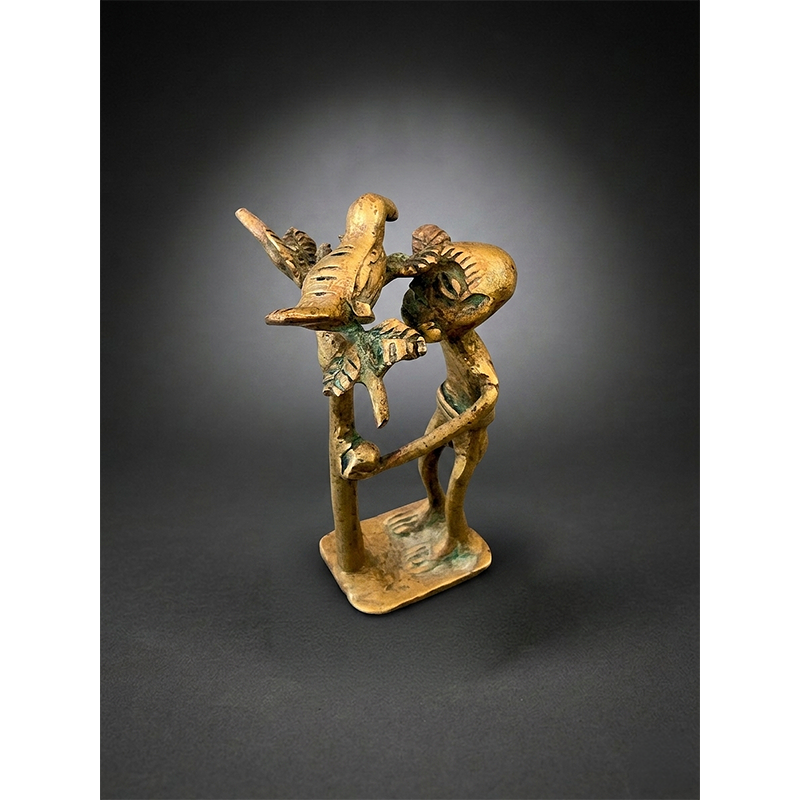


"This remarkable figurative gold weight (mmramo) is a mini-masterpiece of West African metalwork, dating from the height of the Akan mercantile era. The sculpture represents a classic allegorical figure often recorded in regional oral histories: a palm wine tapster climbing or interacting with a palm tree, accompanied by a bird nesting or feeding atop the fronds. In Akan society, such figurative weights were far more than utilitarian tools used to weigh gold dust (sika futuro) in daily trade; they were visual vehicles for complex moral philosophies, proverbs (abebu), and social commentary."
The relationship between the man, the tree, and the bird likely translates to a specific traditional proverb regarding caution, resource sharing, or the inevitable presence of nature in human endeavors (e.g., "If you climb a good tree, you are given a push," or proverbs relating to the bird witnessing the secrets of the forest). The level of expressive detail in this 6 cm piece is exceptional—capturing the intense posture of the figure alongside a highly stylized bird.
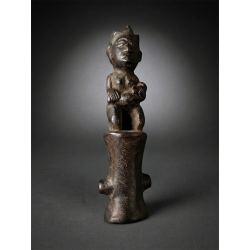
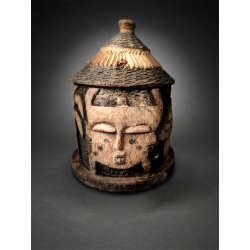
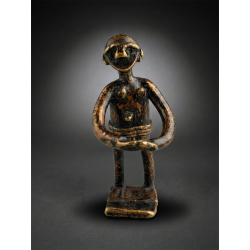
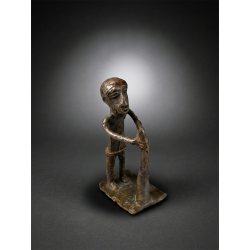
The figure stands erect on a thick rectangular plinth — the structural anchor that lets a hand-modelled wax composition cool evenly during casting, and lets the finished weight rest stable on a trader's scale-pan. The body is rendered in the elongated, almost calligraphic idiom of Akan figural weights: long limbs, a narrow torso, a girdled waist, and bare feet planted square. Across his head, supported by a raised arm, the man carries — or wrestles, or presents — a stylised bird with outspread wings and an elongated beak. The wings are scored with parallel incisions that read as primary flight feathers; the bird's body is squat, the head turned sideways. The composition is sculptural in the round: the negative space between the man's leg and the bird's tail is fully open, a feat that only lost-wax casting allows at this scale. The surface alternates between two registers. The high points — shoulders, brow, kneecaps, the curve of the base — retain a warm, yellow-brass tone, evidence of handling and the natural polish that decades of use confer. Recesses and undercuts carry verdigris: the green-blue copper carbonate that forms slowly in humid tropical air. The patina is uneven in a way that reads as authentic — concentrated where moisture would settle, absent where contact would wear it away.
From the 15th to the early 20th century, the Akan peoples of what is now Ghana and southeastern Côte d'Ivoire operated one of the most refined indigenous monetary economies in West Africa. Gold dust (sika futuro) was the currency. Brass weights — called mrammuo or abrammuo — were the instruments of valuation. Every adult Akan man of standing owned a kit: a balance, a spoon, a small box, and a graduated set of weights ranging from a fraction of a gram to nearly a hundred. The earliest weights, from the 15th–17th centuries, are geometric — pyramids, lozenges, knotted forms. Figural weights, depicting people, animals, tools, and proverb scenes, emerge with greater frequency from the late 17th century onward, flourishing through the 18th and 19th. Each figural composition carried a proverb (ebe), a moral lesson, or a reference to history. To do business with the Akan was to negotiate inside a moral cosmology cast in brass. The weight system was tied to international standards through centuries of trade with Portuguese, Dutch, Danish, and British merchants. The Asante dwa (ounce) was calibrated to the Dutch trade-ounce of approximately 30.7 grams — itself derived from the medieval Cologne mark. A weight of 29–30 grams, as ours measures, sits squarely on this canonical mass. The system was largely abandoned between 1896 and 1900, when British colonial authority introduced sterling currency in the Gold Coast. The latest functional weights belong to this twilight moment.
FUNCTION
Goldweights were primarily commercial instruments, not ritual objects. Their working life was lived on the scale-pan, balanced against gold dust drawn from a leather pouch. To call them sacred would overstate; to call them secular would miss their density. The figural weights — and this is one of their distinguishing qualities in world art — operated simultaneously as standards of value, as moral mnemonics, and as expressions of personal identity. A man's kit of weights, accumulated over a lifetime and inherited by his heirs, reflected his trade, his lineage, and the proverbs he chose to live by. Some weights entered funerary inventories; some were deposited at shrines as thanksgiving offerings. The boundary between everyday commerce and sacred meaning was, in the Akan world, deliberately porous.
PROVERB READING
The composition — a man carrying or holding a bird overhead — belongs to the broad Akan proverb genre of man-and-fowl scenes. Possible readings include the hunter who has caught a prize, the diviner who consults a bird oracle, or the proverb “The bird flies high, but it must come down to drink” — a meditation on the inevitability of return. We do not assign a single proverb in this report. Specific proverb identification in Akan goldweights is contested even among specialists; the same scene can illustrate different sayings in different regional traditions. We present the iconographic genre and invite the collector to read.
We attribute this piece to the broader Akan cultural complex (Ghana / southeastern Côte d'Ivoire) without finer sub-group specification. Goldweight production circulated across regional boundaries — Asante, Fante, Baoulé, and Anyi castors shared iconographic vocabulary and mass standards — and confident sub-attribution from photography alone would overreach. Dating: late 19th to early 20th century — the terminal active phase of the Akan weight system, between roughly 1880 and 1920. We hold this dating on three converging grounds:
• (i) the mass conforms to the canonical dwa standard, consistent with functional use;
• (ii) the figural style and casting fluency match the late-period idiom catalogued by Garrard, Niangoran-Bouah, and Plass;
• (iii) the patina distribution — concentrated verdigris in recesses, warm-brass wear on high points — reflects decades of handling rather than fresh production.
Excellent, museum-grade state of preservation. It displays a smooth, handling-worn honeyed surface with structural stability and rich, undisturbed oxidized green deposits in the deep crevices.
Casting complete and structurally sound; all limbs intact, base unfractured, the bird's wings and beak preserved. Patina natural and stable: warm brass on the high points, blue-green verdigris in the recesses and the underside of the base. No visible repairs, no fills, no modern solder. Minor casting irregularities consistent with cire perdue production. Mass: 29–30 g — stable, verifiable, and within standard tolerance for the Akan ounce.
Three reasons stand out:
1. THE MASS AUTHENTICATES : 29–30 grams is not a casual number; it is one Akan ounce. The piece was made to function, and it does.
2. THE ICONOGRAPHY READS : A clearly figural composition with intact attributes — bird, wings, base, raised arm — is scarcer than the abundant supply of geometric weights, and delivers a far stronger visual presence on the shelf.
For the discerning collector of tribal art, this specimen offers a rare combination of narrative complexity and aesthetic grace. While geometric weights are common, highly detailed figurative compositions depicting multiple interactive entities—a human figure, a structural tree, and an animal—require immense technical skill in lost-wax casting. The rich, varied patina proves decades of handling within its indigenous context, long before it entered the international art market. It stands as a profound testament to the sophistication of historical African metallurgy.
 Security policy
Transactions protected by 256-bit SSL through 3D-Secure gateways—we never store your card details.
 Delivery policy
All items are professionally packed and shipped via premium, fully tracked carrier services.
 Return policy
If you are not entirely satisfied, you can return your acquisition within 15 days for a full refund.
Data sheet
"This remarkable figurative gold weight (mmramo) is a mini-masterpiece of West African metalwork, dating from the height of the Akan mercantile era. The sculpture represents a classic allegorical figure often recorded in regional oral histories: a palm wine tapster climbing or interacting with a palm tree, accompanied by a bird nesting or feeding atop the fronds. In Akan society, such figurative weights were far more than utilitarian tools used to weigh gold dust (sika futuro) in daily trade; they were visual vehicles for complex moral philosophies, proverbs (abebu), and social commentary."
The relationship between the man, the tree, and the bird likely translates to a specific traditional proverb regarding caution, resource sharing, or the inevitable presence of nature in human endeavors (e.g., "If you climb a good tree, you are given a push," or proverbs relating to the bird witnessing the secrets of the forest). The level of expressive detail in this 6 cm piece is exceptional—capturing the intense posture of the figure alongside a highly stylized bird.
The figure stands erect on a thick rectangular plinth — the structural anchor that lets a hand-modelled wax composition cool evenly during casting, and lets the finished weight rest stable on a trader's scale-pan. The body is rendered in the elongated, almost calligraphic idiom of Akan figural weights: long limbs, a narrow torso, a girdled waist, and bare feet planted square. Across his head, supported by a raised arm, the man carries — or wrestles, or presents — a stylised bird with outspread wings and an elongated beak. The wings are scored with parallel incisions that read as primary flight feathers; the bird's body is squat, the head turned sideways. The composition is sculptural in the round: the negative space between the man's leg and the bird's tail is fully open, a feat that only lost-wax casting allows at this scale. The surface alternates between two registers. The high points — shoulders, brow, kneecaps, the curve of the base — retain a warm, yellow-brass tone, evidence of handling and the natural polish that decades of use confer. Recesses and undercuts carry verdigris: the green-blue copper carbonate that forms slowly in humid tropical air. The patina is uneven in a way that reads as authentic — concentrated where moisture would settle, absent where contact would wear it away.
From the 15th to the early 20th century, the Akan peoples of what is now Ghana and southeastern Côte d'Ivoire operated one of the most refined indigenous monetary economies in West Africa. Gold dust (sika futuro) was the currency. Brass weights — called mrammuo or abrammuo — were the instruments of valuation. Every adult Akan man of standing owned a kit: a balance, a spoon, a small box, and a graduated set of weights ranging from a fraction of a gram to nearly a hundred. The earliest weights, from the 15th–17th centuries, are geometric — pyramids, lozenges, knotted forms. Figural weights, depicting people, animals, tools, and proverb scenes, emerge with greater frequency from the late 17th century onward, flourishing through the 18th and 19th. Each figural composition carried a proverb (ebe), a moral lesson, or a reference to history. To do business with the Akan was to negotiate inside a moral cosmology cast in brass. The weight system was tied to international standards through centuries of trade with Portuguese, Dutch, Danish, and British merchants. The Asante dwa (ounce) was calibrated to the Dutch trade-ounce of approximately 30.7 grams — itself derived from the medieval Cologne mark. A weight of 29–30 grams, as ours measures, sits squarely on this canonical mass. The system was largely abandoned between 1896 and 1900, when British colonial authority introduced sterling currency in the Gold Coast. The latest functional weights belong to this twilight moment.
FUNCTION
Goldweights were primarily commercial instruments, not ritual objects. Their working life was lived on the scale-pan, balanced against gold dust drawn from a leather pouch. To call them sacred would overstate; to call them secular would miss their density. The figural weights — and this is one of their distinguishing qualities in world art — operated simultaneously as standards of value, as moral mnemonics, and as expressions of personal identity. A man's kit of weights, accumulated over a lifetime and inherited by his heirs, reflected his trade, his lineage, and the proverbs he chose to live by. Some weights entered funerary inventories; some were deposited at shrines as thanksgiving offerings. The boundary between everyday commerce and sacred meaning was, in the Akan world, deliberately porous.
PROVERB READING
The composition — a man carrying or holding a bird overhead — belongs to the broad Akan proverb genre of man-and-fowl scenes. Possible readings include the hunter who has caught a prize, the diviner who consults a bird oracle, or the proverb “The bird flies high, but it must come down to drink” — a meditation on the inevitability of return. We do not assign a single proverb in this report. Specific proverb identification in Akan goldweights is contested even among specialists; the same scene can illustrate different sayings in different regional traditions. We present the iconographic genre and invite the collector to read.
We attribute this piece to the broader Akan cultural complex (Ghana / southeastern Côte d'Ivoire) without finer sub-group specification. Goldweight production circulated across regional boundaries — Asante, Fante, Baoulé, and Anyi castors shared iconographic vocabulary and mass standards — and confident sub-attribution from photography alone would overreach. Dating: late 19th to early 20th century — the terminal active phase of the Akan weight system, between roughly 1880 and 1920. We hold this dating on three converging grounds:
• (i) the mass conforms to the canonical dwa standard, consistent with functional use;
• (ii) the figural style and casting fluency match the late-period idiom catalogued by Garrard, Niangoran-Bouah, and Plass;
• (iii) the patina distribution — concentrated verdigris in recesses, warm-brass wear on high points — reflects decades of handling rather than fresh production.
Excellent, museum-grade state of preservation. It displays a smooth, handling-worn honeyed surface with structural stability and rich, undisturbed oxidized green deposits in the deep crevices.
Casting complete and structurally sound; all limbs intact, base unfractured, the bird's wings and beak preserved. Patina natural and stable: warm brass on the high points, blue-green verdigris in the recesses and the underside of the base. No visible repairs, no fills, no modern solder. Minor casting irregularities consistent with cire perdue production. Mass: 29–30 g — stable, verifiable, and within standard tolerance for the Akan ounce.
Three reasons stand out:
1. THE MASS AUTHENTICATES : 29–30 grams is not a casual number; it is one Akan ounce. The piece was made to function, and it does.
2. THE ICONOGRAPHY READS : A clearly figural composition with intact attributes — bird, wings, base, raised arm — is scarcer than the abundant supply of geometric weights, and delivers a far stronger visual presence on the shelf.
For the discerning collector of tribal art, this specimen offers a rare combination of narrative complexity and aesthetic grace. While geometric weights are common, highly detailed figurative compositions depicting multiple interactive entities—a human figure, a structural tree, and an animal—require immense technical skill in lost-wax casting. The rich, varied patina proves decades of handling within its indigenous context, long before it entered the international art market. It stands as a profound testament to the sophistication of historical African metallurgy.